Ch. 3 - Polynomial and Rational Functions
Blitzer - College Algebra 8th Edition
Blitzer8th EditionCollege AlgebraISBN: 9780136970514Not the one you use?Change textbook
Chapter 4, Problem 49

In Exercises 49–50, find all the zeros of each polynomial function and write the polynomial as a product of linear factors. f(x)=2x4+3x3+3x2f(x) = 2x^4 + 3x^3 + 3x - 2

Verified step by step guidance
1
First, write down the polynomial function: \(f(x) = 2x^4 + 3x^3 + 3x - 2\).
Look for possible rational zeros using the Rational Root Theorem. The possible rational zeros are of the form \(\pm \frac{p}{q}\), where \(p\) divides the constant term \(-2\) and \(q\) divides the leading coefficient \(2\). So possible zeros are \(\pm 1\), \(\pm 2\), \(\pm \frac{1}{2}\).
Test each possible rational zero by substituting into \(f(x)\) or by using synthetic division to check if it yields a remainder of zero. When you find a zero, say \(r\), factor out \((x - r)\) from the polynomial.
After factoring out one linear factor, divide the original polynomial by this factor to get a cubic polynomial. Repeat the process of finding zeros and factoring until the polynomial is expressed as a product of linear factors.
Once all zeros are found and the polynomial is factored completely, write the polynomial as \(f(x) = a(x - r_1)(x - r_2)(x - r_3)(x - r_4)\), where \(a\) is the leading coefficient and \(r_1, r_2, r_3, r_4\) are the zeros.

Verified video answer for a similar problem:

This video solution was recommended by our tutors as helpful for the problem above.
Video duration:
10m
Was this helpful?

Key Concepts

Here are the essential concepts you must grasp in order to answer the question correctly.

Polynomial Zeros

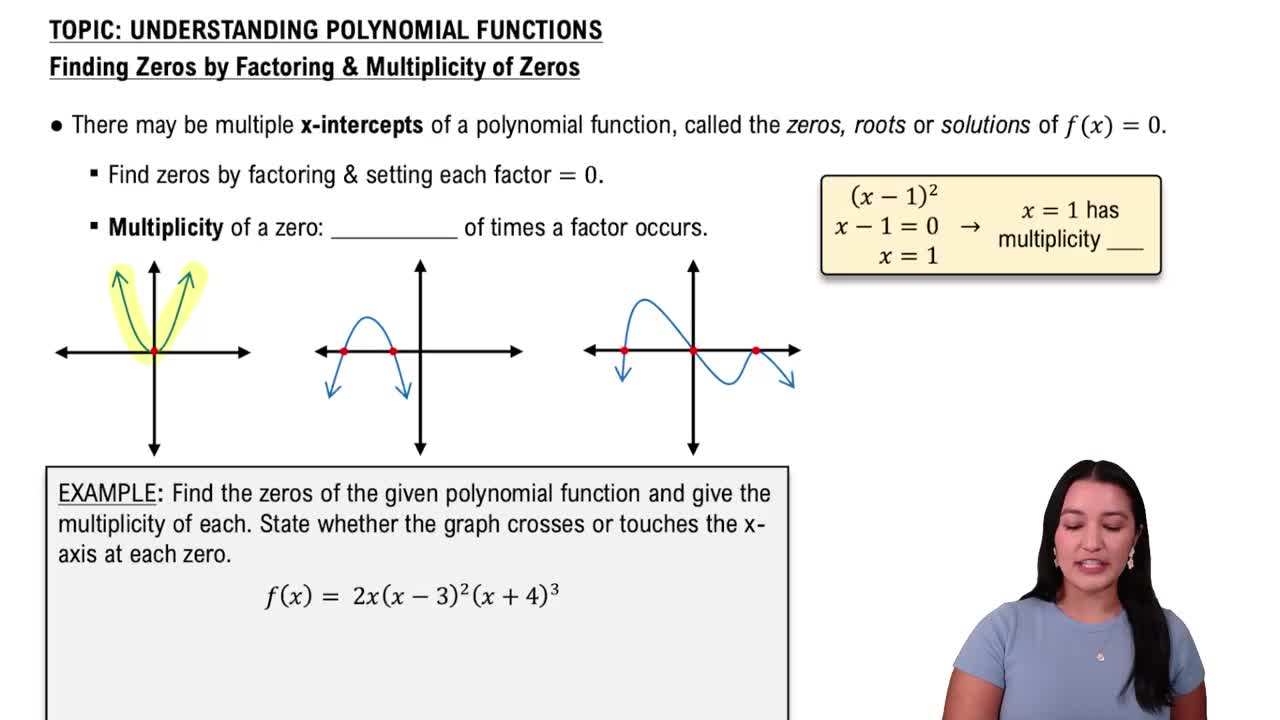
Zeros of a polynomial are the values of x for which the polynomial equals zero. Finding these roots helps in understanding the behavior of the function and is essential for factoring the polynomial into linear factors.
Recommended video:
03:42
Finding Zeros & Their Multiplicity

Factoring Polynomials

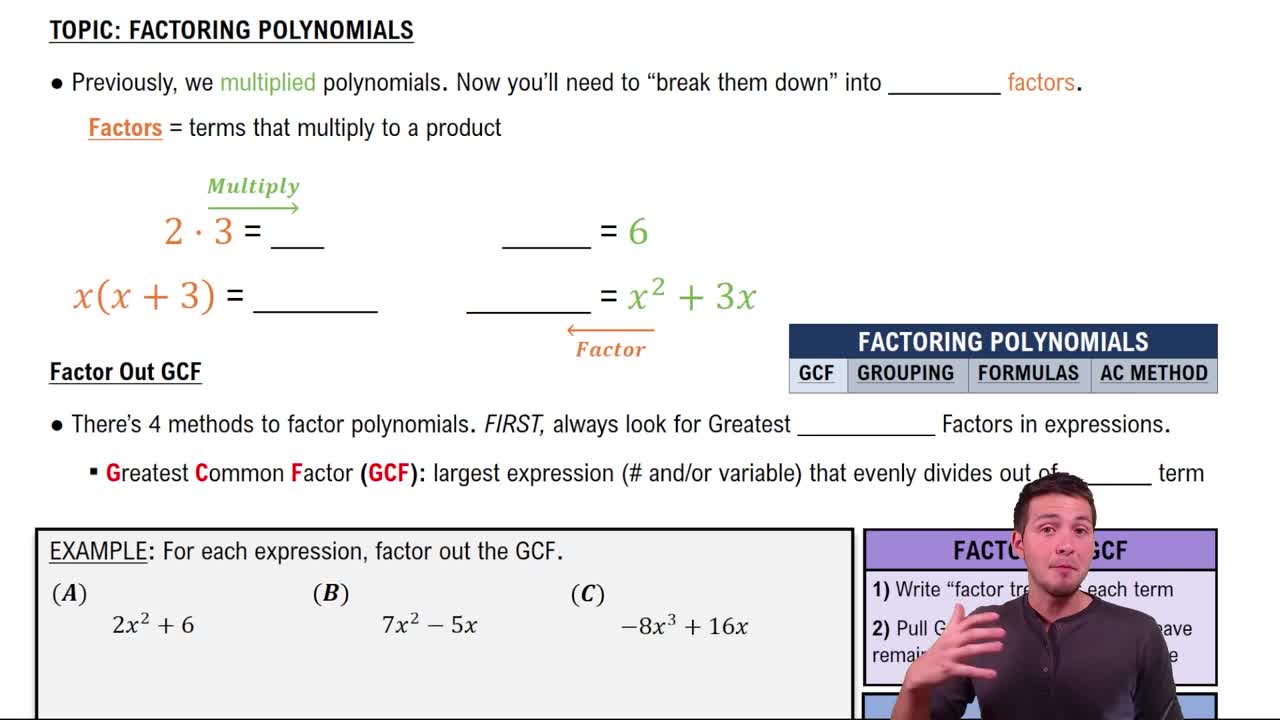
Factoring involves expressing a polynomial as a product of simpler polynomials, ideally linear factors. This process often uses the zeros of the polynomial, allowing it to be written as (x - r) for each root r.
Recommended video:
Guided course
07:30
Introduction to Factoring Polynomials

Rational Root Theorem and Synthetic Division

The Rational Root Theorem helps identify possible rational zeros by considering factors of the constant and leading coefficients. Synthetic division is a streamlined method to test these candidates and simplify the polynomial for further factoring.
Recommended video:
Guided course
04:06
Rational Exponents