Ch. 3 - Polynomial and Rational Functions
Blitzer - College Algebra 8th Edition
Blitzer8th EditionCollege AlgebraISBN: 9780136970514Not the one you use?Change textbook
Chapter 4, Problem 33

Use Descartes's Rule of Signs to determine the possible number of positive and negative real zeros for each given function. f(x)=x3+2x2+5x+4

Verified step by step guidance
1
Write down the given polynomial function: \(f(x) = x^{3} + 2x^{2} + 5x + 4\).
To find the possible number of positive real zeros, count the number of sign changes in the coefficients of \(f(x)\). The coefficients are \$1, 2, 5, 4$. Since all are positive, there are no sign changes.
Therefore, according to Descartes's Rule of Signs, the number of positive real zeros is 0 or less by an even number (which means exactly 0 positive real zeros).
Next, to find the possible number of negative real zeros, evaluate \(f(-x)\) by substituting \(-x\) into the function: \(f(-x) = (-x)^{3} + 2(-x)^{2} + 5(-x) + 4\).
Simplify \(f(-x)\) to get the new polynomial and then count the number of sign changes in its coefficients. This will give the possible number of negative real zeros, which is the number of sign changes or less by an even number.

Verified video answer for a similar problem:

This video solution was recommended by our tutors as helpful for the problem above.
Video duration:
2m
Was this helpful?

Key Concepts

Here are the essential concepts you must grasp in order to answer the question correctly.

Descartes's Rule of Signs

Descartes's Rule of Signs is a method used to determine the possible number of positive and negative real zeros of a polynomial function by counting the sign changes in the coefficients. The number of positive real zeros is equal to the number of sign changes in f(x) or less than that by an even number. For negative zeros, the rule is applied to f(-x).
Recommended video:
Guided course
6:54
Cramer's Rule - 2 Equations with 2 Unknowns

Polynomial Functions and Their Zeros

A polynomial function is an expression involving variables raised to whole-number exponents with coefficients. The zeros of a polynomial are the values of x that make the function equal to zero. Understanding the degree and coefficients helps predict the number and nature of these zeros.
Recommended video:
03:42
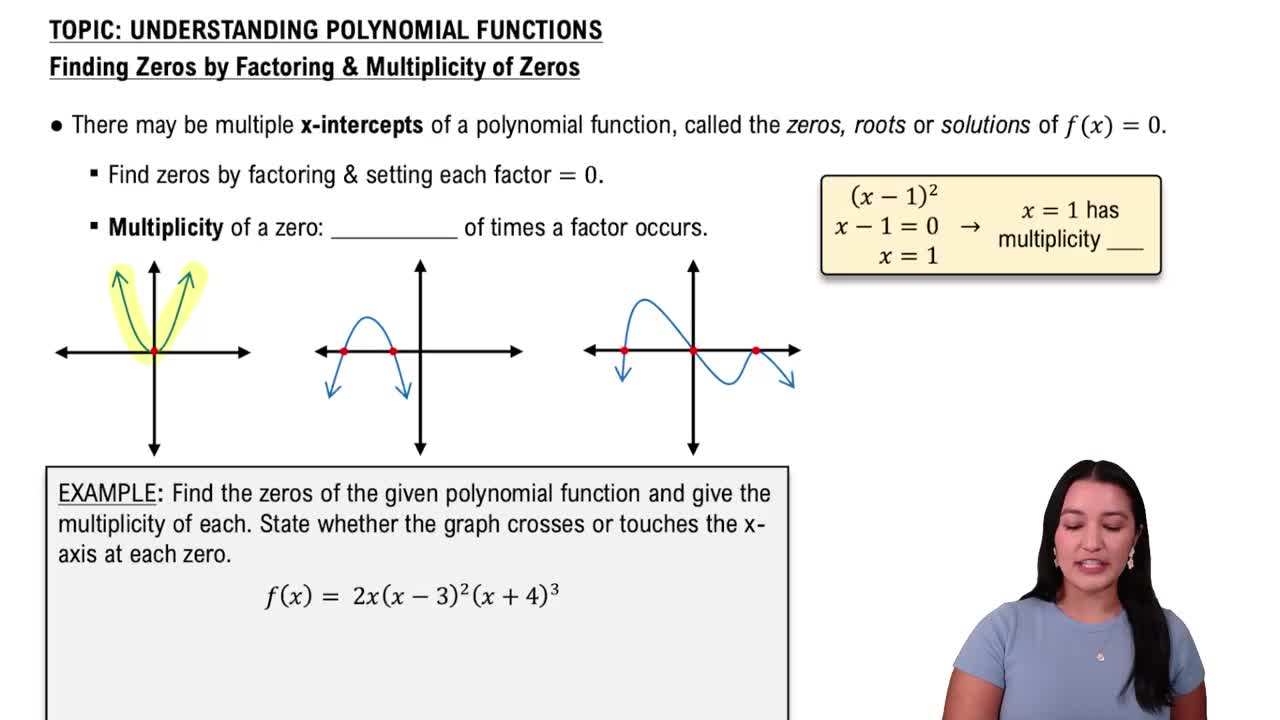
Finding Zeros & Their Multiplicity

Evaluating f(-x) to Find Negative Zeros

To apply Descartes's Rule of Signs for negative zeros, substitute -x into the polynomial to get f(-x). This changes the signs of terms with odd powers. Counting sign changes in f(-x) reveals the possible number of negative real zeros, similar to the process for positive zeros.
Recommended video:
Guided course
6:37
Zero and Negative Rules