
Textbook Question
In Exercises 25–26, graph each polynomial function.

 Verified step by step guidance
 05:33
05:33
 03:42
03:42 5:31
5:31In Exercises 25–26, graph each polynomial function.
Divide using synthetic division. (x5+4x4−3x2+2x+3)÷(x−3)
Solve each polynomial inequality in Exercises 1–42 and graph the solution set on a real number line. Express each solution set in interval notation. −x2 + 2x ≥ 0
In Exercises 19–24, use the Leading Coefficient Test to determine the end behavior of the graph of the polynomial function.
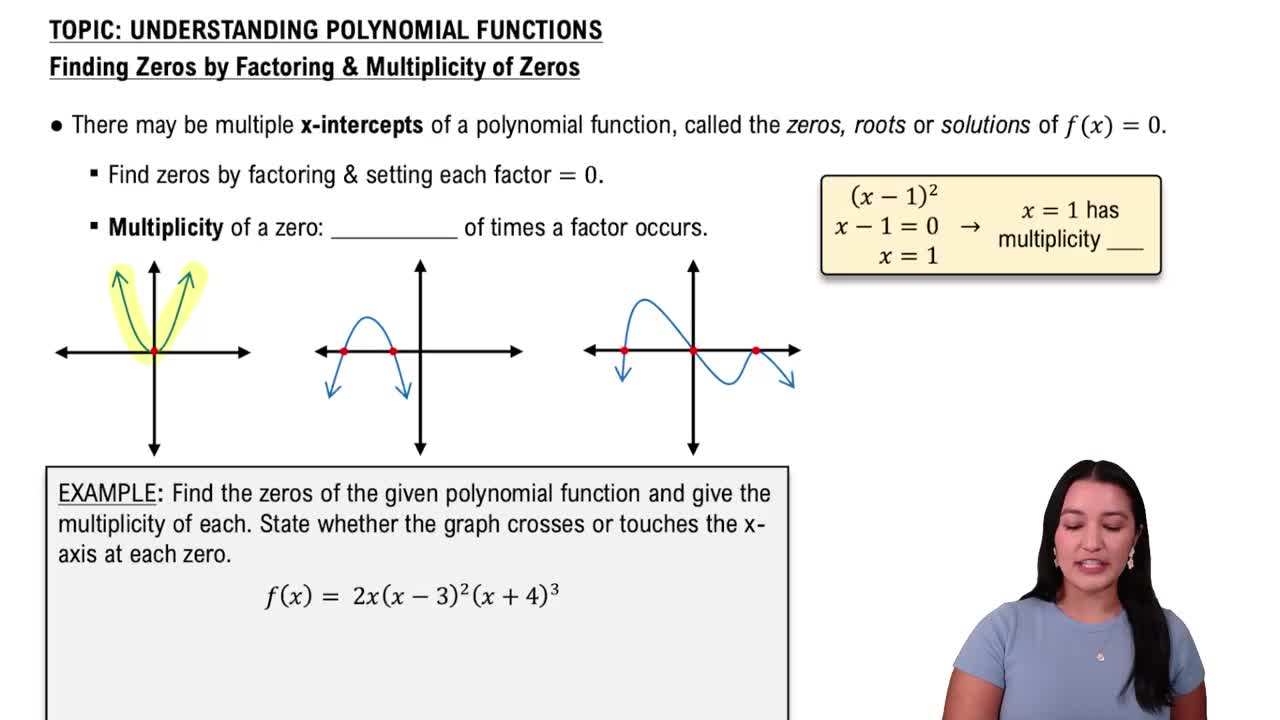
Find the zeros for each polynomial function and give the multiplicity for each zero. State whether the graph crosses the x-axis, or touches the x-axis and turns around, at each zero. f(x)=2(x−5)(x+4)2
Find the vertical asymptotes, if any, and the values of x corresponding to holes, if any, of the graph of each rational function. h(x)=x/x(x+4)