Use the Rational Zero Theorem to list all possible rational zeros for each given function.
Ch. 3 - Polynomial and Rational Functions

Chapter 4, Problem 35
Find the vertical asymptotes, if any, and the values of x corresponding to holes, if any, of the graph of each rational function. r(x)=(x2+4x−21)/(x+7)
Verified step by step guidance1
Start by identifying the rational function given: \(r(x) = \frac{x^{2} + 4x - 21}{x + 7}\).
Factor the numerator \(x^{2} + 4x - 21\) to see if any factors cancel with the denominator. To factor, find two numbers that multiply to \(-21\) and add to \(4\).
Write the factored form of the numerator and check if the denominator \(x + 7\) is a factor of the numerator. If it is, this indicates a hole at the value of \(x\) that makes \(x + 7 = 0\).
If the factor cancels, the hole occurs at \(x = -7\). If it does not cancel, then \(x = -7\) is a vertical asymptote because the denominator is zero there and the function is undefined.
Summarize: vertical asymptotes occur where the denominator is zero and not canceled by the numerator, and holes occur where a factor cancels between numerator and denominator.

Verified video answer for a similar problem:
This video solution was recommended by our tutors as helpful for the problem above.
Video duration:
2mWas this helpful?
Key Concepts
Here are the essential concepts you must grasp in order to answer the question correctly.
Rational Functions
A rational function is a ratio of two polynomials, expressed as f(x) = P(x)/Q(x). Understanding the behavior of rational functions involves analyzing their numerators and denominators, especially where the denominator equals zero, which affects the domain and graph.
Recommended video:
Intro to Rational Functions
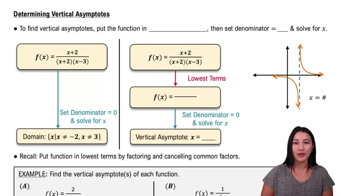
Vertical Asymptotes
Vertical asymptotes occur at values of x where the denominator of a rational function is zero and the numerator is nonzero, causing the function to approach infinity or negative infinity. Identifying these points helps describe the function's behavior near undefined values.
Recommended video:
Determining Vertical Asymptotes
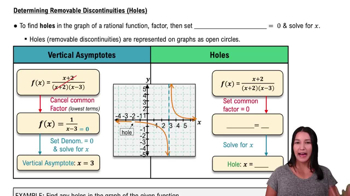
Holes in the Graph
Holes occur when a factor cancels out from both numerator and denominator, indicating a removable discontinuity. At these x-values, the function is undefined, but the limit exists, resulting in a 'hole' rather than an asymptote on the graph.
Recommended video:
Determining Removable Discontinuities (Holes)
Related Practice
Textbook Question
1
views
Textbook Question
Use the vertex and intercepts to sketch the graph of each quadratic function. Give the equation of the parabola's axis of symmetry. Use the graph to determine the function's domain and range. f(x)=2x2+4x−3
2
views
Textbook Question
Use Descartes's Rule of Signs to determine the possible number of positive and negative real zeros for each given function. f(x)=5x3−3x2+3x−1
Textbook Question
Solve each polynomial inequality in Exercises 1–42 and graph the solution set on a real number line. Express each solution set in interval notation.
4
views
Textbook Question
Use the Intermediate Value Theorem to show that each polynomial has a real zero between the given integers.f(x)=2x4−4x2+1; between -1 and 0
Textbook Question
Use synthetic division and the Remainder Theorem to find the indicated function value. f(x)=3x3−7x2−2x+5;f(−3)
3
views