Find an nth-degree polynomial function with real coefficients satisfying the given conditions. If you are using a graphing utility, use it to graph the function and verify the real zeros and the given function value. n=3; -5 and 4+3i are zeros; f(2) = 91
Ch. 3 - Polynomial and Rational Functions

Chapter 4, Problem 27
Find the vertical asymptotes, if any, and the values of x corresponding to holes, if any, of the graph of each rational function. r(x)=x/(x2+4)
Verified step by step guidance1
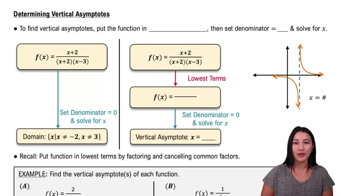
Identify the denominator of the rational function \(r(x) = \frac{x}{x^2 + 4}\). The denominator is \(x^2 + 4\).
Set the denominator equal to zero to find values of \(x\) that might cause vertical asymptotes or holes: solve \(x^2 + 4 = 0\).
Solve the equation \(x^2 + 4 = 0\) by isolating \(x^2\): \(x^2 = -4\). Since \(x^2\) cannot be negative for real numbers, there are no real solutions.
Since there are no real values of \(x\) that make the denominator zero, the function has no vertical asymptotes.
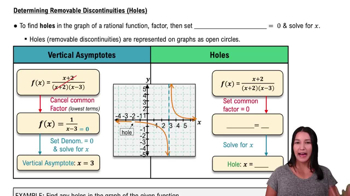
Check for holes by seeing if any factors cancel between numerator and denominator. Here, the numerator is \(x\) and the denominator is \(x^2 + 4\), which share no common factors, so there are no holes.

Verified video answer for a similar problem:
This video solution was recommended by our tutors as helpful for the problem above.
Video duration:
2mWas this helpful?
Key Concepts
Here are the essential concepts you must grasp in order to answer the question correctly.
Vertical Asymptotes
Vertical asymptotes occur where a rational function's denominator equals zero and the numerator is nonzero, causing the function to approach infinity or negative infinity. To find them, set the denominator equal to zero and solve for x, excluding any values that also make the numerator zero.
Recommended video:
Determining Vertical Asymptotes
Holes in the Graph
Holes occur in the graph of a rational function when a factor cancels out from both numerator and denominator, resulting in an undefined point rather than an asymptote. Identifying holes involves factoring and simplifying the function to see if any common factors exist.
Recommended video:
Determining Removable Discontinuities (Holes)
Rational Functions and Domain Restrictions
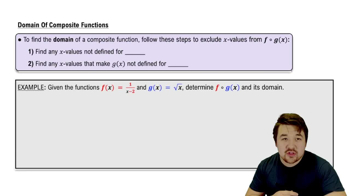
Rational functions are ratios of polynomials, and their domain excludes values that make the denominator zero. Understanding domain restrictions helps determine where the function is undefined, which is essential for locating vertical asymptotes and holes.
Recommended video:
Domain Restrictions of Composed Functions
Related Practice
Textbook Question
Textbook Question
Find the zeros for each polynomial function and give the multiplicity for each zero. State whether the graph crosses the x-axis, or touches the x-axis and turns around, at each zero. f(x)=3(x+5)(x+2)2
4
views
Textbook Question
Use the vertex and intercepts to sketch the graph of each quadratic function. Give the equation of the parabola's axis of symmetry. Use the graph to determine the function's domain and range. f(x)=x2−2x−3
Textbook Question
Divide using long division.
6
views
Textbook Question
Solve each polynomial inequality in Exercises 1–42 and graph the solution set on a real number line. Express each solution set in interval notation. x2≤2x+2
2
views
Textbook Question
Solve each polynomial inequality in Exercises 1–42 and graph the solution set on a real number line. Express each solution set in interval notation. 9x2−6x+1<0
1
views
