Ch. 3 - Polynomial and Rational Functions
Blitzer - College Algebra 8th Edition
Blitzer8th EditionCollege AlgebraISBN: 9780136970514Not the one you use?Change textbook
Chapter 4, Problem 23

Find the vertical asymptotes, if any, and the values of x corresponding to holes, if any, of the graph of each rational function. g(x)=(x+3)/x(x+4)

Verified step by step guidance
1
Identify the rational function given: \(g(x) = \frac{x+3}{x(x+4)}\).
Determine the values of \(x\) that make the denominator zero, since these are potential vertical asymptotes or holes. Set the denominator equal to zero: \(x(x+4) = 0\).
Solve the equation \(x(x+4) = 0\) to find the values of \(x\) that cause the denominator to be zero. These values are \(x = 0\) and \(x = -4\).
Check if any of these values also make the numerator zero by substituting them into the numerator \(x+3\). If a value makes both numerator and denominator zero, it corresponds to a hole; otherwise, it corresponds to a vertical asymptote.
Since neither \(x=0\) nor \(x=-4\) makes the numerator zero (check \(0+3=3\) and \(-4+3=-1\)), both values correspond to vertical asymptotes. Therefore, the vertical asymptotes are at \(x=0\) and \(x=-4\), and there are no holes.

Verified video answer for a similar problem:

This video solution was recommended by our tutors as helpful for the problem above.
Video duration:
1m
Was this helpful?

Key Concepts

Here are the essential concepts you must grasp in order to answer the question correctly.

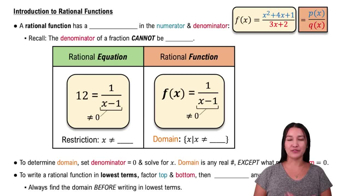
Rational Functions

A rational function is a ratio of two polynomials, expressed as f(x) = P(x)/Q(x). Understanding the domain restrictions caused by the denominator is essential, as values that make Q(x) = 0 are excluded from the domain and can lead to vertical asymptotes or holes.
Recommended video:
6:04
Intro to Rational Functions

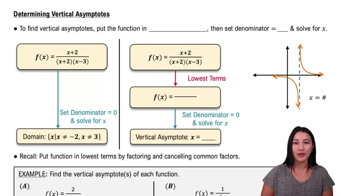
Vertical Asymptotes

Vertical asymptotes occur at values of x where the denominator is zero but the numerator is not zero, causing the function to approach infinity or negative infinity. Identifying these points involves factoring the denominator and checking which zeros remain after simplification.
Recommended video:
3:12
Determining Vertical Asymptotes

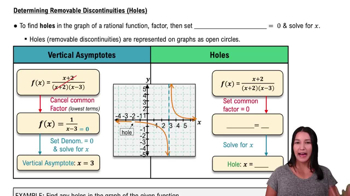
Holes in the Graph

Holes occur when a factor cancels out from both numerator and denominator, indicating a removable discontinuity. The x-value causing the zero factor corresponds to a hole, and the function is undefined there, but the limit exists and can be found by simplifying the function.
Recommended video:
3:34
Determining Removable Discontinuities (Holes)