Ch. 3 - Polynomial and Rational Functions
Blitzer - College Algebra 8th Edition
Blitzer8th EditionCollege AlgebraISBN: 9780136970514Not the one you use?Change textbook
Chapter 4, Problem 37

In Exercises 17–38, use the vertex and intercepts to sketch the graph of each quadratic function. Give the equation of the parabola's axis of symmetry. Use the graph to determine the function's domain and range. f(x)=2x−x2−2

Verified step by step guidance
1
Rewrite the function in standard quadratic form: \(f(x) = -x^{2} + 2x - 2\).
Find the vertex using the formula for the x-coordinate of the vertex: \(x = -\frac{b}{2a}\), where \(a = -1\) and \(b = 2\).
Calculate the y-coordinate of the vertex by substituting the x-value back into the function: \(f(x) = -x^{2} + 2x - 2\).
Find the y-intercept by evaluating \(f(0)\), and find the x-intercepts by solving the equation \(-x^{2} + 2x - 2 = 0\).
Write the equation of the axis of symmetry as \(x = \) (the x-coordinate of the vertex), then determine the domain (all real numbers) and the range based on the vertex and the direction the parabola opens.

Verified video answer for a similar problem:

This video solution was recommended by our tutors as helpful for the problem above.
Video duration:
2m
Was this helpful?

Key Concepts

Here are the essential concepts you must grasp in order to answer the question correctly.

Quadratic Functions and Their Graphs

A quadratic function is a polynomial of degree two, typically written as f(x) = ax^2 + bx + c. Its graph is a parabola that opens upward if a > 0 and downward if a < 0. Understanding the shape and key features of the parabola helps in sketching the graph accurately.
Recommended video:
5:26
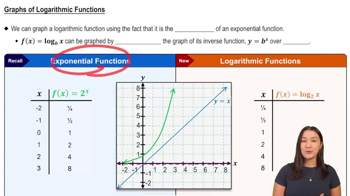
Graphs of Logarithmic Functions

Vertex and Axis of Symmetry

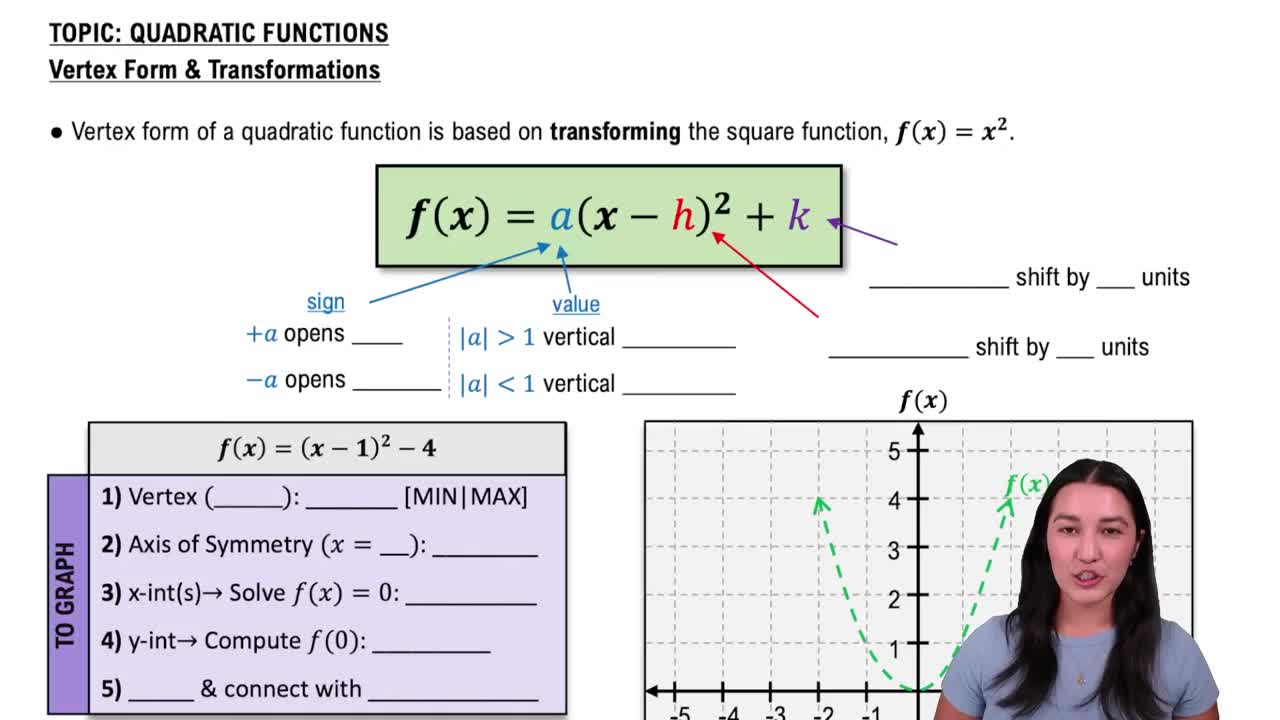
The vertex is the highest or lowest point on the parabola, found using the formula x = -b/(2a). The axis of symmetry is a vertical line through the vertex that divides the parabola into two mirror images. Knowing the vertex and axis helps in plotting the graph and understanding its symmetry.
Recommended video:
08:07
Vertex Form

Domain and Range of Quadratic Functions

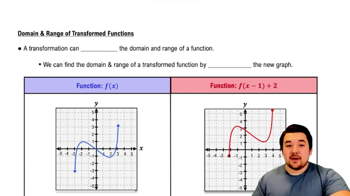
The domain of any quadratic function is all real numbers since x can take any value. The range depends on the vertex: if the parabola opens upward, the range is all y-values greater than or equal to the vertex's y-coordinate; if downward, all y-values less than or equal to the vertex's y-coordinate. This helps describe the function's output values.
Recommended video:
4:22
Domain & Range of Transformed Functions