Ch. 3 - Polynomial and Rational Functions
Blitzer - College Algebra 8th Edition
Blitzer8th EditionCollege AlgebraISBN: 9780136970514Not the one you use?Change textbook
Chapter 4, Problem 25

Divide using synthetic division. (x2−5x−5x3+x4)÷(5+x)

Verified step by step guidance
1
First, rewrite the dividend polynomial in standard form, arranging the terms in descending powers of x: \(x^{4} - 5x^{3} + x^{2} - 5x\).
Identify the divisor, which is \(5 + x\). Rewrite it in the form \(x - r\) by factoring out a negative sign: \(x + 5 = x - (-5)\), so \(r = -5\).
Set up synthetic division by writing the coefficients of the dividend polynomial in order, including zeros for any missing powers: coefficients are \([1, -5, 1, -5, 0]\) corresponding to \(x^{4}, x^{3}, x^{2}, x^{1}, x^{0}\).
Perform synthetic division using \(r = -5\): bring down the first coefficient, multiply by \(r\), add to the next coefficient, and repeat this process across all coefficients.
Write the quotient polynomial using the results from synthetic division, noting that the degree of the quotient is one less than the dividend, and express the remainder if any.

Verified video answer for a similar problem:

This video solution was recommended by our tutors as helpful for the problem above.
Video duration:
5m
Was this helpful?

Key Concepts

Here are the essential concepts you must grasp in order to answer the question correctly.

Polynomial Division

Polynomial division is the process of dividing one polynomial by another, similar to numerical long division. It helps simplify expressions and find quotients and remainders. Understanding how to organize terms by descending powers is essential before performing the division.
Recommended video:
Guided course
05:13
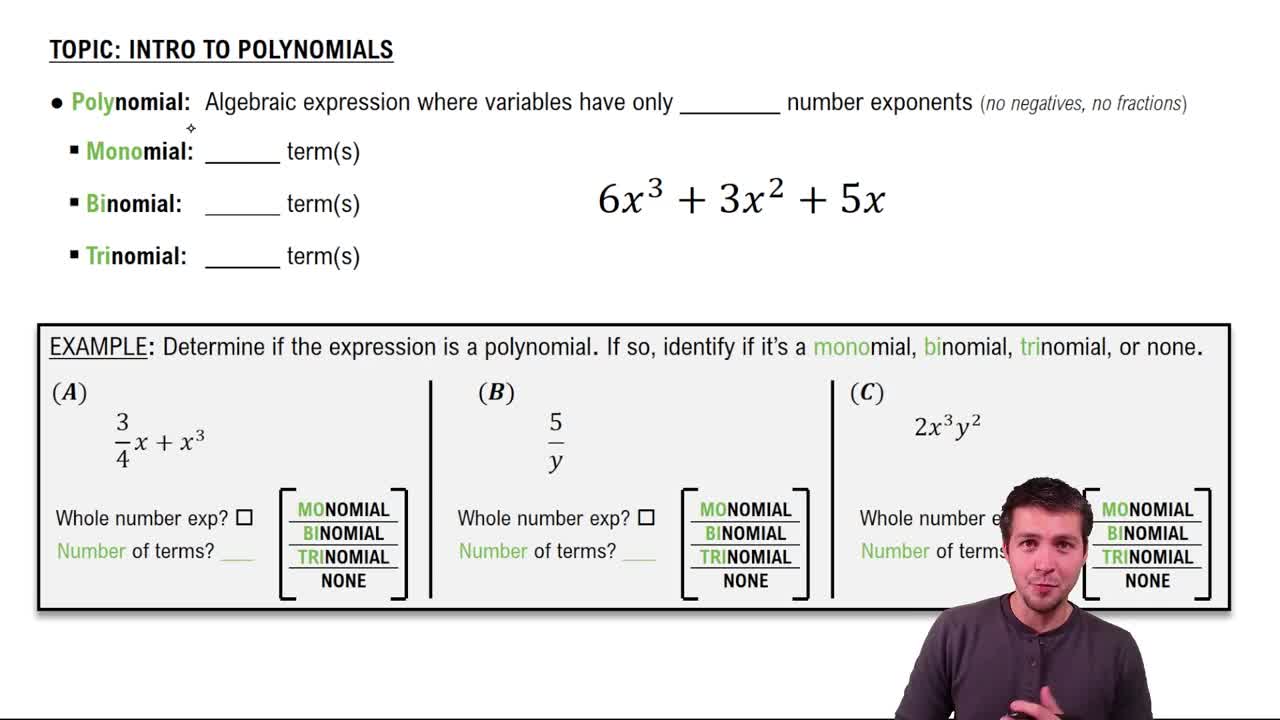
Introduction to Polynomials

Synthetic Division

Synthetic division is a shortcut method for dividing a polynomial by a linear binomial of the form (x - c). It uses only the coefficients of the polynomial, making the process faster and less error-prone than long division. It requires the divisor to be in the form x - c, so adjustments may be needed.
Recommended video:
05:10
Higher Powers of i

Polynomial Standard Form and Rearrangement

Before dividing, polynomials must be written in standard form, with terms ordered from highest to lowest degree and all degrees represented, including zero coefficients if necessary. Rearranging the given polynomial and divisor into this form ensures synthetic division can be applied correctly.
Recommended video:
Guided course
05:16
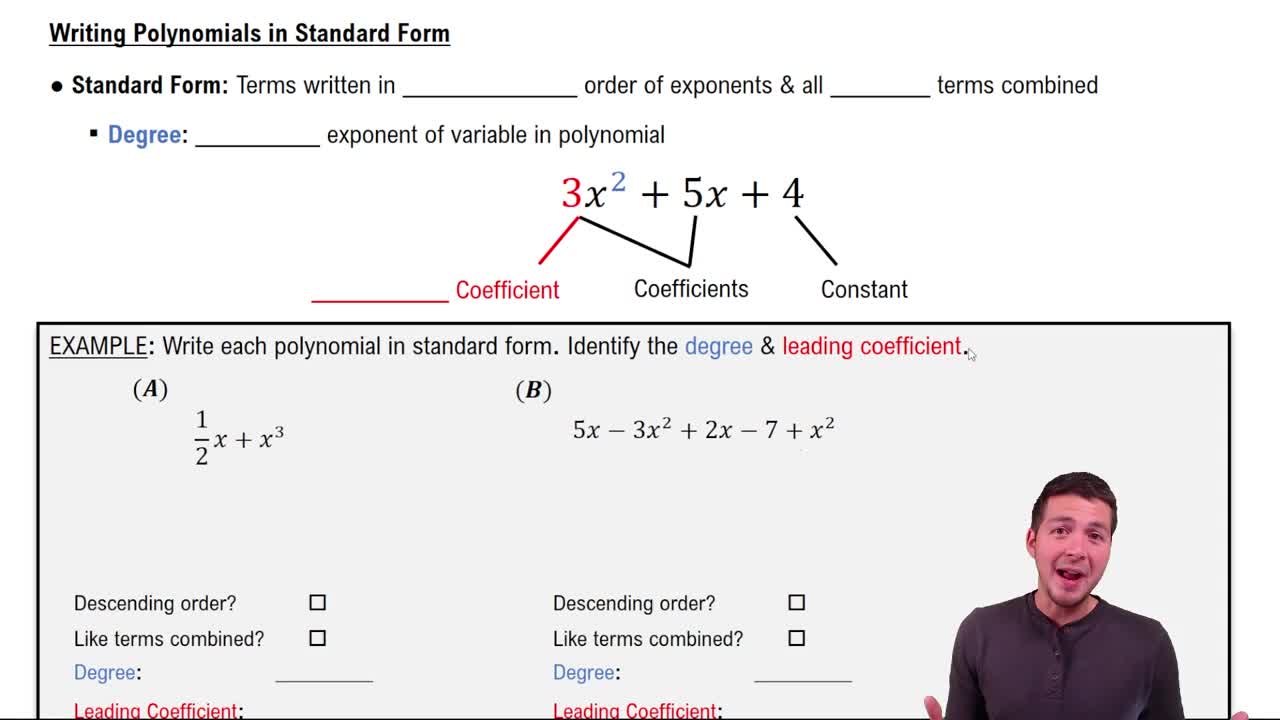
Standard Form of Polynomials