Find the coordinates of the vertex for the parabola defined by the given quadratic function. f(x)=−2(x+1)2+5
Ch. 3 - Polynomial and Rational Functions

Chapter 4, Problem 11
Divide using long division. State the quotient, and the remainder, r(x). (4x4−4x2+6x)/(x−4)
Verified step by step guidance1
Write the division in long division format, placing the dividend \(4x^{4} - 4x^{2} + 6x\) under the division bar and the divisor \(x - 4\) outside.
Identify the first term of the quotient by dividing the leading term of the dividend \$4x^{4}\( by the leading term of the divisor \)x\(, which gives \)4x^{3}$.
Multiply the entire divisor \(x - 4\) by this term \$4x^{3}$, resulting in \(4x^{4} - 16x^{3}\), and subtract this from the dividend to find the new remainder.
Bring down the next terms and repeat the process: divide the leading term of the new remainder by \(x\), multiply the divisor by this term, subtract, and continue until the degree of the remainder is less than the degree of the divisor.
Express the final answer as the quotient polynomial plus the remainder over the divisor, in the form \(\text{quotient} + \frac{r(x)}{x - 4}\).

Verified video answer for a similar problem:
This video solution was recommended by our tutors as helpful for the problem above.
Video duration:
6mWas this helpful?
Key Concepts
Here are the essential concepts you must grasp in order to answer the question correctly.
Polynomial Long Division
Polynomial long division is a method used to divide one polynomial by another, similar to numerical long division. It involves dividing the leading term of the dividend by the leading term of the divisor, multiplying the divisor by this result, subtracting from the dividend, and repeating until the degree of the remainder is less than the divisor.
Recommended video:
Guided course
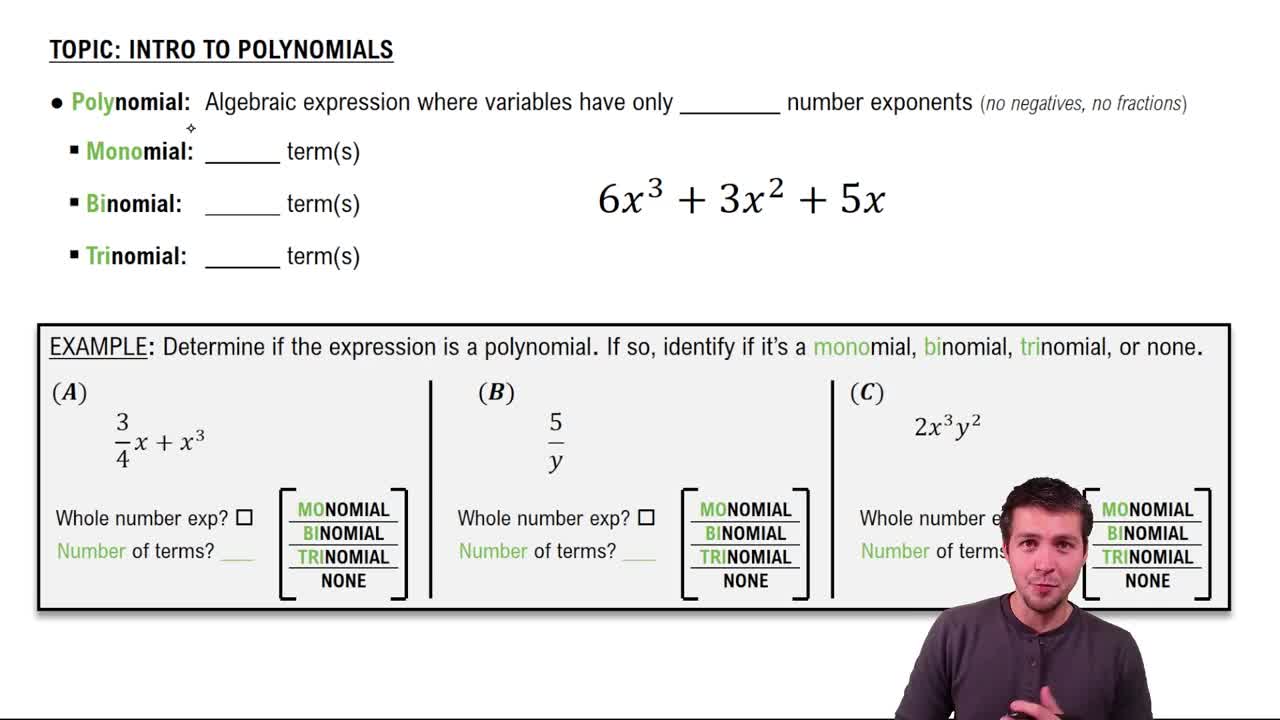
Introduction to Polynomials
Degree of a Polynomial
The degree of a polynomial is the highest power of the variable in the expression. Understanding the degree helps determine when to stop the division process, as the remainder must have a degree less than that of the divisor for the division to be complete.
Recommended video:
Guided course
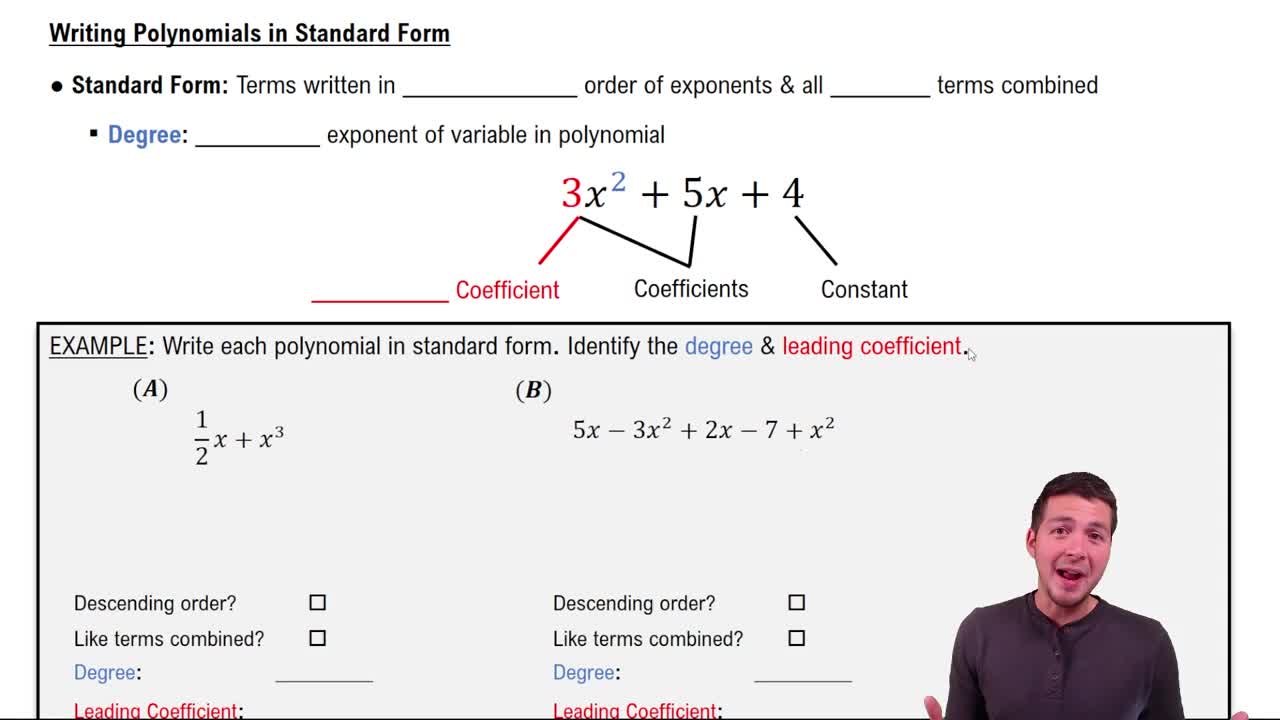
Standard Form of Polynomials
Quotient and Remainder in Polynomial Division
When dividing polynomials, the result consists of a quotient and a remainder. The quotient is the polynomial obtained from the division process, and the remainder is the leftover polynomial with a degree less than the divisor. Expressing the division as dividend = divisor × quotient + remainder is essential.
Recommended video:
Guided course
Introduction to Polynomials
Related Practice
Textbook Question
2
views
Textbook Question
Use the Leading Coefficient Test to determine the end behavior of the graph of the given polynomial function. Then use this end behavior to match the polynomial function with its graph. [The graphs are labeled (a) through (d).]
1
views
Textbook Question
Use the graph of the rational function in the figure shown to complete each statement in Exercises 9–14.
As ______
Textbook Question
Write an equation that expresses each relationship. Then solve the equation for y. x varies jointly as y and z.
Textbook Question
Identify which graphs are not those of polynomial functions.
7
views
Textbook Question
Solve each polynomial inequality in Exercises 1–42 and graph the solution set on a real number line. Express each solution set in interval notation. 3x2+10x−8≤0