Ch. 3 - Polynomial and Rational Functions
Blitzer - College Algebra 8th Edition
Blitzer8th EditionCollege AlgebraISBN: 9780136970514Not the one you use?Change textbook
Chapter 4, Problem 10

In Exercises 1–16, divide using long division. State the quotient, and the remainder, r(x). (3x2−2x+5)/(x−3)

Verified step by step guidance
1
Identify the dividend and divisor. Here, the dividend is \(3x^{2} - 2x + 5\) and the divisor is \(x - 3\).
Set up the long division by writing \(3x^{2} - 2x + 5\) under the division bar and \(x - 3\) outside the division bar.
Divide the leading term of the dividend, \$3x^{2}\(, by the leading term of the divisor, \)x$, to get the first term of the quotient: \(\frac{3x^{2}}{x} = 3x\).
Multiply the entire divisor \(x - 3\) by \$3x$ and subtract the result from the dividend. This will give you a new polynomial.
Repeat the process: divide the leading term of the new polynomial by \(x\), multiply the divisor by this term, subtract again, and continue until the degree of the remainder is less than the degree of the divisor.

Verified video answer for a similar problem:

This video solution was recommended by our tutors as helpful for the problem above.
Video duration:
2m
Was this helpful?

Key Concepts

Here are the essential concepts you must grasp in order to answer the question correctly.

Polynomial Long Division

Polynomial long division is a method used to divide one polynomial by another, similar to numerical long division. It involves dividing the leading term of the dividend by the leading term of the divisor, multiplying the divisor by this result, subtracting, and repeating until the degree of the remainder is less than the divisor.
Recommended video:
Guided course
05:13
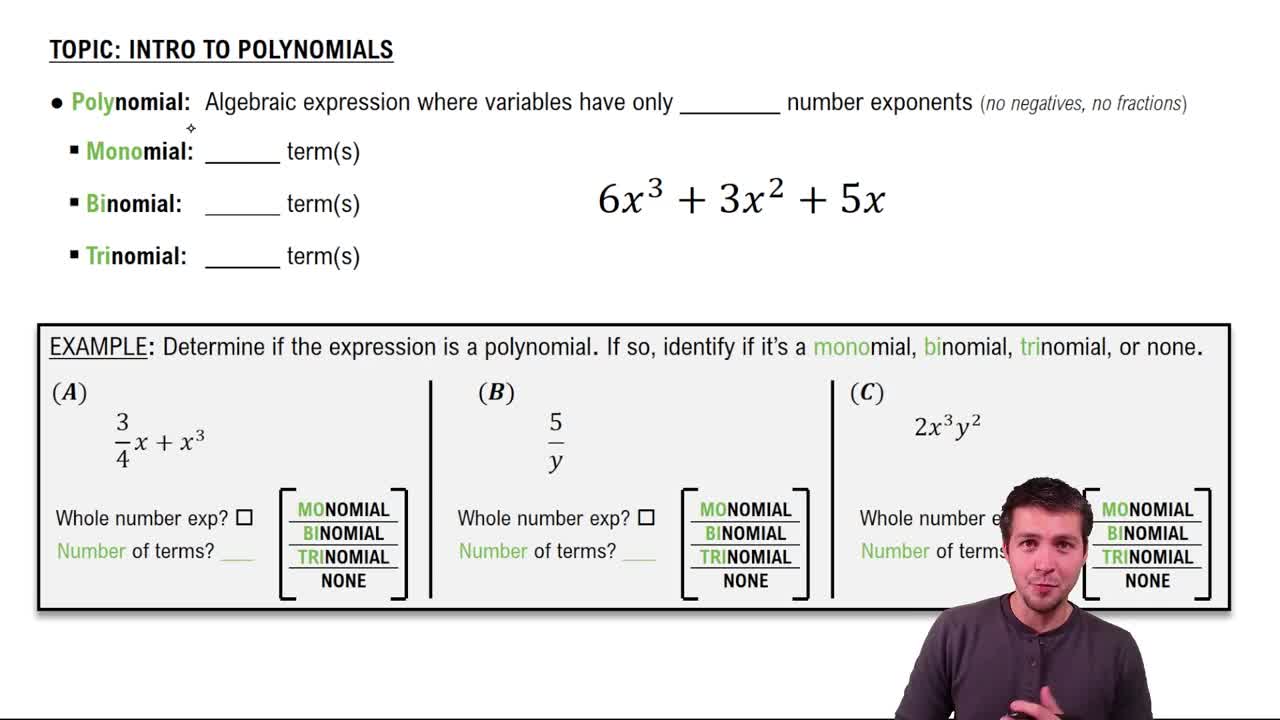
Introduction to Polynomials

Quotient and Remainder in Polynomial Division

When dividing polynomials, the quotient is the result of the division, and the remainder is what is left over when the division cannot continue. The remainder must have a degree less than the divisor. The division can be expressed as: Dividend = Divisor × Quotient + Remainder.
Recommended video:
Guided course
05:13
Introduction to Polynomials

Degree of a Polynomial

The degree of a polynomial is the highest power of the variable in the expression. Understanding the degree is essential in polynomial division because the process continues until the remainder's degree is less than the divisor's degree, indicating the division is complete.
Recommended video:
Guided course
05:16
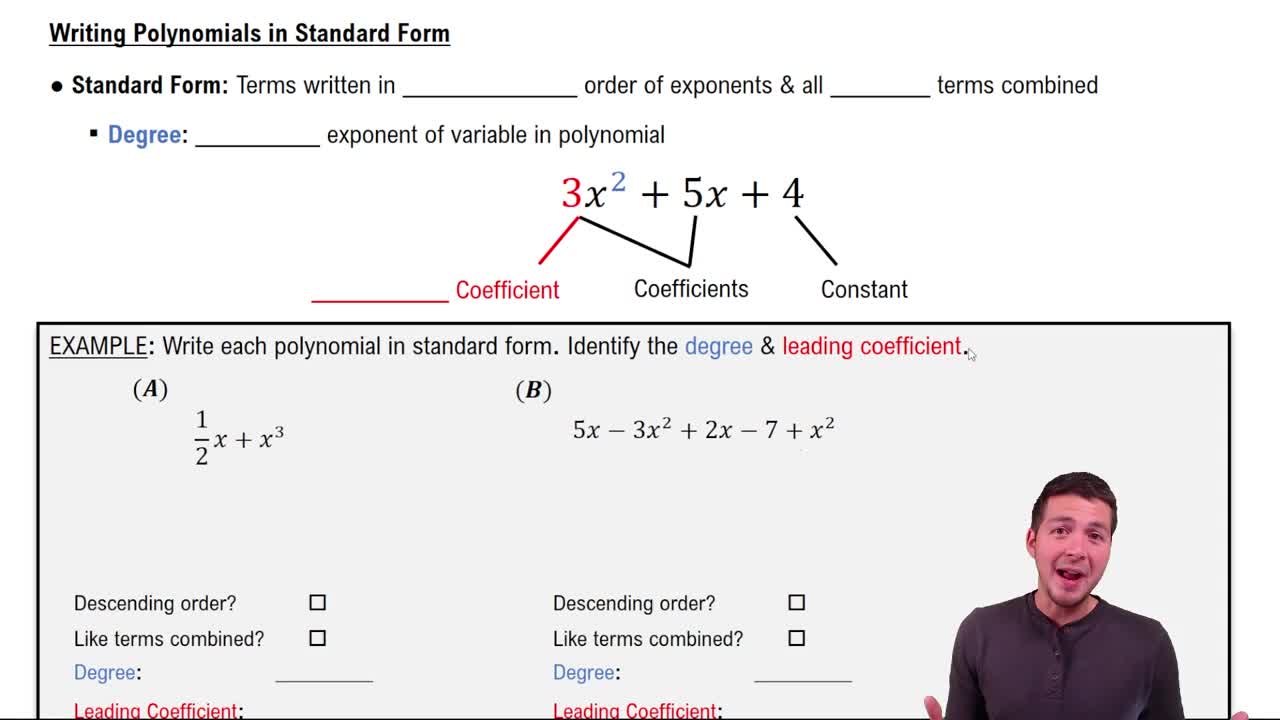
Standard Form of Polynomials
Related Practice
Textbook Question

In Exercises 9–16, a) List all possible rational zeros. b) Use synthetic division to test the possible rational zeros and find an actual zero. c) Use the quotient from part (b) to find the remaining zeros of the polynomial function. f(x)=2x3−3x2−11x+6

3
views
Textbook Question

Determine which functions are polynomial functions. For those that are, identify the degree. f(x)=(x2+7)/3f(x)=(x^2+7)/3

2
views
Textbook Question

Use the Leading Coefficient Test to determine the end behavior of the graph of the given polynomial function. Then use this end behavior to match the polynomial function with its graph. [The graphs are labeled (a) through (d).]

f(x)=x66x4+9x2 f(x) = x^6 -6x^4 + 9x^2

1
views
Textbook Question

Use the Leading Coefficient Test to determine the end behavior of the graph of the given polynomial function. Then use this end behavior to match the polynomial function with its graph. [The graphs are labeled (a) through (d).] f(x)=x3+x2+2xf(x) = -x^3 + x^2 + 2x

a.b. c. d.

2
views
Textbook Question

In Exercises 9–16, a) List all possible rational zeros. b) Use synthetic division to test the possible rational zeros and find an actual zero. c) Use the quotient from part (b) to find the remaining zeros of the polynomial function. f(x)=x3−2x2−11x+12

1
views
Textbook Question

Use the four-step procedure for solving variation problems given on page 447 to solve Exercises 1–10. y varies jointly as a and b and inversely as the square root of c. y = 12 when a = 3, b = 2, and c = 25. Find y when a = 5, b = 3 and c = 9.