Solve and graph the solution set on a number line: 3|2x-1| ≥ 21
Ch. 2 - Functions and Graphs

Chapter 3, Problem 101
Solve: 5x3/4- 15 = 0.
Verified step by step guidance1
Start with the given equation: \(5x^{\frac{3}{4}} - 15 = 0\).
Isolate the term with the variable by adding 15 to both sides: \(5x^{\frac{3}{4}} = 15\).
Divide both sides by 5 to solve for \(x^{\frac{3}{4}}\): \(x^{\frac{3}{4}} = \frac{15}{5}\).
Simplify the right side: \(x^{\frac{3}{4}} = 3\).
To solve for \(x\), raise both sides of the equation to the reciprocal power of \(\frac{3}{4}\), which is \(\frac{4}{3}\): \(\left(x^{\frac{3}{4}}\right)^{\frac{4}{3}} = 3^{\frac{4}{3}}\), simplifying to \(x = 3^{\frac{4}{3}}\).

Verified video answer for a similar problem:
This video solution was recommended by our tutors as helpful for the problem above.
Video duration:
3mKey Concepts
Here are the essential concepts you must grasp in order to answer the question correctly.
Solving Equations Involving Rational Exponents
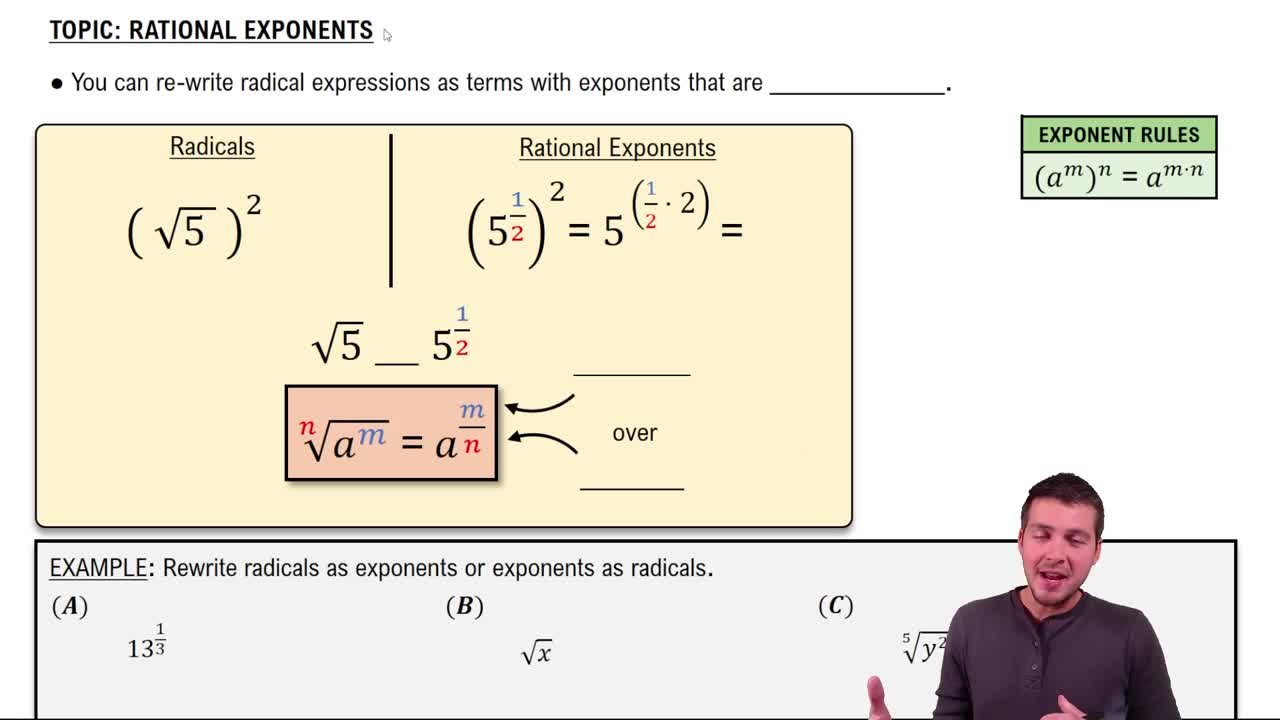
Rational exponents represent roots and powers, such as x^(3/4) meaning the fourth root of x cubed. To solve equations with rational exponents, isolate the term with the exponent and then raise both sides to the reciprocal power to eliminate the exponent.
Recommended video:
Rational Exponents
Isolating the Variable Term
Before applying exponent rules, rearrange the equation to isolate the term containing the variable. This often involves adding, subtracting, multiplying, or dividing both sides of the equation to simplify and prepare for further operations.
Recommended video:
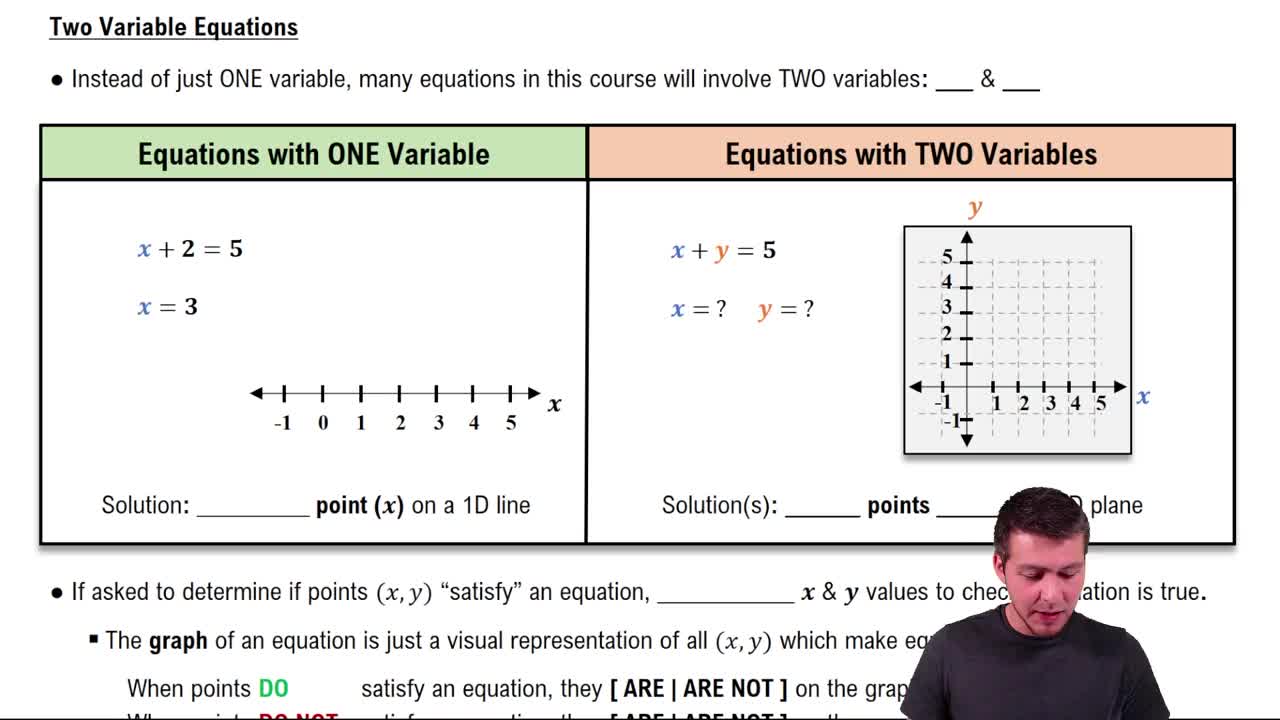
Equations with Two Variables
Checking for Extraneous Solutions
When solving equations with rational exponents, especially involving even roots, some solutions may not satisfy the original equation. Always substitute solutions back into the original equation to verify their validity.
Recommended video:
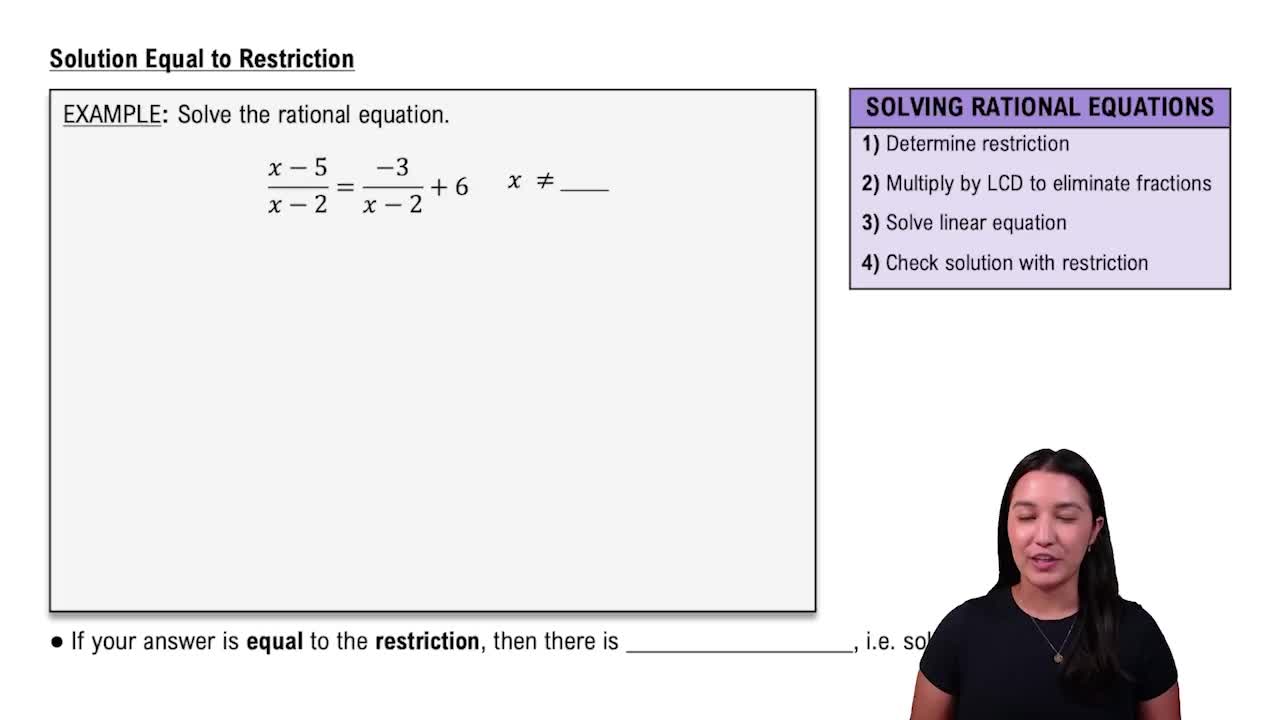
Restrictions on Rational Equations
Related Practice
Textbook Question
Textbook Question
In Exercises 101–102, find an equation for f^(-1)(x). Then graph f and f^(-1) in the same rectangular coordinate system. f(x) = 1 - x^2, x ≥ 0.
Textbook Question
Exercises 103–105 will help you prepare for the material covered in the next section. Let (x1, y₁) = (7, 2) and (x2, y2) = (1, −1). Find √[(x2 − x1)² + (y2 − y₁)²]. Express the - answer in simplified radical form.
1
views
Textbook Question
Begin by graphing the standard cubic function, f(x) = x³. Then use transformations of this graph to graph the given function. h(x) = x³/2
1
views
Textbook Question
Solve by completing the square: 2x² – 5x + 1 = 0.
Textbook Question
Exercises 103–105 will help you prepare for the material covered in the next section. Use a rectangular coordinate system to graph the circle with center (1, -1) and radius 1.
4
views