Express the given function h as a composition of two functions f and g so that h(x) = (f ○ g)(x). h(x) = (x2 + 2x - 1)4
Ch. 2 - Functions and Graphs

Chapter 3, Problem 89
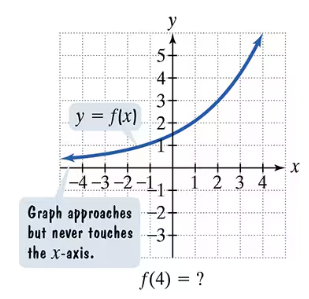
In Exercises 77–92, use the graph to determine a. the function's domain; b. the function's range; c. the x-intercepts, if any; d. the y-intercept, if any; and e. the missing function values, indicated by question marks, below each graph.

Verified step by step guidance1
Step 1: Determine the domain of the function by looking at the x-values for which the graph is defined. Since the graph extends from negative infinity to positive 4 (and beyond), the domain includes all real numbers less than or equal to 4. Write the domain as \((-\infty, 4]\).
Step 2: Determine the range of the function by observing the y-values the graph takes. The graph approaches the x-axis (y=0) but never touches it, and it increases without bound as x increases. So, the range is all y-values greater than 0, written as \((0, \infty)\).
Step 3: Identify the x-intercepts by finding where the graph crosses the x-axis (where \(y=0\)). Since the graph approaches but never touches the x-axis, there are no x-intercepts.
Step 4: Identify the y-intercept by finding where the graph crosses the y-axis (where \(x=0\)). From the graph, observe the y-value at \(x=0\) and note it as the y-intercept.
Step 5: Find the missing function value \(f(4)\) by locating \(x=4\) on the graph and reading the corresponding y-value. This value is the output of the function at \(x=4\).

Verified video answer for a similar problem:
This video solution was recommended by our tutors as helpful for the problem above.
Video duration:
3mWas this helpful?
Key Concepts
Here are the essential concepts you must grasp in order to answer the question correctly.
Domain of a Function
The domain of a function is the set of all possible input values (x-values) for which the function is defined. In a graph, it corresponds to the horizontal extent of the curve. Understanding the domain helps determine where the function exists and can be evaluated.
Recommended video:
Domain Restrictions of Composed Functions
Range of a Function
The range of a function is the set of all possible output values (y-values) that the function can produce. On a graph, it is the vertical spread of the curve. Knowing the range is essential to understand the behavior and limits of the function's outputs.
Recommended video:
Domain & Range of Transformed Functions
Intercepts and Asymptotes
Intercepts are points where the graph crosses the axes: x-intercepts occur where y=0, and y-intercepts where x=0. An asymptote is a line the graph approaches but never touches, indicating limits of the function. Recognizing these helps analyze function behavior and solve for missing values.
Recommended video:
Introduction to Asymptotes
Related Practice
Textbook Question
4
views
Textbook Question
In Exercises 77–92, use the graph to determine a. the function's domain; b. the function's range; c. the x-intercepts, if any; d. the y-intercept, if any; and e. the missing function values, indicated by question marks, below each graph.
Textbook Question
Begin by graphing the absolute value function, f(x) = |x|. Then use transformations of this graph to graph the given function. g(x) = -|x + 4| +2
3
views
Textbook Question
Begin by graphing the absolute value function, f(x) = |x|. Then use transformations of this graph to graph the given function. h(x) = -|x+3|
Textbook Question
Use the graphs of f and g to solve Exercises 83–90.
Find the domain of ƒ/g.
7
views
Textbook Question
Use the graphs of f and g to solve Exercises 83–90.
Graph f+g.