Give the center and radius of the circle described by the equation and graph each equation. Use the graph to identify the relation's domain and range. (x − 3)² + (y + 1)² = 36
Ch. 2 - Functions and Graphs

Chapter 3, Problem 43
Give the slope and y-intercept of each line whose equation is given. Then graph the linear function. f(x) = (3/4)x-2
Verified step by step guidance1
Identify the given linear function: \(f(x) = \frac{3}{4}x - 2\).
Recall that the slope-intercept form of a line is \(y = mx + b\), where \(m\) is the slope and \(b\) is the y-intercept.
Compare the given function to the slope-intercept form to find the slope \(m = \frac{3}{4}\) and the y-intercept \(b = -2\).
To graph the line, start by plotting the y-intercept point at \((0, -2)\) on the coordinate plane.
From the y-intercept, use the slope \(\frac{3}{4}\) to find another point: rise 3 units up and run 4 units to the right, then draw the line through these points.

Verified video answer for a similar problem:
This video solution was recommended by our tutors as helpful for the problem above.
Video duration:
2mWas this helpful?
Key Concepts
Here are the essential concepts you must grasp in order to answer the question correctly.
Slope of a Linear Function
The slope represents the rate of change of the function and indicates how steep the line is. It is the coefficient of x in the equation f(x) = mx + b, where m is the slope. A positive slope means the line rises, while a negative slope means it falls.
Recommended video:
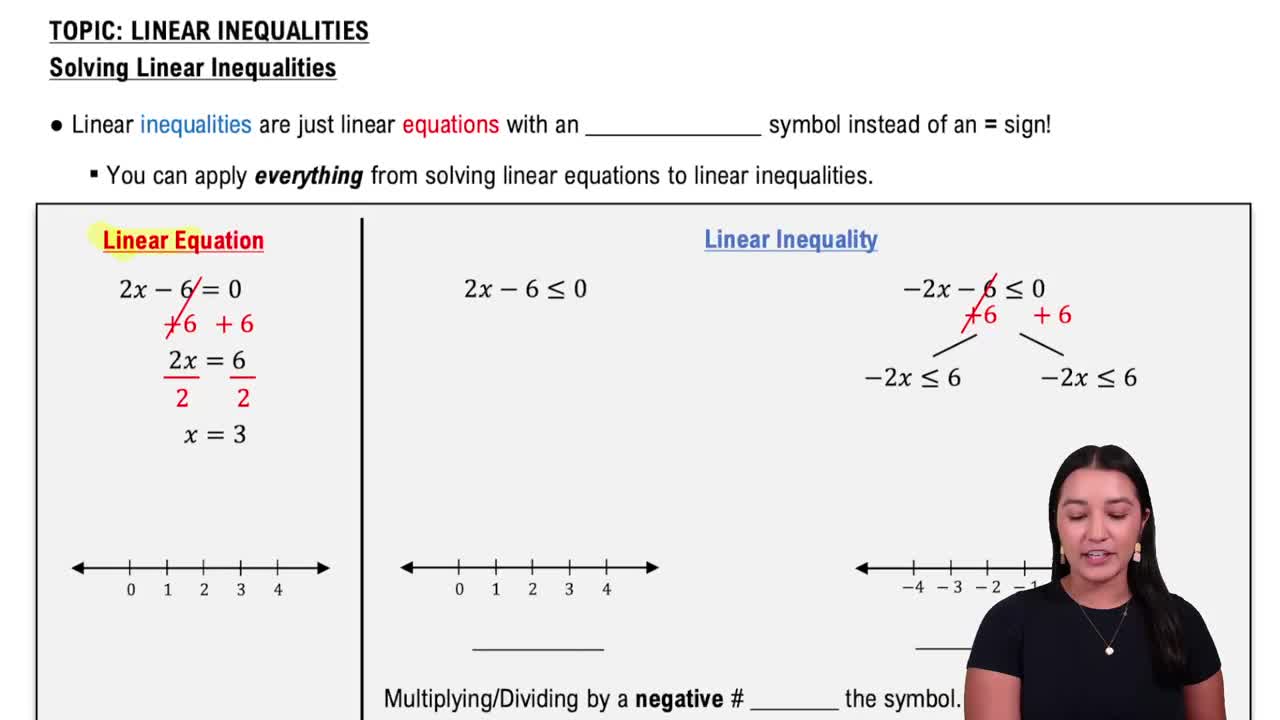
Linear Inequalities
Y-Intercept of a Linear Function
The y-intercept is the point where the line crosses the y-axis, given by the constant term b in the equation f(x) = mx + b. It represents the value of the function when x is zero and is essential for graphing the line accurately.
Recommended video:
Linear Inequalities
Graphing Linear Functions
Graphing involves plotting the y-intercept on the coordinate plane and using the slope to find other points by rising and running from the intercept. Connecting these points forms the line representing the function, visually showing its behavior.
Recommended video:
Graphs of Logarithmic Functions
Related Practice
Textbook Question
2
views
Textbook Question
In Exercises 39-52, a. Find an equation for ƒ¯¹(x). b. Graph ƒ and ƒ¯¹(x) in the same rectangular coordinate system. c. Use interval notation to give the domain and the range off and ƒ¯¹. f(x) = (x − 1)², x ≤ 1
Textbook Question
Use the graph of y = f(x) to graph each function g. g(x) = (1/2)f(2x)
Textbook Question
Find f−g and determine the domain for each function. f(x)= = (5x+1)/(x² - 9), g(x) = (4x -2)/(x² - 9)
Textbook Question
Find ƒ+g and determine the domain for each function.
f(x)= = (5x+1)/(x² - 9), g(x) = (4x -2)/(x² - 9)
Textbook Question
In Exercises 41–44, use the given conditions to write an equation for each line in point-slope form and slope-intercept form. Passing through (4, -7) and parallel to the line whose equation is 3x + y - 9 = 0.