Ch. 2 - Functions and Graphs
Blitzer - College Algebra 8th Edition
Blitzer8th EditionCollege AlgebraISBN: 9780136970514Not the one you use?Change textbook
Chapter 3, Problem 49c

In Exercises 31–50, find ƒ+g, f−g, fg, and f/g. Determine the domain for each function. f(x) = √(x -2), g(x) = √(2-x)

Verified step by step guidance
1
Step 1: Understand the problem. We are tasked with finding the sum (ƒ+g), difference (ƒ−g), product (ƒg), and quotient (ƒ/g) of the two functions f(x) = √(x - 2) and g(x) = √(2 - x). Additionally, we need to determine the domain for each resulting function.
Step 2: Find ƒ+g. The sum of the two functions is given by (ƒ+g)(x) = f(x) + g(x). Substituting the given functions, we have (ƒ+g)(x) = √(x - 2) + √(2 - x). To determine the domain, both square roots must be defined, meaning x - 2 ≥ 0 and 2 - x ≥ 0. Solve these inequalities to find the domain.
Step 3: Find ƒ−g. The difference of the two functions is given by (ƒ−g)(x) = f(x) - g(x). Substituting the given functions, we have (ƒ−g)(x) = √(x - 2) - √(2 - x). The domain is the same as for ƒ+g, as it depends on the square roots being defined. Use the same inequalities to determine the domain.
Step 4: Find ƒg. The product of the two functions is given by (ƒg)(x) = f(x) * g(x). Substituting the given functions, we have (ƒg)(x) = √(x - 2) * √(2 - x). The domain is again determined by ensuring both square roots are defined, so solve the inequalities x - 2 ≥ 0 and 2 - x ≥ 0.
Step 5: Find ƒ/g. The quotient of the two functions is given by (ƒ/g)(x) = f(x) / g(x). Substituting the given functions, we have (ƒ/g)(x) = √(x - 2) / √(2 - x). In addition to ensuring the square roots are defined, we must also ensure the denominator is not zero, meaning √(2 - x) ≠ 0. Solve the inequalities and consider this additional restriction to determine the domain.

Verified video answer for a similar problem:

This video solution was recommended by our tutors as helpful for the problem above.
Video duration:
1m
Was this helpful?

Key Concepts

Here are the essential concepts you must grasp in order to answer the question correctly.

Function Operations

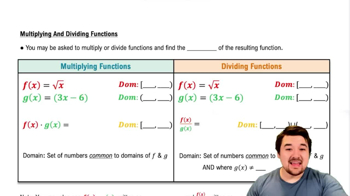
Function operations involve combining two functions through addition, subtraction, multiplication, or division. For functions f and g, these operations are defined as (f + g)(x) = f(x) + g(x), (f - g)(x) = f(x) - g(x), (fg)(x) = f(x) * g(x), and (f/g)(x) = f(x) / g(x), provided that g(x) is not zero.
Recommended video:
7:24
Multiplying & Dividing Functions

Domain of a Function

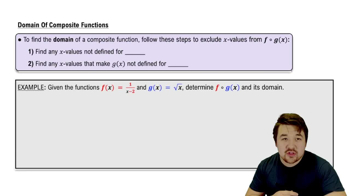
The domain of a function is the set of all possible input values (x-values) for which the function is defined. For functions involving square roots, the expression inside the root must be non-negative. Therefore, determining the domain requires solving inequalities to find the valid x-values for each function.
Recommended video:
3:51
Domain Restrictions of Composed Functions

Square Root Functions

Square root functions, such as f(x) = √(x - 2) and g(x) = √(2 - x), are defined only for non-negative arguments. This means that the expressions inside the square roots must be greater than or equal to zero, which directly influences the domain of the functions and the results of the operations performed on them.
Recommended video:
02:20
Imaginary Roots with the Square Root Property