Ch. 2 - Functions and Graphs
Blitzer - College Algebra 8th Edition
Blitzer8th EditionCollege AlgebraISBN: 9780136970514Not the one you use?Change textbook
Chapter 3, Problem 37

Write the standard form of the equation of the circle with the given center and radius. Center (−3, −1), r = √3

Verified step by step guidance
1
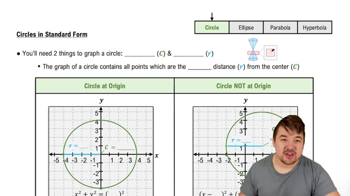
Recall that the standard form of the equation of a circle with center \((h, k)\) and radius \(r\) is given by the formula: \[ (x - h)^2 + (y - k)^2 = r^2 \]
Identify the center \((h, k)\) and radius \(r\) from the problem. Here, the center is \((-3, -1)\) and the radius is \(\sqrt{3}\).
Substitute the values of \(h = -3\), \(k = -1\), and \(r = \sqrt{3}\) into the standard form equation: \[ (x - (-3))^2 + (y - (-1))^2 = (\sqrt{3})^2 \]
Simplify the expressions inside the parentheses by removing the double negatives: \[ (x + 3)^2 + (y + 1)^2 = (\sqrt{3})^2 \]
Square the radius \(\sqrt{3}\) to get \(3\), so the equation becomes: \[ (x + 3)^2 + (y + 1)^2 = 3 \]

Verified video answer for a similar problem:

This video solution was recommended by our tutors as helpful for the problem above.
Video duration:
1m
Was this helpful?

Key Concepts

Here are the essential concepts you must grasp in order to answer the question correctly.

Standard Form of a Circle's Equation

The standard form of a circle's equation is (x - h)² + (y - k)² = r², where (h, k) is the center and r is the radius. This form directly relates the coordinates of any point on the circle to its center and radius.
Recommended video:
5:18
Circles in Standard Form

Coordinates of the Center

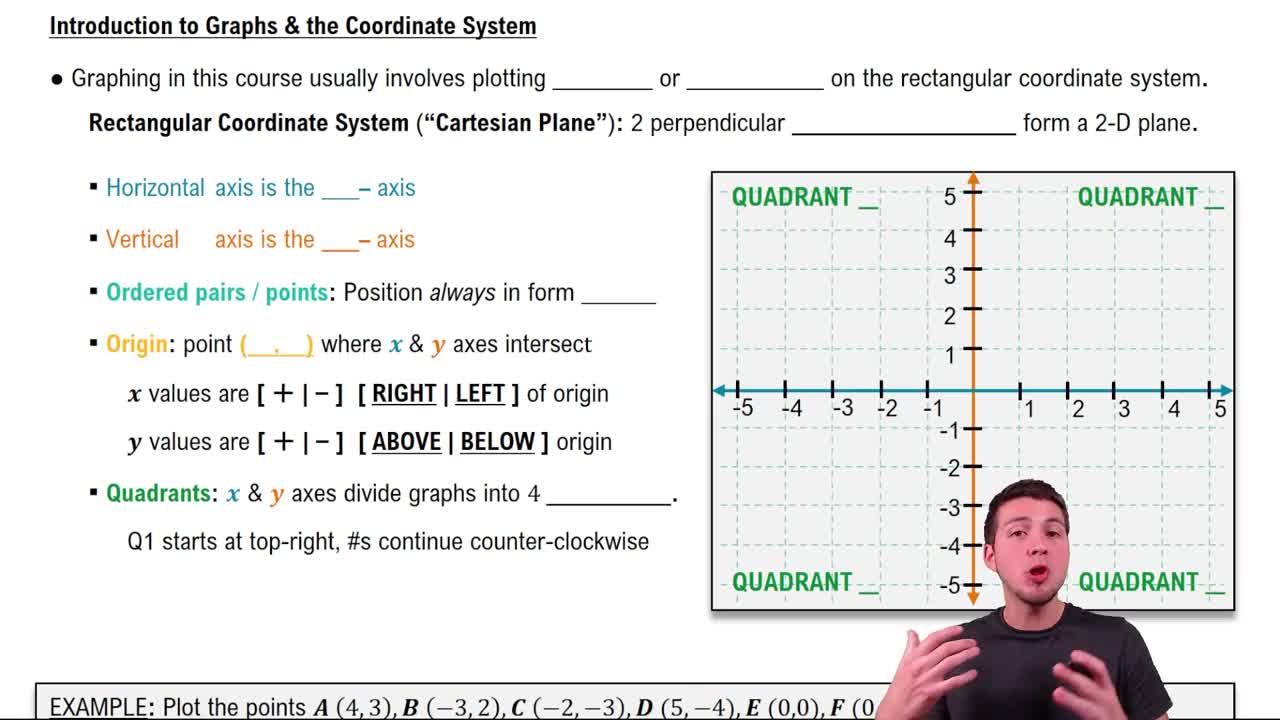
The center of the circle is given as a point (h, k). In this problem, the center is (-3, -1), which means the equation will use (x + 3) and (y + 1) to represent the horizontal and vertical distances from the center.
Recommended video:
Guided course
05:10
Graphs & the Rectangular Coordinate System

Radius and Its Square

The radius r is the distance from the center to any point on the circle. Since the equation uses r², you must square the given radius. Here, r = √3, so r² = 3, which will be the constant on the right side of the equation.
Recommended video:
06:24
Solving Quadratic Equations by Completing the Square