Ch. 2 - Functions and Graphs
Blitzer - College Algebra 8th Edition
Blitzer8th EditionCollege AlgebraISBN: 9780136970514Not the one you use?Change textbook
Chapter 3, Problem 38c

Evaluate each function at the given values of the independent variable and simplify. f(x) = |x+3|/(x + 3) c. f(−9 - x)

Verified step by step guidance
1
Step 1: Start by substituting the given value of the independent variable, −9 − x, into the function f(x). Replace x in f(x) = |x + 3| / |x + 3| with −9 − x. The function becomes f(−9 − x) = |(−9 − x) + 3| / |(−9 − x) + 3|.
Step 2: Simplify the expression inside the absolute value symbols. For the numerator and denominator, calculate (−9 − x) + 3. This simplifies to −6 − x. The function now becomes f(−9 − x) = |−6 − x| / |−6 − x|.
Step 3: Analyze the behavior of the absolute value expression |−6 − x|. Absolute value represents the distance of a number from zero, so |−6 − x| will always be non-negative.
Step 4: Recognize that the numerator and denominator are identical, both being |−6 − x|. When dividing a non-zero quantity by itself, the result is 1. However, if the numerator and denominator are both zero, the result is undefined.
Step 5: Conclude that f(−9 − x) = 1 for all values of x except when −6 − x = 0. Solve −6 − x = 0 to find x = −6. At x = −6, the function is undefined because division by zero occurs.

Verified video answer for a similar problem:

This video solution was recommended by our tutors as helpful for the problem above.
Video duration:
1m
Was this helpful?

Key Concepts

Here are the essential concepts you must grasp in order to answer the question correctly.

Absolute Value Function

The absolute value function, denoted as |x|, represents the distance of a number x from zero on the number line, always yielding a non-negative result. For example, |−5| equals 5, and |3| equals 3. This function is crucial in the given problem as it affects how the function f(x) behaves based on the input values.
Recommended video:
4:56
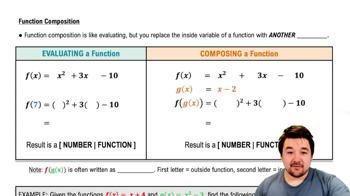
Function Composition

Function Evaluation

Function evaluation involves substituting a specific value for the independent variable (in this case, x) into a function to determine its output. For instance, if f(x) = x^2 and we evaluate f(2), we calculate 2^2 = 4. This process is essential for solving the problem by finding f(−9 - x) and simplifying the result.
Recommended video:
4:26
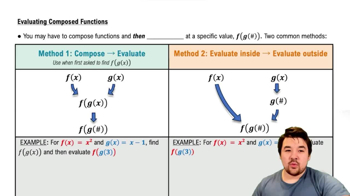
Evaluating Composed Functions

Simplification of Expressions

Simplification refers to the process of reducing an expression to its simplest form, making it easier to understand or compute. This can involve combining like terms, factoring, or canceling common factors. In the context of the given function, simplifying the expression after evaluating it at f(−9 - x) is necessary to arrive at a clear and concise answer.
Recommended video:
Guided course
05:09
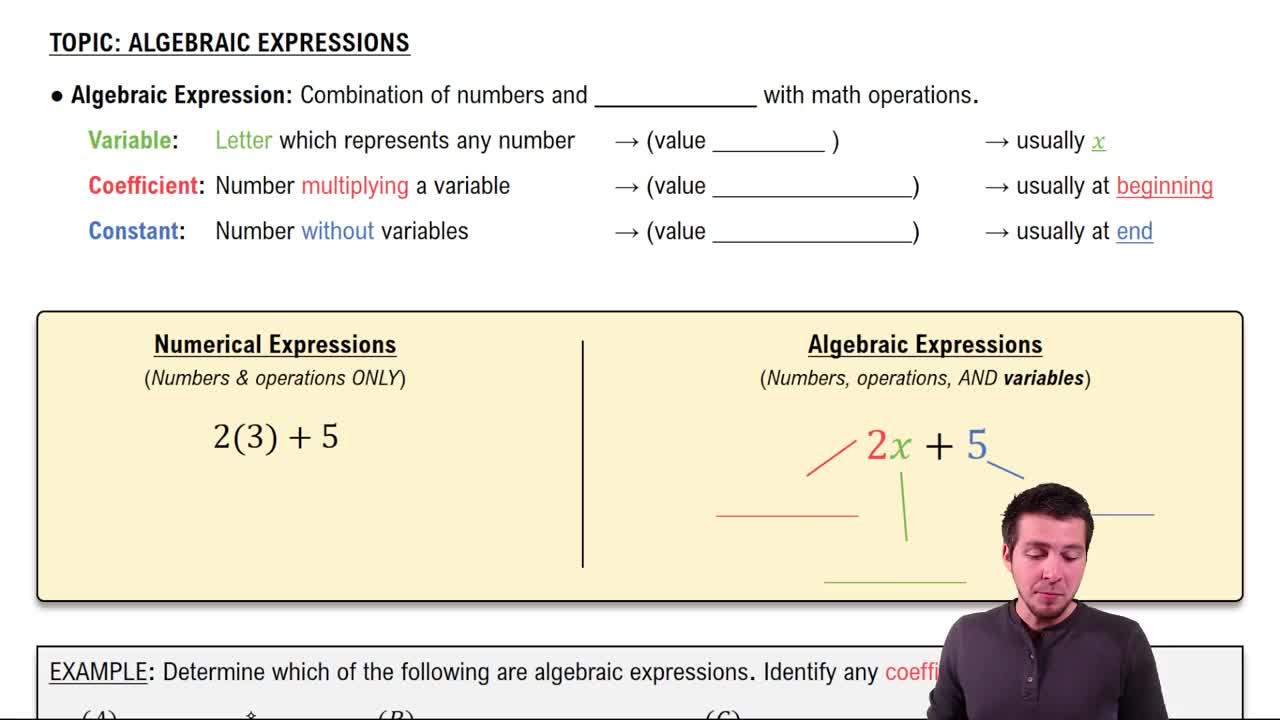
Introduction to Algebraic Expressions