Ch. 2 - Functions and Graphs
Blitzer - College Algebra 8th Edition
Blitzer8th EditionCollege AlgebraISBN: 9780136970514Not the one you use?Change textbook
Chapter 3, Problem 30c

Evaluate each function at the given values of the independent variable and simplify. g(x) = x² - 10x - 3 c. g(-x)

Verified step by step guidance
1
Step 1: Understand the problem. You are given a function g(x) = x² + 2x + 3, and you are tasked with evaluating g(-x). This means substituting -x in place of x in the function.
Step 2: Substitute -x into the function. Replace every occurrence of x in g(x) with -x. The function becomes g(-x) = (-x)² + 2(-x) + 3.
Step 3: Simplify the first term (-x)². Recall that squaring a negative number results in a positive value, so (-x)² = x².
Step 4: Simplify the second term 2(-x). Multiply 2 by -x to get -2x.
Step 5: Combine all simplified terms. The function g(-x) simplifies to g(-x) = x² - 2x + 3.

Verified video answer for a similar problem:

This video solution was recommended by our tutors as helpful for the problem above.
Video duration:
1m
Was this helpful?

Key Concepts

Here are the essential concepts you must grasp in order to answer the question correctly.

Function Evaluation

Function evaluation involves substituting a specific value for the independent variable in a function to determine its output. For example, if g(x) = x² - 10x - 3, evaluating g(-x) means replacing x with -x, resulting in g(-x) = (-x)² - 10(-x) - 3. This process is fundamental in understanding how functions behave under different inputs.
Recommended video:
4:26
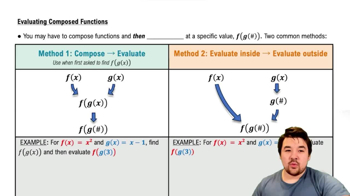
Evaluating Composed Functions

Simplification of Expressions

Simplification of expressions refers to the process of reducing a mathematical expression to its simplest form. This often involves combining like terms, factoring, or applying algebraic identities. For instance, after evaluating g(-x), one would simplify the resulting expression to make it easier to interpret or use in further calculations.
Recommended video:
Guided course
05:09
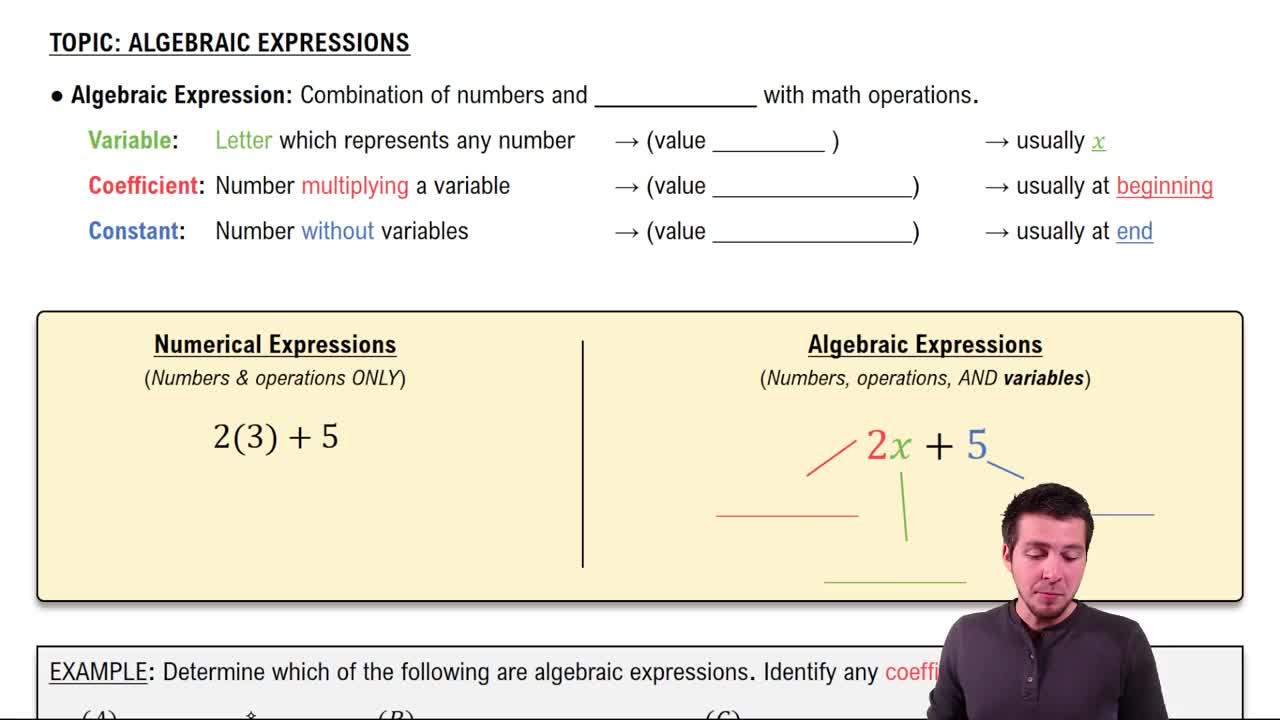
Introduction to Algebraic Expressions

Quadratic Functions

Quadratic functions are polynomial functions of degree two, typically expressed in the form g(x) = ax² + bx + c, where a, b, and c are constants. Understanding the properties of quadratic functions, such as their parabolas' shape and vertex, is crucial for evaluating and simplifying expressions involving them. In the given question, both functions are quadratic, which influences how we evaluate and simplify them.
Recommended video:
06:36
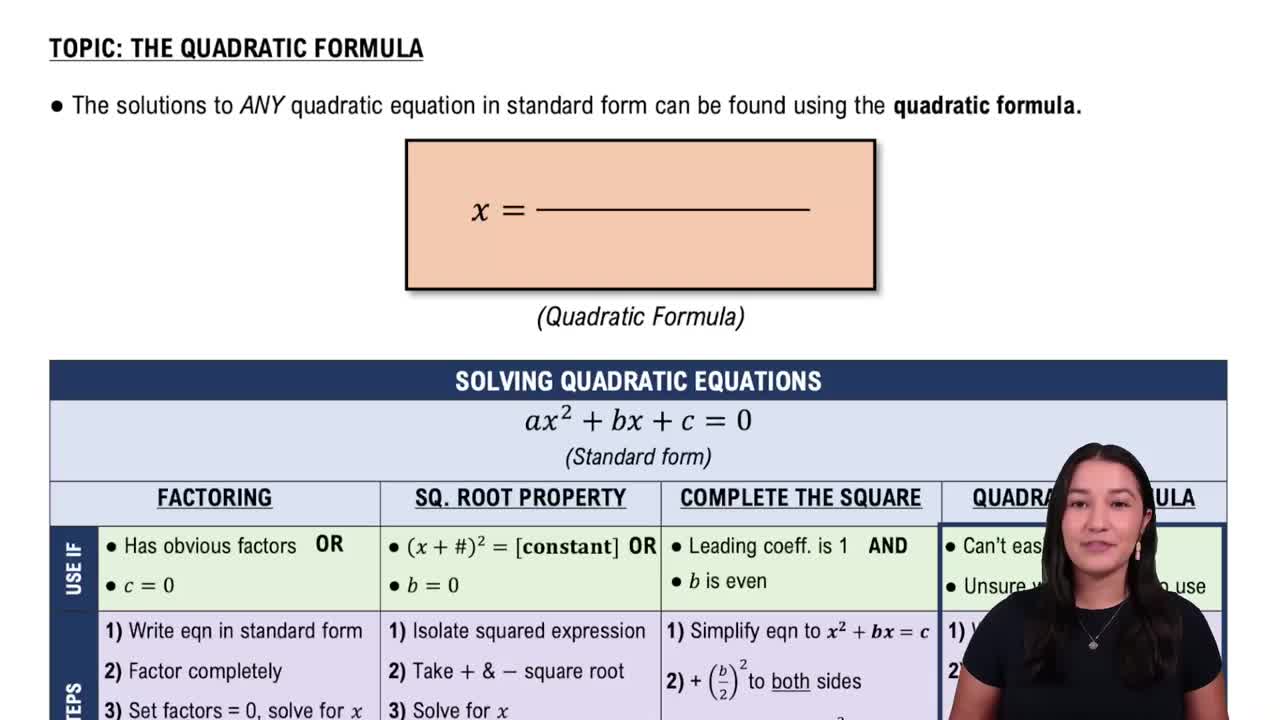
Solving Quadratic Equations Using The Quadratic Formula