Ch. 2 - Functions and Graphs
Blitzer - College Algebra 8th Edition
Blitzer8th EditionCollege AlgebraISBN: 9780136970514Not the one you use?Change textbook
Chapter 3, Problem 26

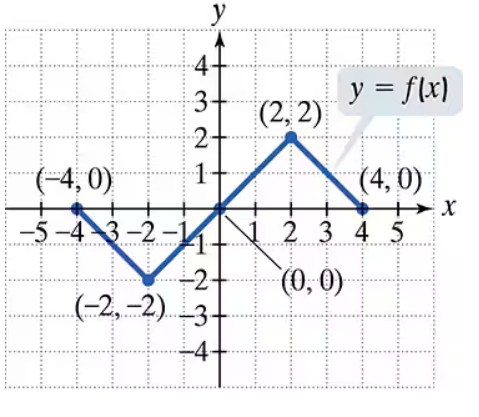
Use the graph of y = f(x) to graph each function g. g(x) = -f(x)+1

Verified step by step guidance
1
Step 1: Understand the given problem. The function g(x) = -f(x) + 1 is a transformation of the original function y = f(x). This involves two transformations: a reflection over the x-axis and a vertical shift.
Step 2: Apply the reflection transformation. The term -f(x) reflects the graph of y = f(x) over the x-axis. For every point (x, y) on the graph of y = f(x), the corresponding point on y = -f(x) will be (x, -y).
Step 3: Apply the vertical shift. The +1 in g(x) = -f(x) + 1 shifts the graph of y = -f(x) upward by 1 unit. For every point (x, -y) on y = -f(x), the corresponding point on g(x) will be (x, -y + 1).
Step 4: Combine the transformations. Start with the graph of y = f(x), reflect it over the x-axis to get y = -f(x), and then shift the entire graph upward by 1 unit to obtain g(x) = -f(x) + 1.
Step 5: Plot the transformed graph. Use the transformations to adjust key points from the original graph of y = f(x) and sketch the new graph of g(x). Ensure that the shape and behavior of the graph are consistent with the transformations applied.

Verified video answer for a similar problem:

This video solution was recommended by our tutors as helpful for the problem above.
Video duration:
3m
Was this helpful?

Key Concepts

Here are the essential concepts you must grasp in order to answer the question correctly.

Function Transformation

Function transformation refers to the process of altering the graph of a function through various operations, such as shifting, reflecting, or stretching. In this case, the function g(x) = -f(x) + 1 involves a reflection across the x-axis due to the negative sign and a vertical shift upwards by 1 unit.
Recommended video:
4:22
Domain & Range of Transformed Functions

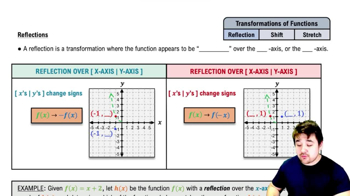
Reflection Across the X-Axis

Reflection across the x-axis occurs when the output values of a function are negated. For the function g(x) = -f(x), every point on the graph of f(x) is mirrored over the x-axis, meaning if f(x) has a point (a, b), then g(x) will have the point (a, -b). This transformation changes the sign of the y-values.
Recommended video:
5:00
Reflections of Functions

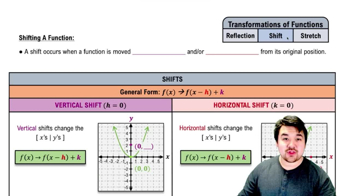
Vertical Shift

A vertical shift involves moving the entire graph of a function up or down without altering its shape. In the function g(x) = -f(x) + 1, the '+1' indicates that after reflecting f(x) across the x-axis, the graph is then shifted upwards by 1 unit, resulting in a new set of y-values that are all increased by 1.
Recommended video:
5:34
Shifts of Functions