Ch. 2 - Functions and Graphs
Blitzer - College Algebra 8th Edition
Blitzer8th EditionCollege AlgebraISBN: 9780136970514Not the one you use?Change textbook
Chapter 3, Problem 21

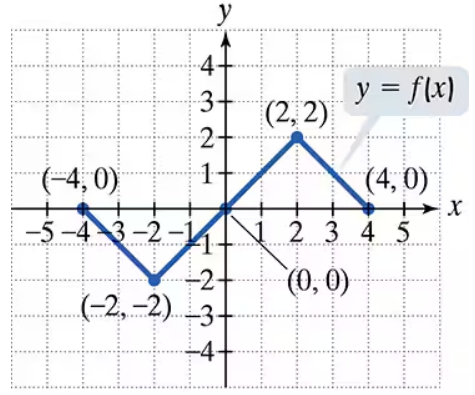
Use the graph of y = f(x) to graph each function g.

g(x) = f(x-1)+2

Verified step by step guidance
1
Identify the given function transformation: \(g(x) = f(x-1) + 2\). This means the graph of \(f(x)\) is shifted horizontally and vertically.
Understand the horizontal shift: The term \((x-1)\) inside the function indicates a shift to the right by 1 unit. So, every point \((x, y)\) on \(f(x)\) moves to \((x+1, y)\) on \(g(x)\).
Understand the vertical shift: The \(+2\) outside the function means the graph is shifted up by 2 units. So, every point \((x, y)\) on \(f(x)\) moves to \((x, y+2)\) on \(g(x)\).
Apply both transformations to each key point on the graph of \(f(x)\): For example, the point \((-2, 0)\) on \(f(x)\) will move to \((-2+1, 0+2) = (-1, 2)\) on \(g(x)\). Repeat this for the points \((0, -4)\) and \((2, 0)\).
Plot the new points on the coordinate plane and connect them with the same shape as the original graph to complete the graph of \(g(x)\).

Verified video answer for a similar problem:

This video solution was recommended by our tutors as helpful for the problem above.
Video duration:
3m
Was this helpful?

Key Concepts

Here are the essential concepts you must grasp in order to answer the question correctly.

Function Transformations

Function transformations involve shifting, stretching, compressing, or reflecting the graph of a function. In this problem, the function g(x) = f(x - 1) + 2 represents a horizontal shift to the right by 1 unit and a vertical shift upward by 2 units of the original function f(x). Understanding these shifts helps in accurately graphing the transformed function.
Recommended video:
4:22
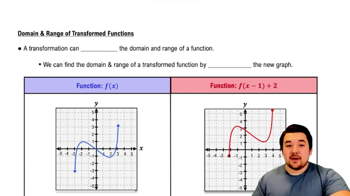
Domain & Range of Transformed Functions

Horizontal Shifts

A horizontal shift occurs when the input variable x is replaced by (x - h), shifting the graph h units to the right if h is positive, or to the left if h is negative. For g(x) = f(x - 1), the graph of f(x) moves 1 unit to the right. This affects the x-coordinates of all points on the graph.
Recommended video:
5:34
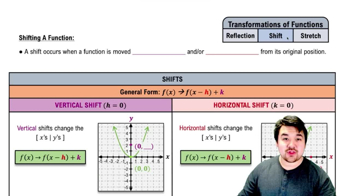
Shifts of Functions

Vertical Shifts

A vertical shift happens when a constant k is added to the function, changing it to f(x) + k. This moves the graph up by k units if k is positive, or down if k is negative. In g(x) = f(x - 1) + 2, adding 2 shifts the entire graph of f(x - 1) upward by 2 units, affecting the y-coordinates.
Recommended video:
5:34
Shifts of Functions