
Textbook Question
In Exercises 11–26, determine whether each equation defines y as a function of x. 4x = y²

 Verified step by step guidance
 5:34
5:34
 5:26
5:26 04:29
04:29In Exercises 11–26, determine whether each equation defines y as a function of x. 4x = y²
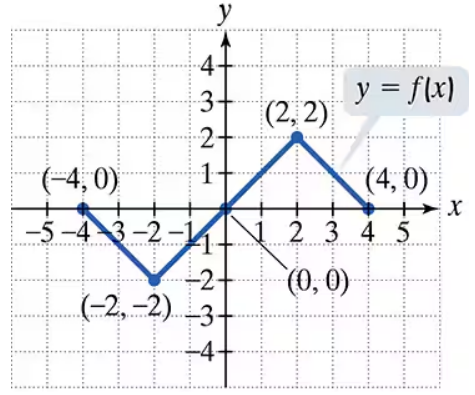
Use the graph to determine (a) the function's domain, (b) the function's range, (c) the x-intercepts, if any, (d) the y-intercept, if there is one, (e) intervals on which the function is increasing, decreasing or constant, (f) the missing function values, indicated by question marks, below each graph.
Find the distance between each pair of points. If necessary, express answers in simplified radical form and then round to two decimal places. (-1/4, -1/7) and (3/4, 6/7)
Find the midpoint of each line segment with the given endpoints. (6, 8) and (2, 4)
The functions in Exercises 11-28 are all one-to-one. For each function, a. Find an equation for f-1(x), the inverse function. b. Verify that your equation is correct by showing that f(ƒ-1 (x)) = = x and ƒ-1 (f(x)) = x. f(x) = (x+2)³
Find the domain of each function. f(x) = 1/√(x - 3)