The functions in Exercises 11-28 are all one-to-one. For each function, a. Find an equation for f-1(x), the inverse function. b. Verify that your equation is correct by showing that f(ƒ-1 (x)) = = x and ƒ-1 (f(x)) = x. f(x) = x³ +2
Ch. 2 - Functions and Graphs

Chapter 3, Problem 16a
Use the given conditions to write an equation for each line in point-slope form and slope-intercept form. Slope = -5, passing through (-4, -2)
Verified step by step guidance1
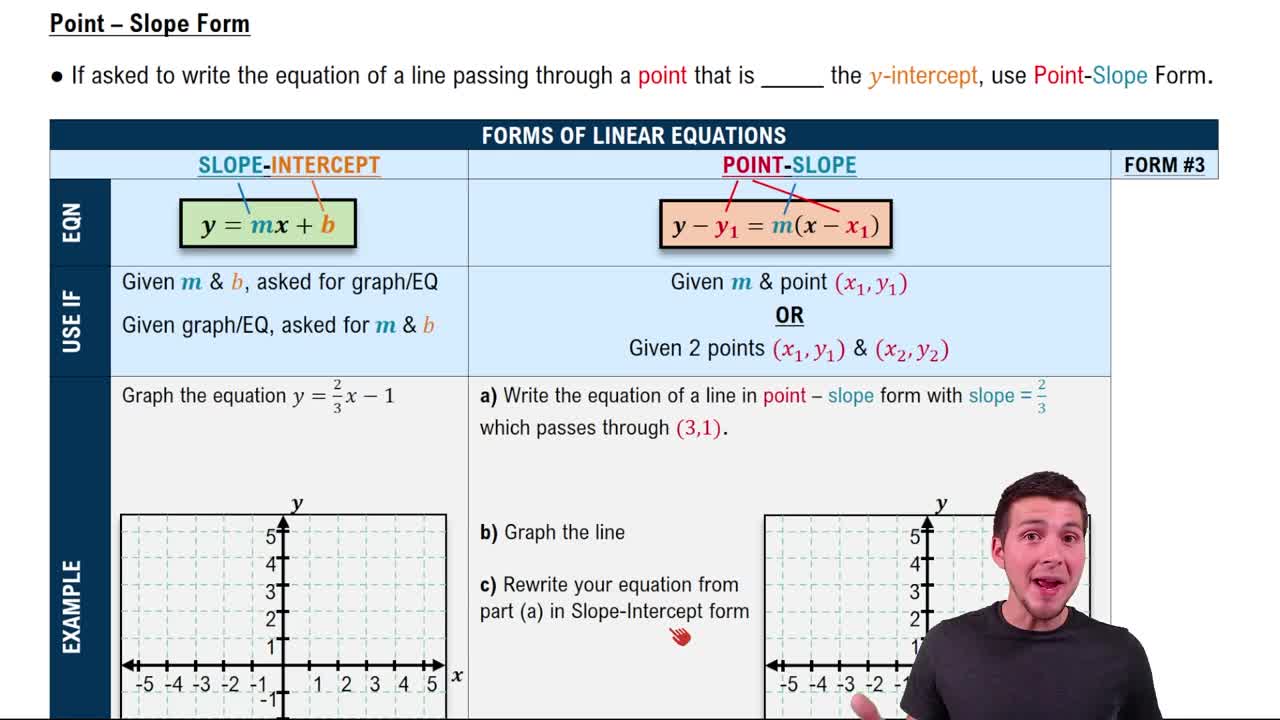
Start with the point-slope form of a linear equation: , where is the slope and is a point on the line.
Substitute the given slope and the point into the point-slope form. This gives: .
Simplify the equation by removing the double negatives: . This is the equation in point-slope form.
To convert to slope-intercept form, expand the equation: Distribute to both terms inside the parentheses: .
Isolate by subtracting from both sides: . This is the equation in slope-intercept form.

Verified video answer for a similar problem:
This video solution was recommended by our tutors as helpful for the problem above.
Video duration:
1mWas this helpful?
Key Concepts
Here are the essential concepts you must grasp in order to answer the question correctly.
Point-Slope Form
Point-slope form is a way to express the equation of a line when you know the slope and a point on the line. It is written as y - y1 = m(x - x1), where (x1, y1) is the point and m is the slope. This form is particularly useful for quickly writing the equation of a line when given a slope and a specific point.
Recommended video:
Guided course
Point-Slope Form
Slope-Intercept Form
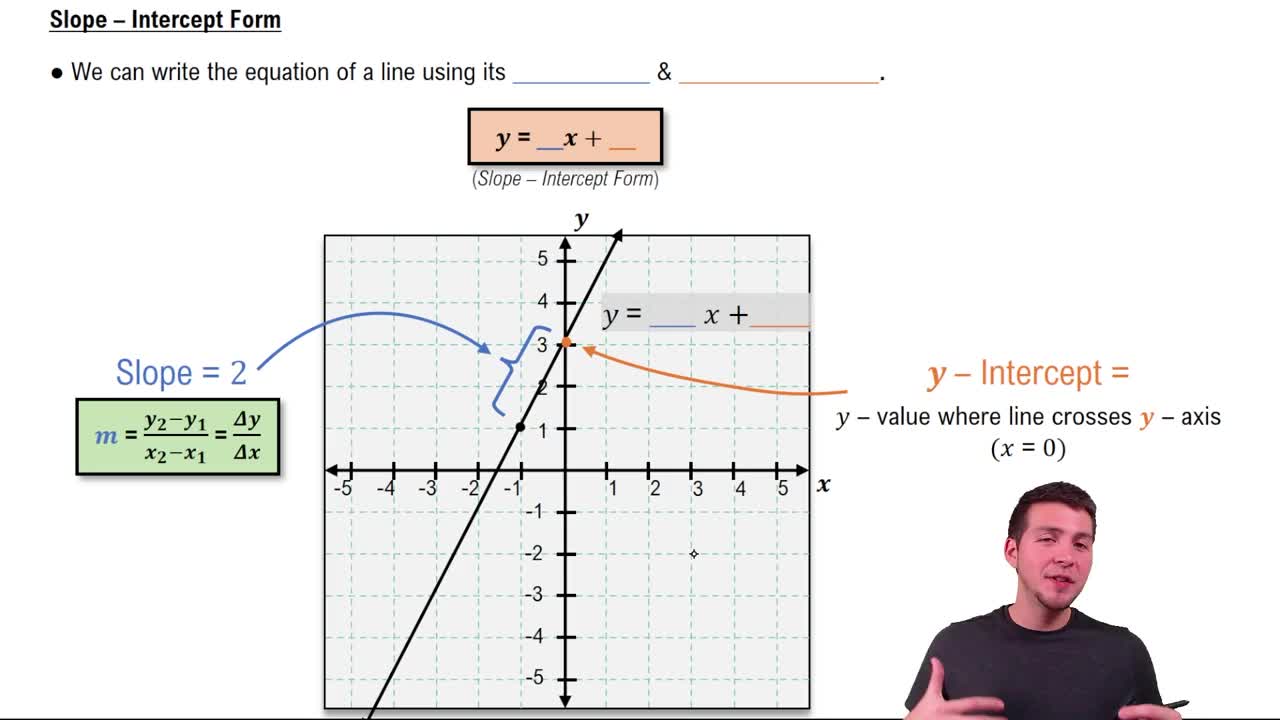
Slope-intercept form is another way to express the equation of a line, defined as y = mx + b, where m is the slope and b is the y-intercept. This form is beneficial for easily identifying the slope and where the line crosses the y-axis. Converting from point-slope to slope-intercept form involves rearranging the equation to isolate y.
Recommended video:
Guided course
Slope-Intercept Form
Slope
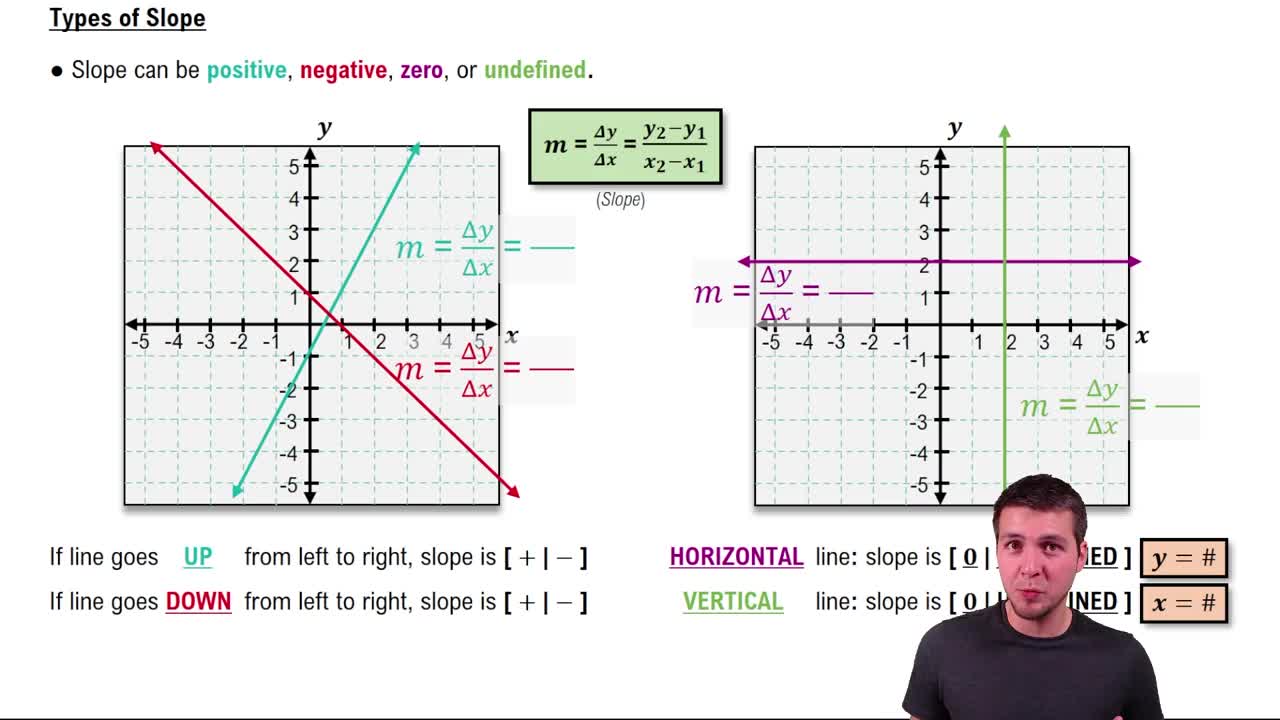
The slope of a line measures its steepness and direction, calculated as the change in y divided by the change in x (rise over run). A negative slope indicates that the line descends from left to right, while a positive slope indicates it ascends. Understanding slope is crucial for graphing lines and interpreting their behavior in relation to other lines.
Recommended video:
Guided course
Types of Slope
Related Practice
Textbook Question
Textbook Question
The functions in Exercises 11-28 are all one-to-one. For each function, a. Find an equation for f-1(x), the inverse function. b. Verify that your equation is correct by showing that f(ƒ-1 (x)) = = x and ƒ-1 (f(x)) = x. f(x) = 2x + 3
Textbook Question
In Exercises 1-16, use the graph of y = f(x) to graph each function g.
g(x) = -f(2x) - 1
2
views
Textbook Question
Find the domain of each function. f(x) = 1/[4/(x - 1) - 2]
Textbook Question
Find the average rate of change of the function from x1 to x2. f(x) = √x from x1 = 4 to x2 = 9
Textbook Question
Find the distance between each pair of points. If necessary, express answers in simplified radical form and then round to two decimal places. (7/3, 1/5) and (1/3, 6/5)
1
views