Begin by graphing the cube root function, f(x) = ∛x. Then use transformations of this graph to graph the given function. g(x) = ∛x+2
Ch. 2 - Functions and Graphs

Chapter 3, Problem 111
In Exercises 109–111, give the center and radius of each circle. x^2 + y^2 - 4x + 2y - 4 = 0
Verified step by step guidance1
Rewrite the given equation of the circle: . Group the terms involving and together: .
Complete the square for the -terms. Take half the coefficient of (which is ), square it, and add it inside the parentheses: . To maintain equality, add to the right-hand side of the equation.
Rewrite the equation with the completed squares: . This is now in the standard form of a circle: , where is the center and is the radius.
Identify the center and radius from the equation. The center is , and the radius is .

Verified video answer for a similar problem:
This video solution was recommended by our tutors as helpful for the problem above.
Video duration:
5mWas this helpful?
Key Concepts
Here are the essential concepts you must grasp in order to answer the question correctly.
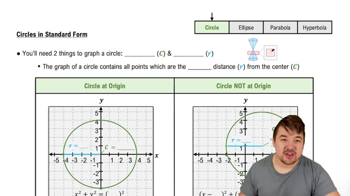
Standard Form of a Circle
The standard form of a circle's equation is (x - h)² + (y - k)² = r², where (h, k) is the center and r is the radius. To identify the center and radius from a general equation, it is often necessary to rearrange the equation into this standard form through completing the square.
Recommended video:
Circles in Standard Form
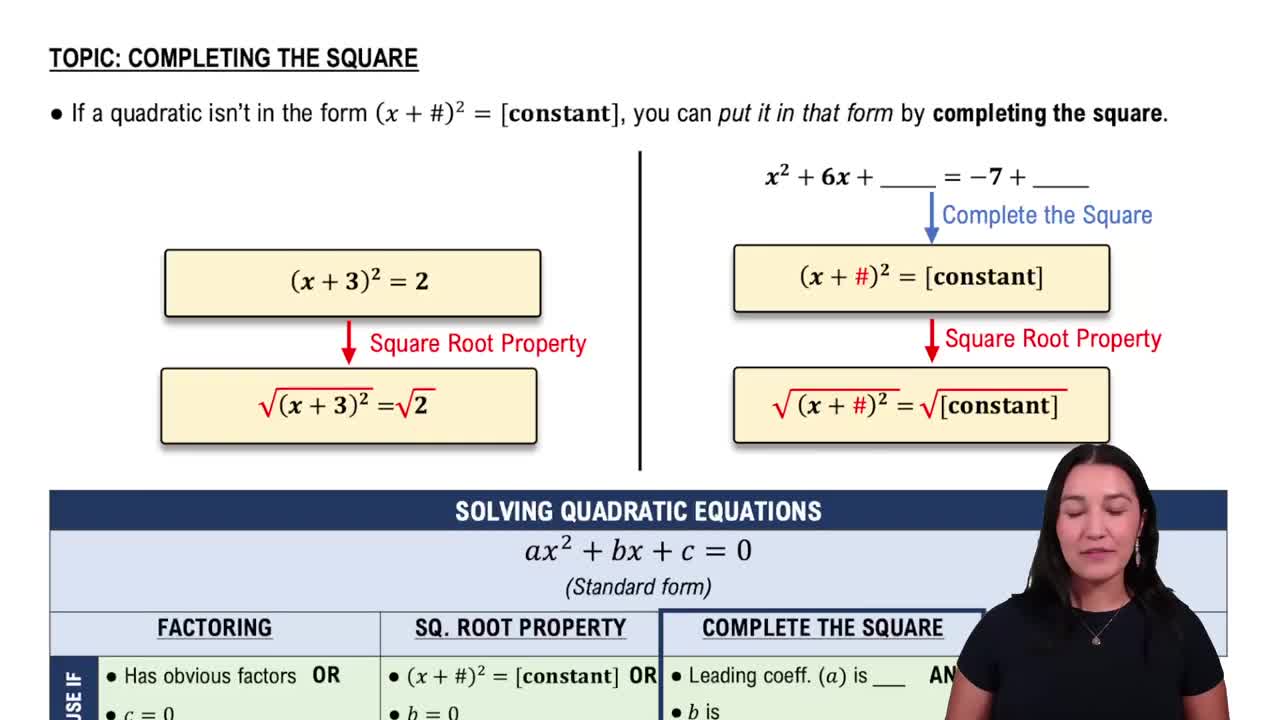
Completing the Square
Completing the square is a method used to transform a quadratic expression into a perfect square trinomial. This technique involves manipulating the equation to isolate the variable terms and create a squared term, which simplifies the process of identifying the center and radius of a circle.
Recommended video:
Solving Quadratic Equations by Completing the Square
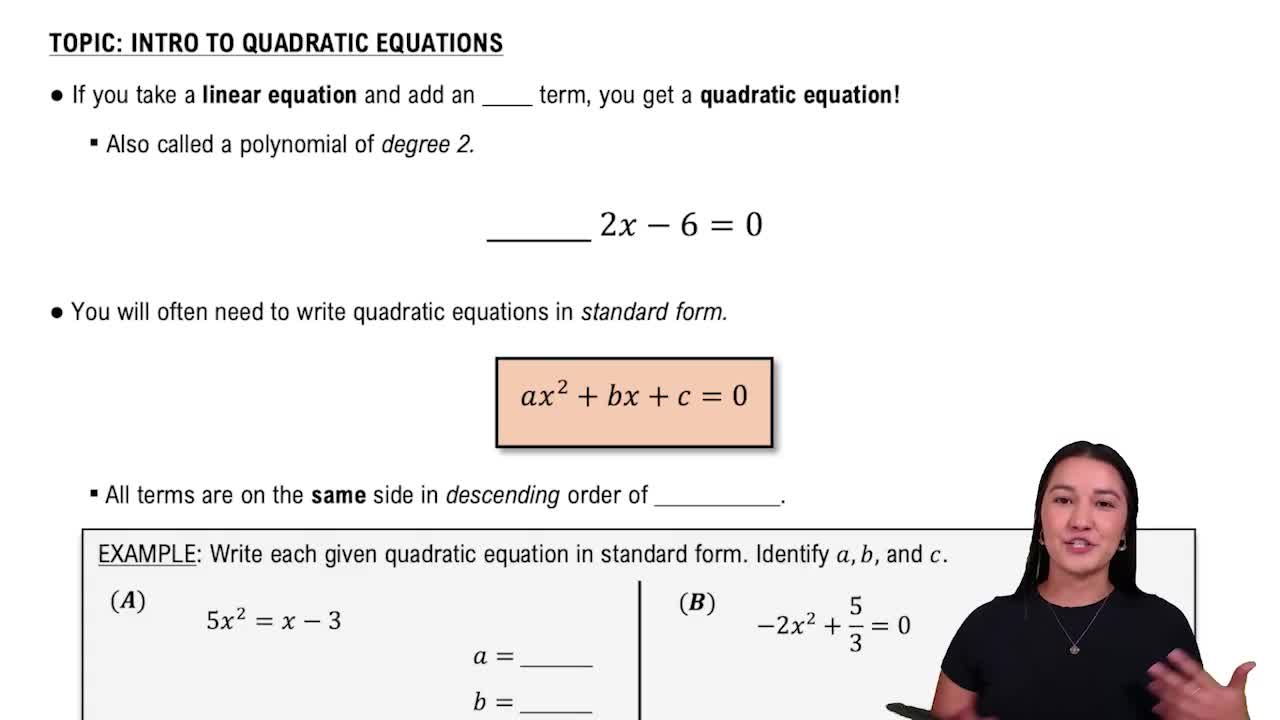
Quadratic Equations
Quadratic equations are polynomial equations of the form ax² + bx + c = 0. In the context of circles, the terms involving x and y can be rearranged to form a quadratic equation, which is essential for identifying the geometric properties of the circle, such as its center and radius.
Recommended video:
Introduction to Quadratic Equations
Related Practice
Textbook Question
Textbook Question
In Exercises 107–108, write the standard form of the equation of the circle with the given center and radius. Center (-2. 4), r = 6
1
views
Textbook Question
Begin by graphing the cube root function, f(x) = ∛x. Then use transformations of this graph to graph the given function. g(x) = (1/2)∛(x-2)
Textbook Question
Begin by graphing the cube root function, f(x) = ∛x. Then use transformations of this graph to graph the given function. g(x) = ∛(x-2)
Textbook Question
Begin by graphing the cube root function, f(x) = ∛x. Then use transformations of this graph to graph the given function. -∛(x+2)
Textbook Question
Begin by graphing the cube root function, f(x) = ∛x. Then use transformations of this graph to graph the given function. g(x) = (1/2)∛(x+2) - 2