In Exercises 11–26, determine whether each equation defines y as a function of x. x + y = 16
Ch. 2 - Functions and Graphs

Chapter 3, Problem 11
Find the distance between each pair of points. If necessary, express answers in simplified radical form and then round to two decimal places. (3.5, 8.2) and (-0.5, 6.2)
Verified step by step guidance1
Identify the coordinates of the two points: Point 1 is (3.5, 8.2) and Point 2 is (-0.5, 6.2).
Recall the distance formula between two points \((x_1, y_1)\) and \((x_2, y_2)\):
\[d = \sqrt{(x_2 - x_1)^2 + (y_2 - y_1)^2}\]
Substitute the given coordinates into the formula:
\[d = \sqrt{(-0.5 - 3.5)^2 + (6.2 - 8.2)^2}\]
Simplify the expressions inside the parentheses:
Calculate \((-0.5 - 3.5)\) and \((6.2 - 8.2)\), then square each result.
Add the squared values and take the square root of the sum to find the distance. If possible, simplify the radical before rounding to two decimal places.

Verified video answer for a similar problem:
This video solution was recommended by our tutors as helpful for the problem above.
Was this helpful?
Key Concepts
Here are the essential concepts you must grasp in order to answer the question correctly.
Distance Formula
The distance formula calculates the length between two points in the coordinate plane. It is derived from the Pythagorean theorem and given by d = √[(x2 - x1)² + (y2 - y1)²], where (x1, y1) and (x2, y2) are the coordinates of the points.
Recommended video:
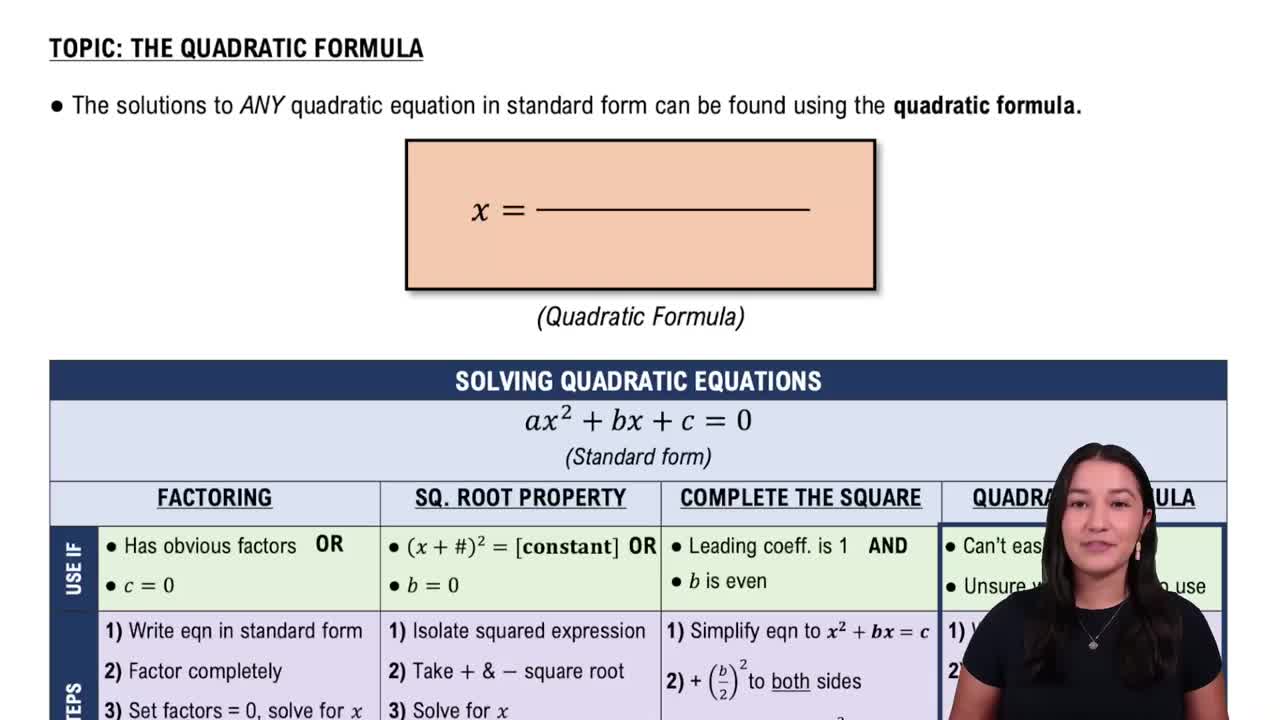
Solving Quadratic Equations Using The Quadratic Formula
Simplified Radical Form
Simplified radical form means expressing a square root in its simplest form by factoring out perfect squares. This helps present answers in an exact form before approximating decimals, ensuring clarity and precision in mathematical solutions.
Recommended video:
Guided course
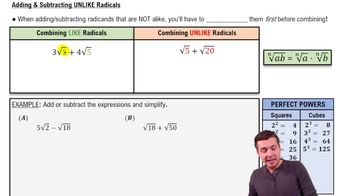
Adding & Subtracting Unlike Radicals by Simplifying
Rounding Decimals
Rounding decimals involves approximating a number to a specified number of decimal places. In this problem, answers are rounded to two decimal places, which means keeping two digits after the decimal point and adjusting the last digit based on the next digit.
Recommended video:
The Number e
Related Practice
Textbook Question
3
views
Textbook Question
Use the graph of y = f(x) to graph each function g.
g(x) = ½ f(x)
2
views
Textbook Question
Find the domain of each function. f(x) = 1/(x2+1) - 1/(x2-1)
6
views
Textbook Question
Use the given conditions to write an equation for each line in point-slope form and general form. Passing through (4, −7) and perpendicular to the line whose equation is x − 2y – 3 = 0
Textbook Question
The functions in Exercises 11-28 are all one-to-one. For each function, a. Find an equation for f-1(x), the inverse function. b. Verify that your equation is correct by showing that f(ƒ-1 (x)) = = x and ƒ-1 (f(x)) = x. f(x) = x +3
Textbook Question
Use the given conditions to write an equation for each line in point-slope form and slope-intercept form. Slope = 2, passing through (3, 5)