Ch. 2 - Functions and Graphs
Blitzer - College Algebra 8th Edition
Blitzer8th EditionCollege AlgebraISBN: 9780136970514Not the one you use?Change textbook
Chapter 3, Problem 38

Find f+gf+g, fgf-g, fgfg, and fg\(\frac{f}{g}\). Determine the domain for each function.
f(x)=5x2f\(\left\)(x\(\right\))=5-x^2, g(x)=x2+4x12g\(\left\)(x\(\right\))=x^2+4x-12

Verified step by step guidance
1
Step 1: To find \( (f+g)(x) \), add the functions \( f(x) \) and \( g(x) \). This means you will add \( 5 - x^2 \) and \( x^2 + 4x - 12 \). Combine like terms to simplify.
Step 2: To find \( (f-g)(x) \), subtract \( g(x) \) from \( f(x) \). This involves subtracting \( x^2 + 4x - 12 \) from \( 5 - x^2 \). Again, combine like terms to simplify.
Step 3: To find \( (fg)(x) \), multiply the functions \( f(x) \) and \( g(x) \). This requires distributing \( 5 - x^2 \) across \( x^2 + 4x - 12 \) and combining like terms.
Step 4: To find \( \left(\frac{f}{g}\right)(x) \), divide \( f(x) \) by \( g(x) \). This means writing \( \frac{5 - x^2}{x^2 + 4x - 12} \). Simplify if possible, and identify any restrictions on the domain where the denominator is zero.
Step 5: Determine the domain for each function. For \( f+g \) and \( f-g \), the domain is all real numbers. For \( fg \), the domain is also all real numbers. For \( \frac{f}{g} \), exclude values that make the denominator zero by solving \( x^2 + 4x - 12 = 0 \) to find the restricted values.

Verified video answer for a similar problem:

This video solution was recommended by our tutors as helpful for the problem above.
Video duration:
2m
Was this helpful?

Key Concepts

Here are the essential concepts you must grasp in order to answer the question correctly.

Function Operations

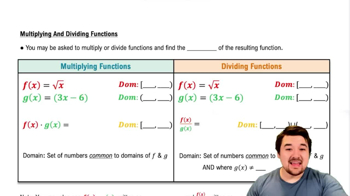
Function operations involve combining two or more functions through addition, subtraction, multiplication, or division. For example, if f(x) and g(x) are two functions, their sum is defined as (f + g)(x) = f(x) + g(x). Understanding these operations is crucial for manipulating and analyzing functions in algebra.
Recommended video:
7:24
Multiplying & Dividing Functions

Domain of a Function

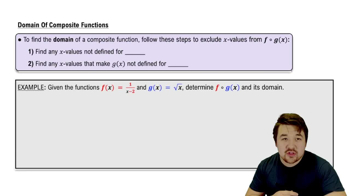
The domain of a function is the set of all possible input values (x-values) for which the function is defined. For instance, in rational functions, the domain excludes values that make the denominator zero. Identifying the domain is essential for understanding the behavior and limitations of a function.
Recommended video:
3:51
Domain Restrictions of Composed Functions

Quadratic Functions

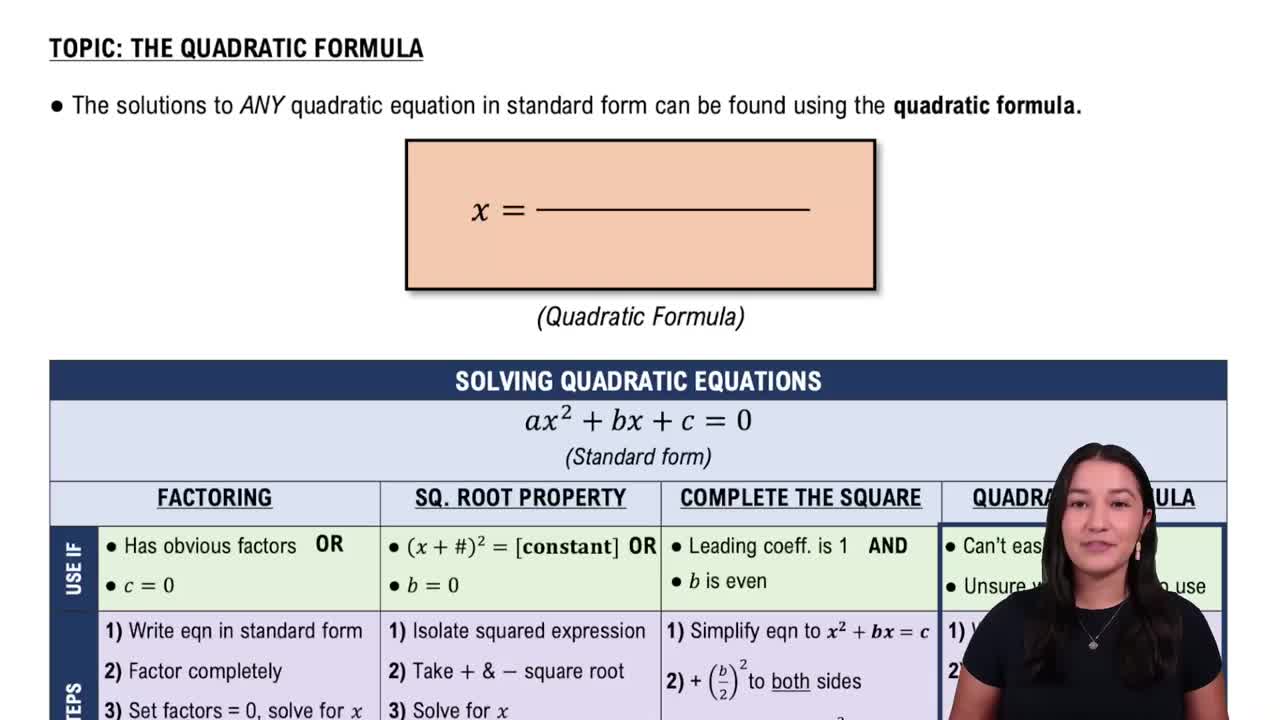
Quadratic functions are polynomial functions of degree two, typically expressed in the form f(x) = ax^2 + bx + c. They have a parabolic graph and can have various properties such as vertex, axis of symmetry, and roots. Recognizing the characteristics of quadratic functions is important for solving equations and analyzing their graphs.
Recommended video:
06:36
Solving Quadratic Equations Using The Quadratic Formula