Ch. 2 - Functions and Graphs
Blitzer - College Algebra 8th Edition
Blitzer8th EditionCollege AlgebraISBN: 9780136970514Not the one you use?Change textbook
Chapter 3, Problem 125

Exercises 123–125 will help you prepare for the material covered in the next section. Solve for y: x = y² -1, y ≥ 0.

Verified step by step guidance
1
Rewrite the equation to isolate the term involving y. Start by adding 1 to both sides of the equation: x + 1 = y².
To solve for y, take the square root of both sides of the equation. Since the problem specifies y ≥ 0, only the positive square root is considered: y = √(x + 1).
Verify the domain of the solution. The expression under the square root, x + 1, must be non-negative. Therefore, x + 1 ≥ 0, which simplifies to x ≥ -1.
State the final solution: y = √(x + 1), with the condition that x ≥ -1 to ensure the square root is defined and y remains non-negative.
Double-check the solution by substituting back into the original equation to confirm it satisfies x = y² - 1 for y ≥ 0.

Verified video answer for a similar problem:

This video solution was recommended by our tutors as helpful for the problem above.
Video duration:
2m
Was this helpful?

Key Concepts

Here are the essential concepts you must grasp in order to answer the question correctly.

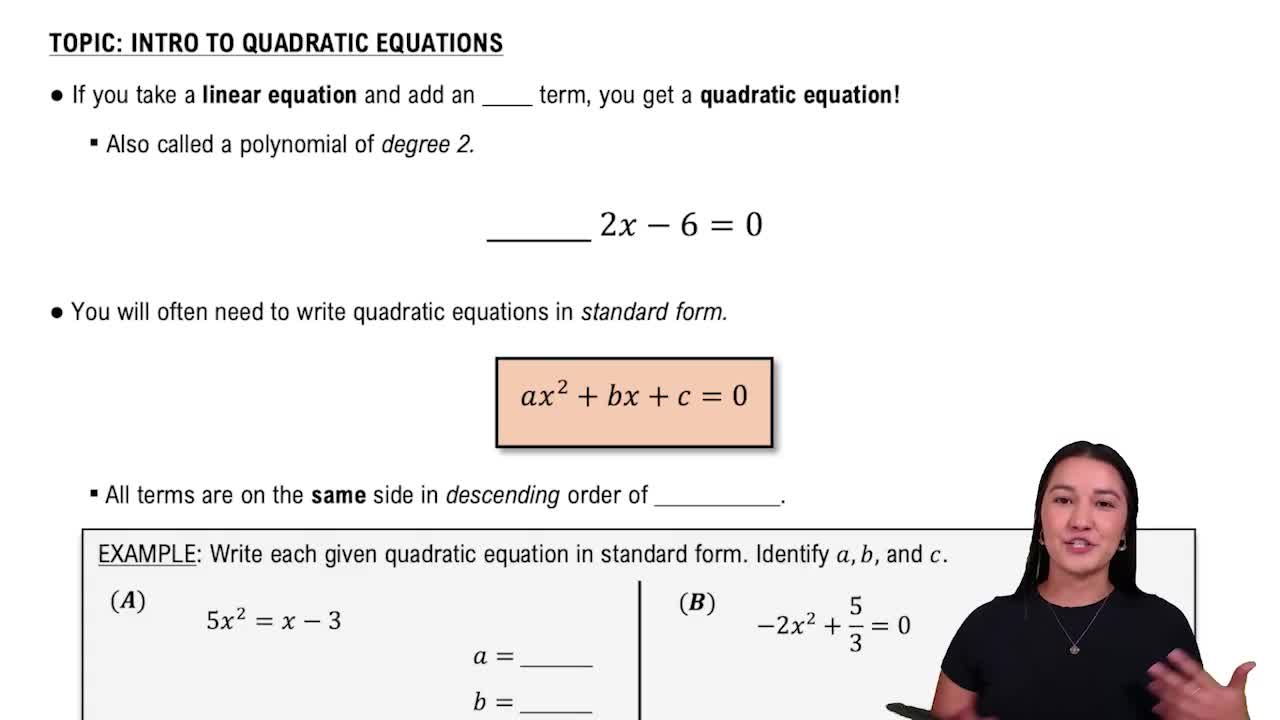
Quadratic Equations

A quadratic equation is a polynomial equation of the form ax² + bx + c = 0, where a, b, and c are constants and a ≠ 0. In the context of the given question, the equation x = y² - 1 can be rearranged to form a quadratic equation in terms of y, which is essential for finding the values of y that satisfy the equation.
Recommended video:
05:35
Introduction to Quadratic Equations

Solving for y

Solving for y involves isolating the variable y in an equation. In this case, we need to manipulate the equation x = y² - 1 to express y in terms of x. This typically involves taking the square root of both sides, while also considering any restrictions on y, such as the condition y ≥ 0.
Recommended video:
5:02
Solving Logarithmic Equations

Domain and Range

The domain refers to the set of possible input values (x-values) for a function, while the range refers to the set of possible output values (y-values). In this problem, the condition y ≥ 0 restricts the range of the solution, meaning we only consider non-negative values of y when solving the equation, which is crucial for finding valid solutions.
Recommended video:
4:22
Domain & Range of Transformed Functions