Find f(g(x)) and g (f(x)) and determine whether each pair of functions ƒ and g are inverses of each other. f(x) = ∛(x − 4) and g(x) = x³ +4
Ch. 2 - Functions and Graphs

Chapter 3, Problem 10
Evaluate each function at the given values of the independent variable and simplify. (a) f(-2), (b) f(1), (c) f(2)
Verified step by step guidance1
Step 1: Understand the problem. You are given a function f(x) and need to evaluate it at specific values of the independent variable x: -2, 1, and 2. This means substituting these values into the function and simplifying the resulting expressions.
Step 2: Substitute x = -2 into the function f(x). Replace every occurrence of x in the function with -2, and simplify the resulting expression.
Step 3: Substitute x = 1 into the function f(x). Replace every occurrence of x in the function with 1, and simplify the resulting expression.
Step 4: Substitute x = 2 into the function f(x). Replace every occurrence of x in the function with 2, and simplify the resulting expression.
Step 5: Write down the simplified results for f(-2), f(1), and f(2). These are the evaluated values of the function at the given points.

Verified video answer for a similar problem:
This video solution was recommended by our tutors as helpful for the problem above.
Video duration:
1mWas this helpful?
Key Concepts
Here are the essential concepts you must grasp in order to answer the question correctly.
Function Evaluation
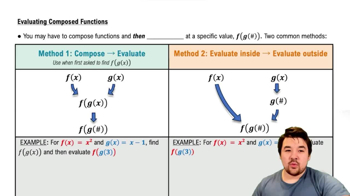
Function evaluation involves substituting a specific value for the independent variable in a function. For example, if f(x) = x^2, evaluating f(2) means calculating 2^2, which equals 4. This process is fundamental in understanding how functions behave at different points.
Recommended video:
Evaluating Composed Functions
Independent Variable
The independent variable is the input of a function, typically represented by 'x' in mathematical expressions. It is the variable that you can control or change, and its value determines the output of the function. In the question, -2, 1, and 2 are the values of the independent variable for which the function is evaluated.
Recommended video:
Probability of Multiple Independent Events
Simplification
Simplification is the process of reducing an expression to its simplest form. This may involve combining like terms, factoring, or reducing fractions. After evaluating the function at the specified values, simplifying the results ensures clarity and conciseness in the final answer.
Recommended video:
Guided course
Multiply Polynomials Using the Distributive Property
Related Practice
Textbook Question
Textbook Question
Use the graph of y = f(x) to graph each function g.
g(x) = f(-x)+3
2
views
Textbook Question
Use the given conditions to write an equation for each line in point-slope form and general form. Passing through (4, −7) and perpendicular to the line whose equation is x − 2y – 3 = 0
Textbook Question
The functions in Exercises 11-28 are all one-to-one. For each function, a. Find an equation for f-1(x), the inverse function. b. Verify that your equation is correct by showing that f(ƒ-1 (x)) = = x and ƒ-1 (f(x)) = x. f(x) = x +3
Textbook Question
Use the given conditions to write an equation for each line in point-slope form and slope-intercept form. Slope = 2, passing through (3, 5)
Textbook Question
Find the domain of each function. f(x) = 1/(x+7) + 3/(x-9)
2
views