Ch. 1 - Equations and Inequalities
Blitzer - College Algebra 8th Edition
Blitzer8th EditionCollege AlgebraISBN: 9780136970514Not the one you use?Change textbook
Chapter 2, Problem 99

Solve each equation in Exercises 83–108 by the method of your choice. x26x+13=0x^2 - 6x + 13 = 0

Verified step by step guidance
1
Identify the type of equation: This is a quadratic equation in the form \(x^2 - 6x + 13 = 0\), where \(a = 1\), \(b = -6\), and \(c = 13\).
Calculate the discriminant using the formula \(\Delta = b^2 - 4ac\). Substitute the values to get \(\Delta = (-6)^2 - 4(1)(13)\).
Evaluate the discriminant to determine the nature of the roots: if \(\Delta > 0\), there are two real roots; if \(\Delta = 0\), one real root; if \(\Delta < 0\), two complex roots.
Since the discriminant is less than zero, use the quadratic formula to find the complex roots: \(x = \frac{-b \pm \sqrt{\Delta}}{2a}\).
Substitute \(a\), \(b\), and \(\Delta\) into the quadratic formula and simplify to express the solutions in terms of real and imaginary parts.

Verified video answer for a similar problem:

This video solution was recommended by our tutors as helpful for the problem above.
Video duration:
3m
Was this helpful?

Key Concepts

Here are the essential concepts you must grasp in order to answer the question correctly.

Quadratic Equations

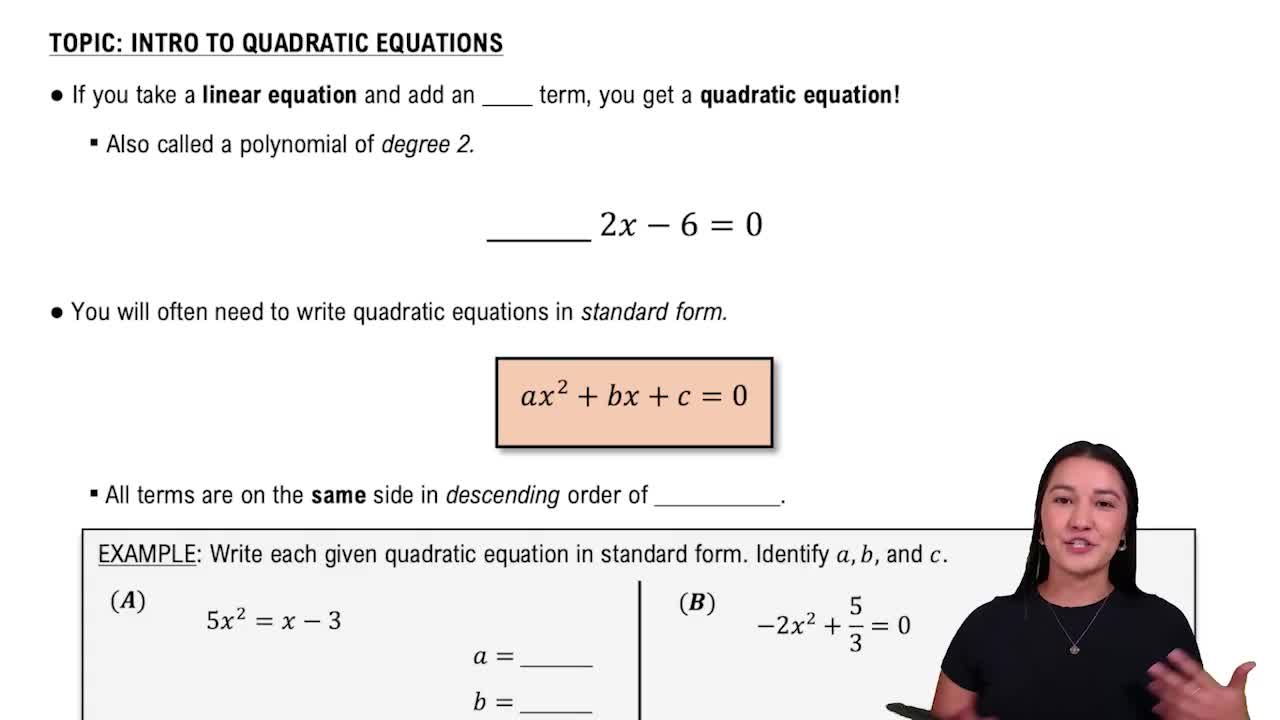
A quadratic equation is a second-degree polynomial equation in the form ax² + bx + c = 0, where a ≠ 0. It represents a parabola when graphed and can have zero, one, or two real solutions depending on the discriminant.
Recommended video:
05:35
Introduction to Quadratic Equations

Discriminant and Nature of Roots

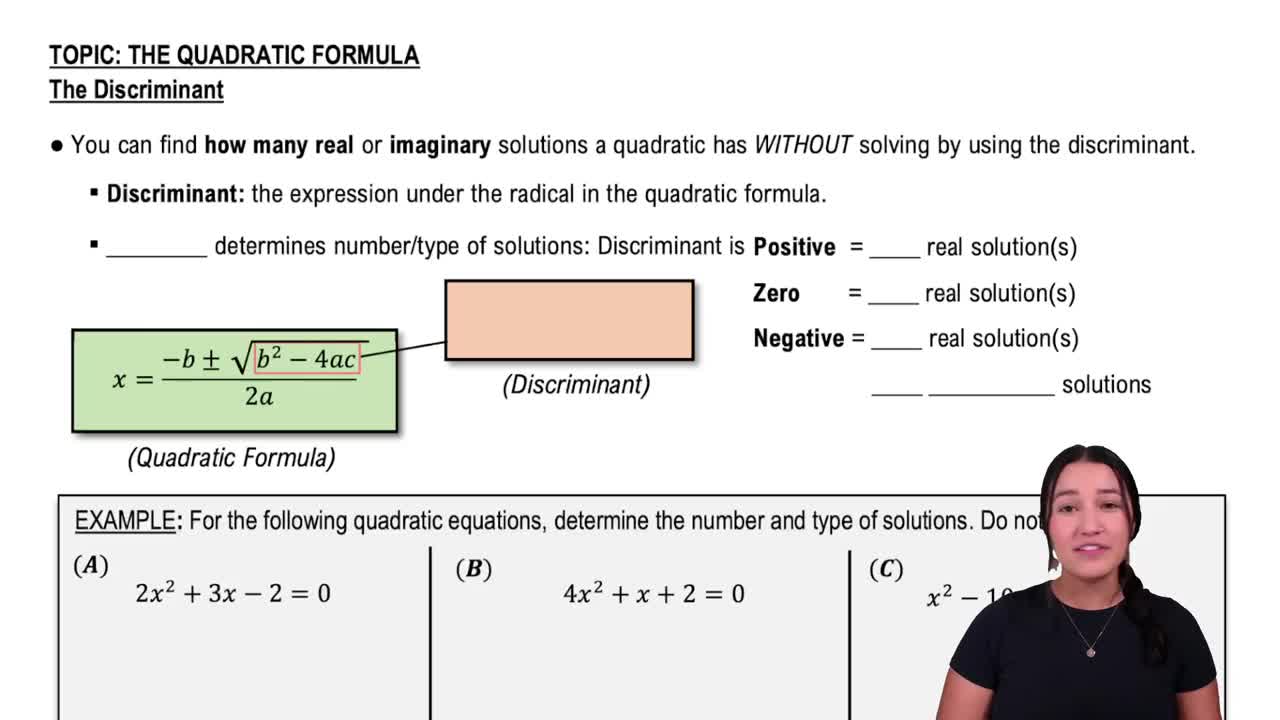
The discriminant, given by b² - 4ac, determines the nature of the roots of a quadratic equation. If it is positive, there are two distinct real roots; if zero, one real root; and if negative, two complex conjugate roots.
Recommended video:
04:11
The Discriminant

Solving Quadratic Equations Using the Quadratic Formula

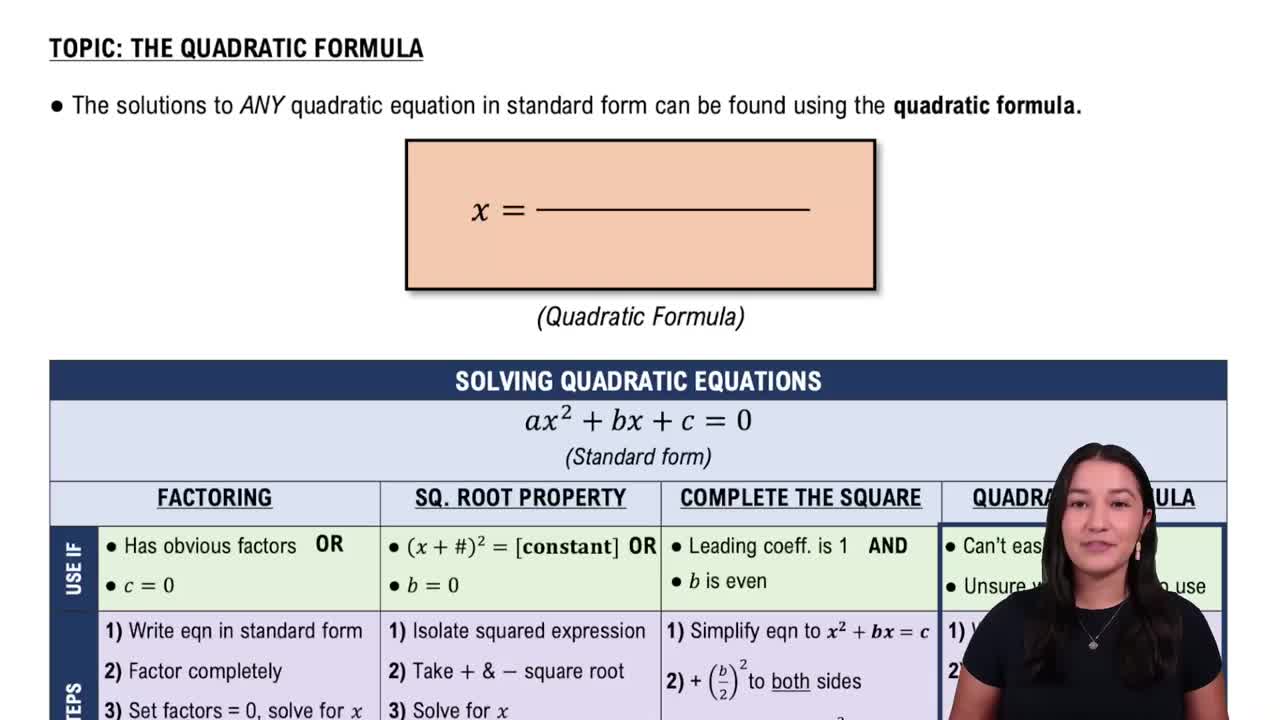
The quadratic formula x = (-b ± √(b² - 4ac)) / (2a) provides the solutions to any quadratic equation. It is especially useful when factoring is difficult or impossible, and it accounts for all types of roots based on the discriminant.
Recommended video:
06:36
Solving Quadratic Equations Using The Quadratic Formula