In Exercises 91–100, find all values of x satisfying the given conditions. y = |2 - 3x| and y = 13
Ch. 1 - Equations and Inequalities

Chapter 2, Problem 91a
Solve each equation in Exercises 83–108 by the method of your choice. (2x + 3)(x + 4) = 1
Verified step by step guidance1
Expand the left-hand side of the equation by using the distributive property: \((2x + 3)(x + 4)\). Multiply each term in \(2x + 3\) by each term in \(x + 4\). This will result in a quadratic expression.
Combine like terms from the expanded expression to simplify it into standard quadratic form: \(ax^2 + bx + c\).
Rewrite the equation so that all terms are on one side of the equation, setting it equal to zero. This will give you a standard quadratic equation: \(ax^2 + bx + c = 0\).
Choose a method to solve the quadratic equation. You can use factoring (if the quadratic is factorable), completing the square, or the quadratic formula: \(x = \frac{-b \pm \sqrt{b^2 - 4ac}}{2a}\).
Solve for \(x\) by applying the chosen method. If using the quadratic formula, substitute the values of \(a\), \(b\), and \(c\) into the formula and simplify to find the solutions for \(x\).

Verified video answer for a similar problem:
This video solution was recommended by our tutors as helpful for the problem above.
Video duration:
3mWas this helpful?
Key Concepts
Here are the essential concepts you must grasp in order to answer the question correctly.
Factoring
Factoring is the process of breaking down an expression into simpler components, or factors, that when multiplied together yield the original expression. In the context of the given equation, recognizing that the left side is a product of two binomials allows for easier manipulation and solving of the equation.
Recommended video:
Guided course
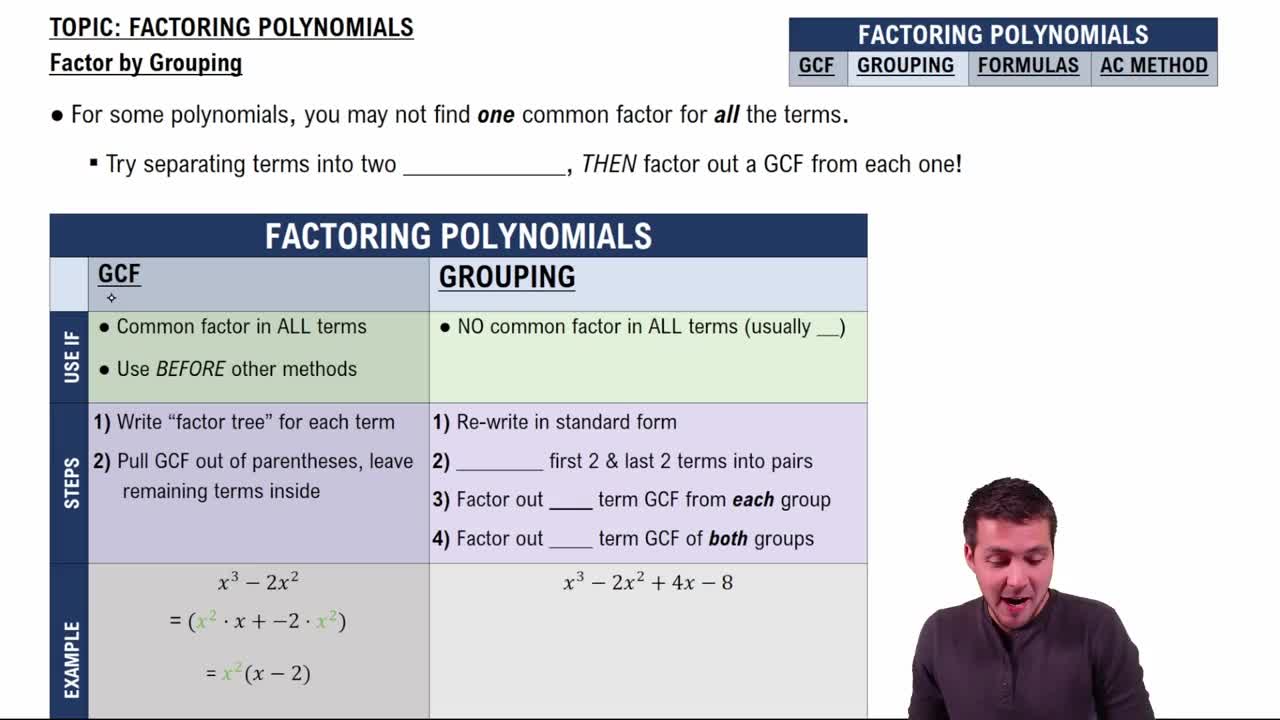
Factor by Grouping
Zero Product Property
The Zero Product Property states that if the product of two factors equals zero, then at least one of the factors must be zero. This principle is crucial when solving equations that have been factored, as it allows us to set each factor equal to zero to find the possible solutions for the variable.
Recommended video:
Product, Quotient, and Power Rules of Logs
Quadratic Equations
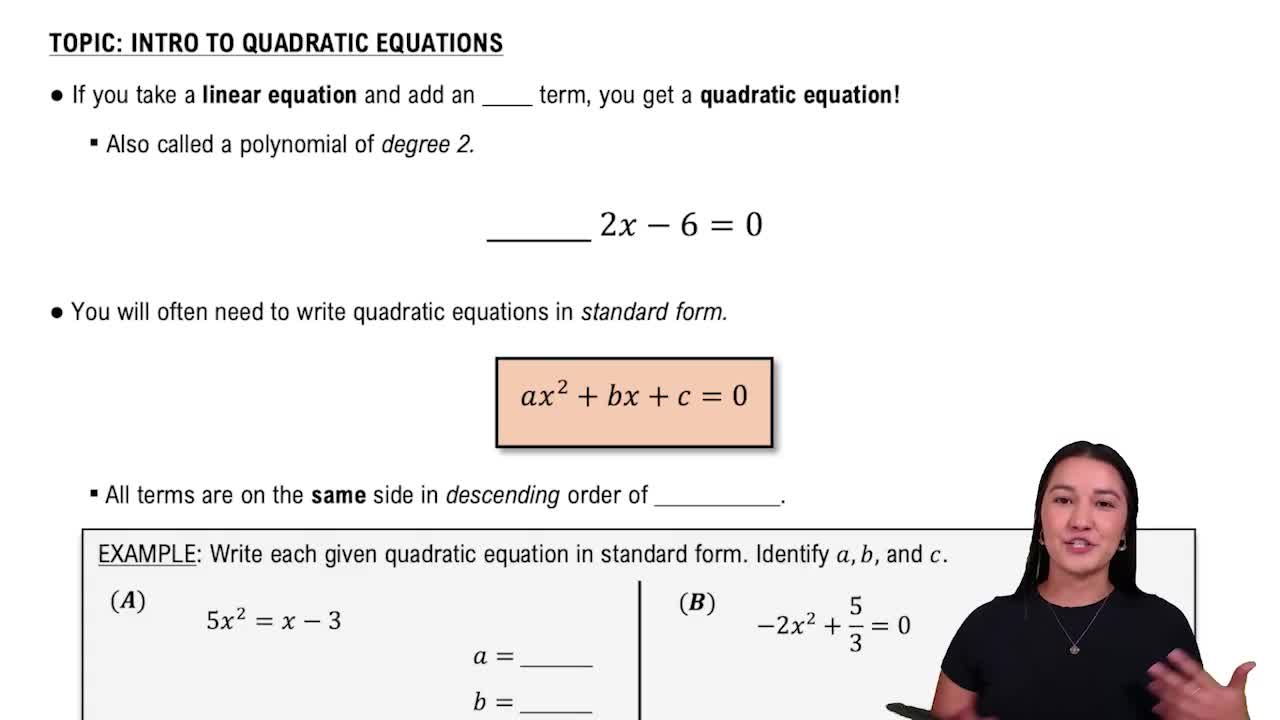
Quadratic equations are polynomial equations of the form ax² + bx + c = 0, where a, b, and c are constants. The equation in the problem can be expanded and rearranged into a quadratic form, enabling the use of various methods such as factoring, completing the square, or the quadratic formula to find the solutions for x.
Recommended video:
Introduction to Quadratic Equations
Related Practice
Textbook Question
1
views
Textbook Question
Solve each equation in Exercises 92–93 by making an appropriate substitution. x^4 - 5x^2 + 4 = 0
Textbook Question
In Exercises 59–94, solve each absolute value inequality.
5
views
Textbook Question
The equations in Exercises 79–90 combine the types of equations we have discussed in this section. Solve each equation. Then state whether the equation is an identity, a conditional equation, or an inconsistent equation. 4/(x2 + 3x - 10) - 1/(x2 + x - 6) = 3/(x2 - x - 12)
Textbook Question
Solve each equation in Exercises 83–108 by the method of your choice. (2x - 5)(x + 1) = 2
Textbook Question
In Exercises 85–90, find the x-intercepts of the graph of each equation. Then use the x-intercepts to match the equation with its graph. [The graphs are labeled (a) through (f).] y = 2(x + 2)^2 + 5(x + 2) - 3
2
views