Simplify and write the result in standard form. √-108
Ch. 1 - Equations and Inequalities

Chapter 2, Problem 32
Solve each equation in Exercises 15–34 by the square root property. (8x - 3)2 = 5
Verified step by step guidance1
Step 1: Start by isolating the squared term. The equation is already in the form \((8x - 3)^2 = 5\), so no further rearrangement is needed.
Step 2: Apply the square root property. The square root property states that if \(a^2 = b\), then \(a = \pm \sqrt{b}\). Using this property, take the square root of both sides: \(8x - 3 = \pm \sqrt{5}\).
Step 3: Solve for \(8x\) by adding 3 to both sides of the equation: \(8x = 3 \pm \sqrt{5}\).
Step 4: Isolate \(x\) by dividing both sides of the equation by 8: \(x = \frac{3 \pm \sqrt{5}}{8}\).
Step 5: The solution can be expressed as two values: \(x = \frac{3 + \sqrt{5}}{8}\) and \(x = \frac{3 - \sqrt{5}}{8}\). These are the two solutions to the equation.

Verified video answer for a similar problem:
This video solution was recommended by our tutors as helpful for the problem above.
Video duration:
3mWas this helpful?
Key Concepts
Here are the essential concepts you must grasp in order to answer the question correctly.
Square Root Property
The square root property states that if a quadratic equation is in the form (x - a)² = b, then the solutions can be found by taking the square root of both sides. This results in two possible equations: x - a = √b and x - a = -√b. This property is essential for solving equations that can be expressed as perfect squares.
Recommended video:
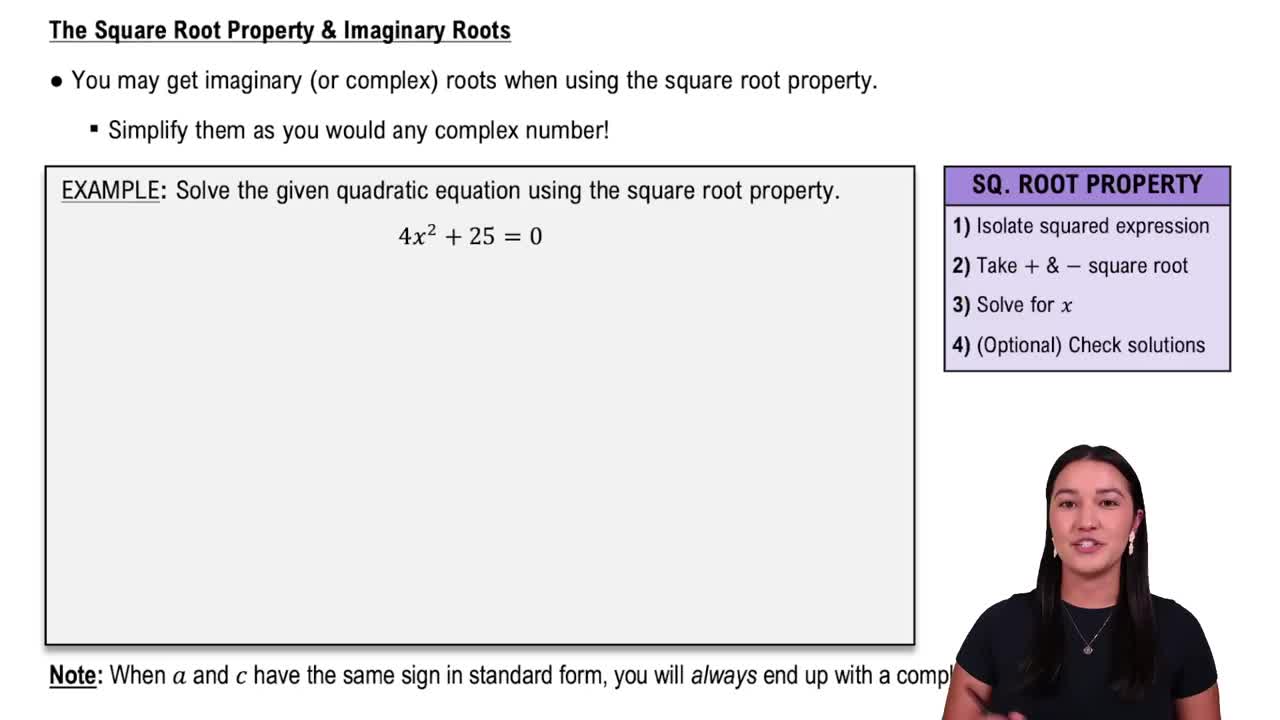
Imaginary Roots with the Square Root Property
Isolating the Variable
Isolating the variable involves rearranging an equation to get the variable on one side and the constants on the other. In the context of the square root property, this means ensuring that the squared term is alone on one side of the equation before applying the square root. This step is crucial for correctly applying the square root property.
Recommended video:
Guided course
Equations with Two Variables
Quadratic Equations
Quadratic equations are polynomial equations of the form ax² + bx + c = 0, where a, b, and c are constants and a ≠ 0. They can be solved using various methods, including factoring, completing the square, and using the quadratic formula. Understanding the structure of quadratic equations is vital for applying the square root property effectively.
Recommended video:
Introduction to Quadratic Equations
Related Practice
Textbook Question
Textbook Question
In all exercises, other than exercises with no solution, use interval notation to express solution sets and graph each solution set on a number line. In Exercises 27–50, solve each linear inequality. 8x - 11 ≤ 3x - 13
3
views
Textbook Question
Exercises 27–40 contain linear equations with constants in denominators. Solve each equation. 3x/5 = 2x/3 + 1
Textbook Question
A repair bill on a sailboat came to \$2356, including \$826 for parts and the remainder for labor. If the cost of labor is \$90 per hour, how many hours of labor did it take to repair the sailboat?
1
views
Textbook Question
In Exercises 29–36, simplify and write the result in standard form. √(32 - 4 × 2 × 5)
Textbook Question
Solve each equation with rational exponents in Exercises 31–40. Check all proposed solutions. (x - 4)3/2 = 27