Ch. 1 - Equations and Inequalities
Blitzer - College Algebra 8th Edition
Blitzer8th EditionCollege AlgebraISBN: 9780136970514Not the one you use?Change textbook
Chapter 2, Problem 101a

Solve each equation. 5 - 12x = 8 - 7x - [6 ÷ 3(2 + 53) + 5x]

Verified step by step guidance
1
Simplify the expression inside the brackets first. Start with the exponentiation: \(5^3 = 125\).
Next, simplify the parentheses: \(2 + 125 = 127\). Then, divide: \(6 \div 3 = 2\). Multiply: \(2 \times 127 = 254\). The expression inside the brackets becomes \(254 + 5x\).
Substitute the simplified expression back into the equation: \(5 - 12x = 8 - 7x - (254 + 5x)\). Distribute the negative sign across the terms inside the brackets: \(5 - 12x = 8 - 7x - 254 - 5x\).
Combine like terms on the right-hand side: \(8 - 254 = -246\) and \(-7x - 5x = -12x\). The equation becomes \(5 - 12x = -246 - 12x\).
Eliminate \(-12x\) from both sides by adding \(12x\) to both sides: \(5 = -246\). This simplifies to a contradiction, indicating no solution exists for this equation.

Verified video answer for a similar problem:

This video solution was recommended by our tutors as helpful for the problem above.
Video duration:
2m
Was this helpful?

Key Concepts

Here are the essential concepts you must grasp in order to answer the question correctly.

Solving Linear Equations

Solving linear equations involves isolating the variable on one side of the equation to find its value. This typically requires combining like terms, applying inverse operations, and maintaining the equality of both sides. Understanding how to manipulate equations is crucial for finding the solution.
Recommended video:
04:02
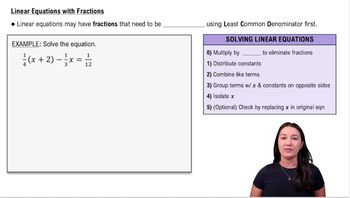
Solving Linear Equations with Fractions

Order of Operations

The order of operations is a set of rules that dictates the sequence in which mathematical operations should be performed to ensure consistent results. The acronym PEMDAS (Parentheses, Exponents, Multiplication and Division, Addition and Subtraction) helps remember this order. Properly applying these rules is essential when simplifying expressions within equations.
Recommended video:
Guided course
8:38
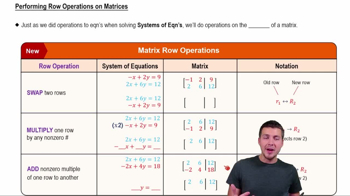
Performing Row Operations on Matrices

Distributive Property

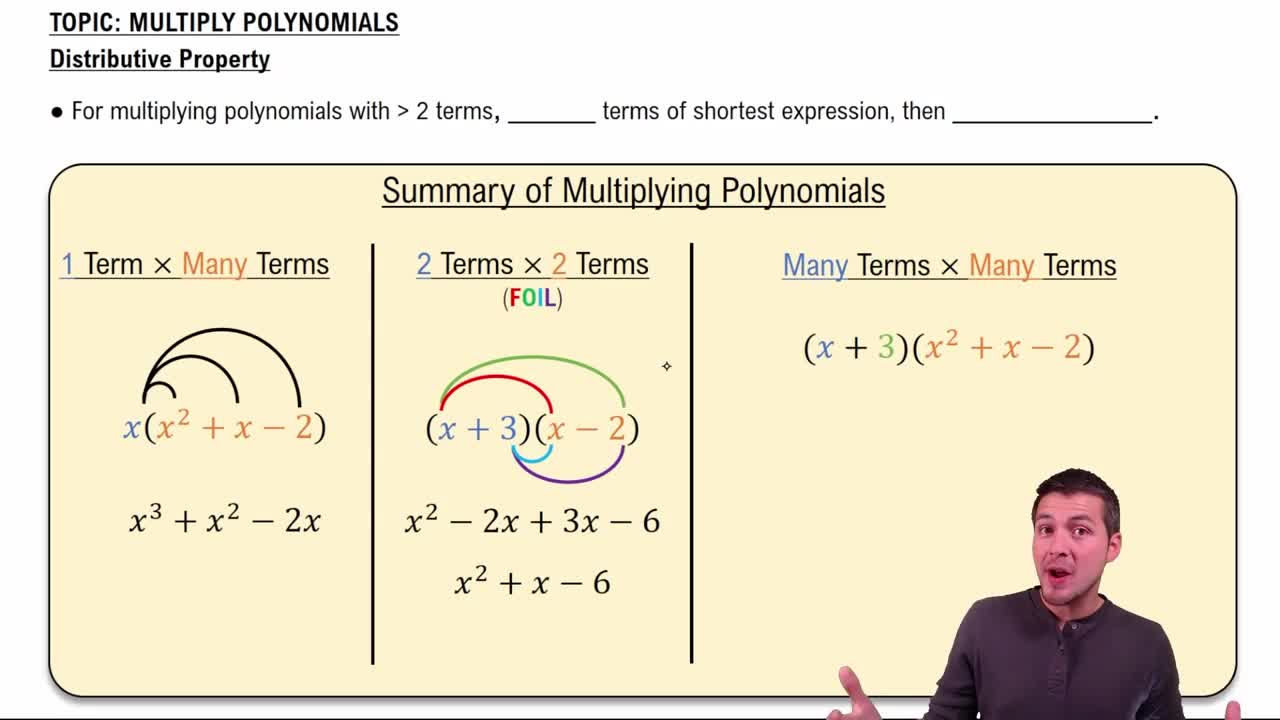
The distributive property states that a(b + c) = ab + ac, allowing for the multiplication of a single term across terms within parentheses. This property is vital for simplifying expressions and solving equations, especially when dealing with terms that involve variables and constants. Mastery of this concept aids in breaking down complex equations into manageable parts.
Recommended video:
Guided course
04:15
Multiply Polynomials Using the Distributive Property