Ch. 1 - Equations and Inequalities
Blitzer - College Algebra 8th Edition
Blitzer8th EditionCollege AlgebraISBN: 9780136970514Not the one you use?Change textbook
Chapter 2, Problem 95

In Exercises 95–99, perform the indicated operations and write the result in standard form. 4/(2 + i)(3 - i)

Verified step by step guidance
1
Rewrite the given expression: \( \frac{4}{(2 + i)(3 - i)} \). The goal is to simplify this expression and write it in standard form \( a + bi \), where \( a \) and \( b \) are real numbers.
First, simplify the denominator by multiplying \( (2 + i) \) and \( (3 - i) \) using the distributive property (FOIL method): \( (2 + i)(3 - i) = 2 \cdot 3 + 2 \cdot (-i) + i \cdot 3 + i \cdot (-i) \).
Combine like terms in the denominator: \( 6 - 2i + 3i - i^2 \). Recall that \( i^2 = -1 \), so substitute \( -1 \) for \( i^2 \) and simplify further.
Now, simplify the numerator and denominator of the fraction. The numerator remains \( 4 \), and the denominator is the simplified result from the previous step. Write the fraction as \( \frac{4}{\text{simplified denominator}} \).
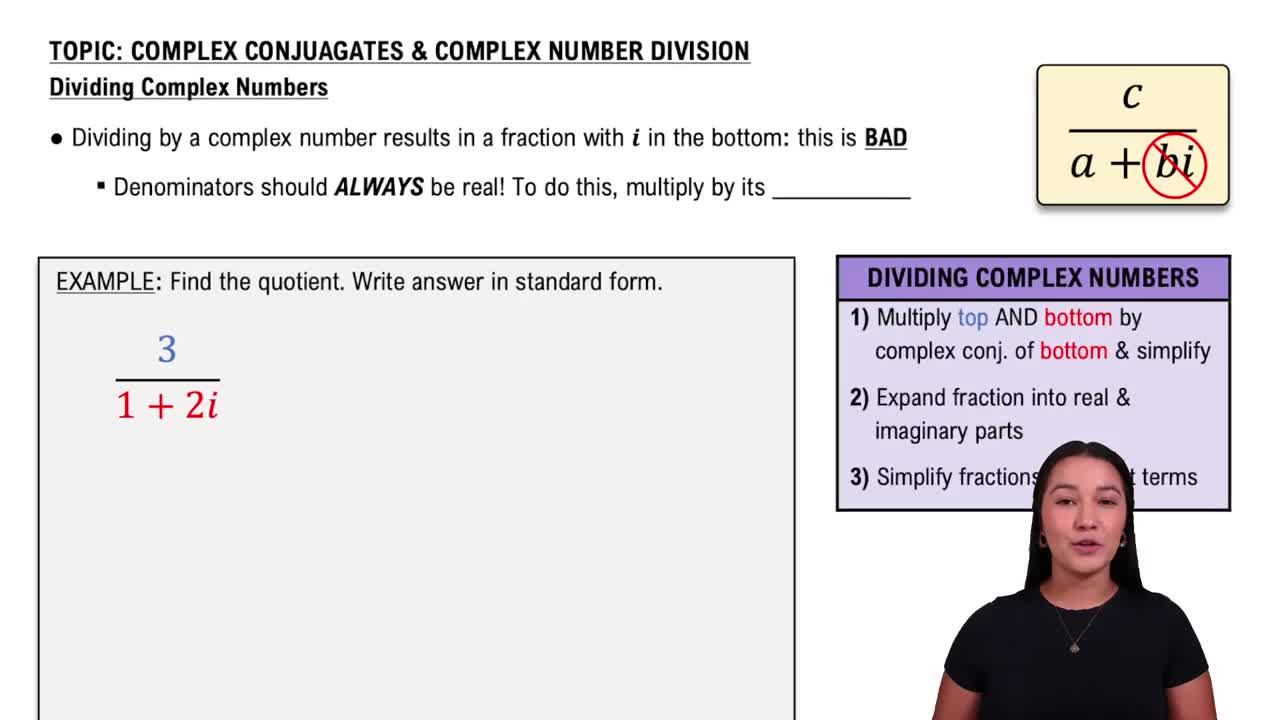
To eliminate the imaginary part in the denominator, multiply both the numerator and denominator by the conjugate of the denominator. The conjugate of \( a + bi \) is \( a - bi \). Simplify the resulting expression and write it in standard form \( a + bi \).

Verified video answer for a similar problem:

This video solution was recommended by our tutors as helpful for the problem above.
Video duration:
6m
Was this helpful?

Key Concepts

Here are the essential concepts you must grasp in order to answer the question correctly.

Complex Numbers

Complex numbers are numbers that have a real part and an imaginary part, expressed in the form a + bi, where a is the real part, b is the imaginary part, and i is the imaginary unit defined as the square root of -1. Understanding complex numbers is essential for performing operations involving them, such as addition, subtraction, multiplication, and division.
Recommended video:
04:22
Dividing Complex Numbers

Multiplication of Complex Numbers

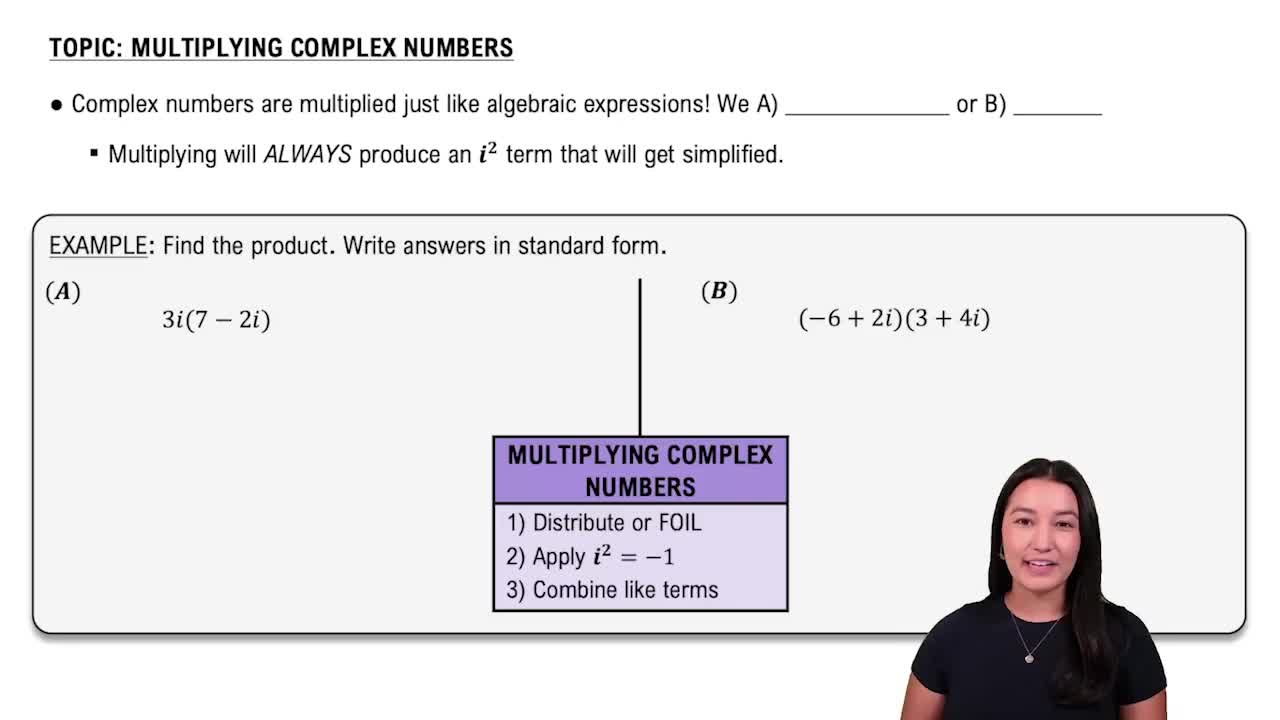
When multiplying complex numbers, the distributive property is applied, treating i as a variable. For example, to multiply (a + bi) and (c + di), you expand the expression to ac + adi + bci + bdi². Since i² = -1, this simplifies to (ac - bd) + (ad + bc)i, which is crucial for simplifying expressions in the given problem.
Recommended video:
05:02
Multiplying Complex Numbers

Standard Form of Complex Numbers

The standard form of a complex number is a + bi, where a and b are real numbers. To express a complex number in standard form, any operations performed must yield a real part and an imaginary part. In the context of the problem, after performing the indicated operations, it is necessary to simplify the result to ensure it is presented in this standard format.
Recommended video:
05:02
Multiplying Complex Numbers