Ch. 1 - Equations and Inequalities
Blitzer - College Algebra 8th Edition
Blitzer8th EditionCollege AlgebraISBN: 9780136970514Not the one you use?Change textbook
Chapter 2, Problem 98

In Exercises 91–100, find all values of x satisfying the given conditions. y=(x5)32andy=125y = (x - 5)^{\(\frac{3}{2}\)} \(\quad\) \(\text{and}\) \(\quad\) y = 125

Verified step by step guidance
1
Start with the given equations: \(y = (x - 5)^{3/2}\) and \(y = 125\). Since both expressions equal \(y\), set them equal to each other: \((x - 5)^{3/2} = 125\).
To isolate \(x - 5\), raise both sides of the equation to the power that is the reciprocal of \(\frac{3}{2}\), which is \(\frac{2}{3}\). This gives: \(\left((x - 5)^{3/2}\right)^{2/3} = 125^{2/3}\).
Simplify the left side using the property of exponents: \((a^{m})^{n} = a^{mn}\). So, \((x - 5)^{(3/2) \times (2/3)} = (x - 5)^1 = x - 5\).
Now, express \(125^{2/3}\) by first recognizing that \(125 = 5^3\). Then, \(125^{2/3} = (5^3)^{2/3} = 5^{3 \times \frac{2}{3}} = 5^2\).
Finally, solve for \(x\) by adding 5 to both sides: \(x = 5 + 5^2\). This will give the value(s) of \(x\) that satisfy the original equation.

Verified video answer for a similar problem:

This video solution was recommended by our tutors as helpful for the problem above.
Video duration:
3m
Was this helpful?

Key Concepts

Here are the essential concepts you must grasp in order to answer the question correctly.

Solving Equations Involving Radicals and Rational Exponents

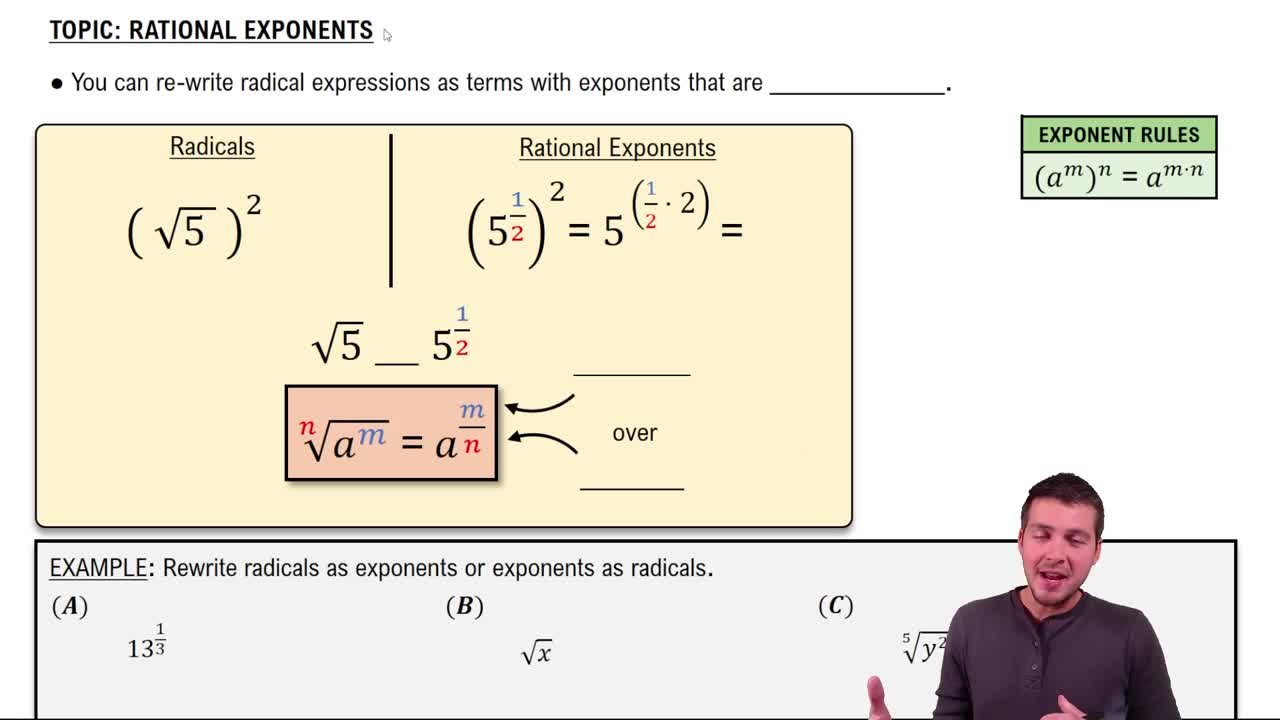
This concept involves understanding how to manipulate and solve equations where variables are raised to fractional powers, such as (x - 5)^(3/2). It requires rewriting the expression in radical form or using exponent rules to isolate the variable and solve for x.
Recommended video:
Guided course
04:06
Rational Exponents

Properties of Exponents

Understanding the properties of exponents, especially rational exponents, is essential. For example, a fractional exponent like 3/2 means taking the square root (denominator) and then cubing the result (numerator). This helps in rewriting and simplifying expressions to solve equations.
Recommended video:
Guided course
04:06
Rational Exponents

Checking for Extraneous Solutions

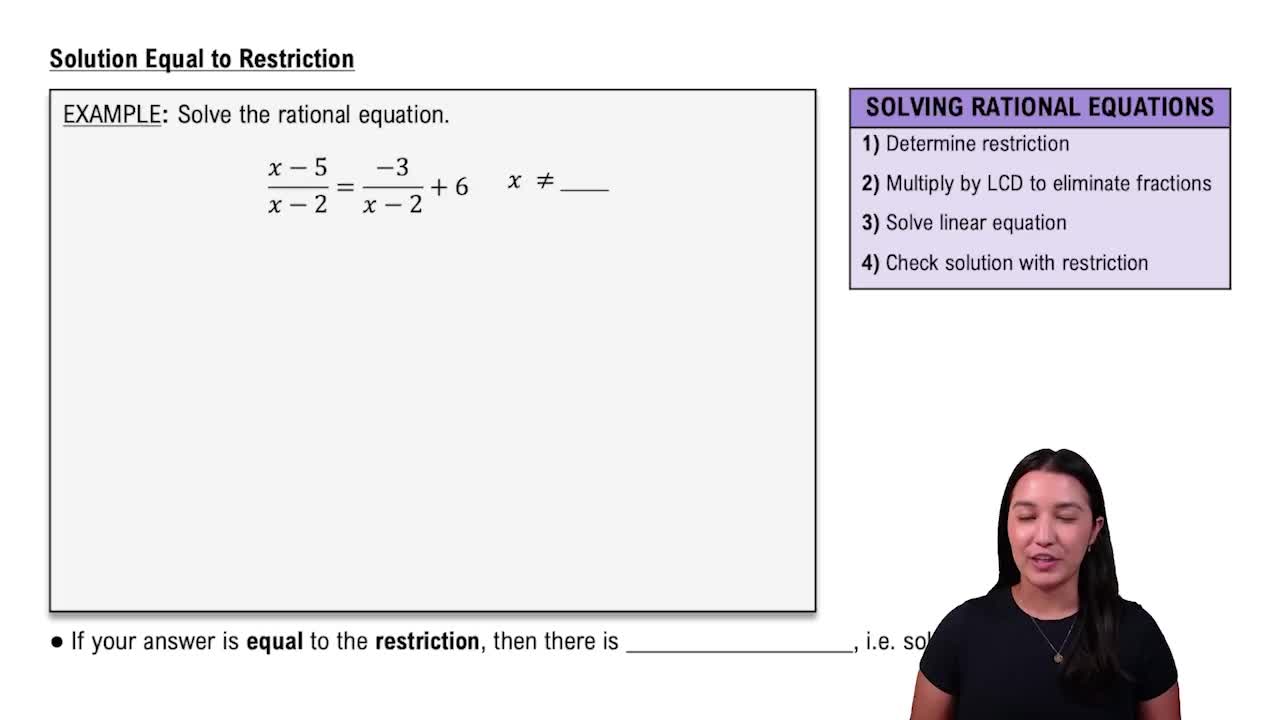
When solving equations involving even roots or rational exponents, some solutions may not satisfy the original equation due to domain restrictions. It is important to substitute solutions back into the original equation to verify their validity.
Recommended video:
05:21
Restrictions on Rational Equations