In Exercises 59–94, solve each absolute value inequality. |(2x + 2)/4| ≥ 2
Ch. 1 - Equations and Inequalities

Chapter 2, Problem 75
In Exercises 75–82, compute the discriminant. Then determine the number and type of solutions for the given equation.
Verified step by step guidance1
Identify the coefficients in the quadratic equation \(x^2 - 4x - 5 = 0\). Here, \(a = 1\), \(b = -4\), and \(c = -5\).
Recall the formula for the discriminant: \(\Delta = b^2 - 4ac\).
Substitute the values of \(a\), \(b\), and \(c\) into the discriminant formula: \(\Delta = (-4)^2 - 4(1)(-5)\).
Simplify the expression to find the discriminant value (do not calculate the final number here).
Use the discriminant to determine the number and type of solutions: if \(\Delta > 0\), there are two distinct real solutions; if \(\Delta = 0\), there is one real solution; if \(\Delta < 0\), there are two complex solutions.

Verified video answer for a similar problem:
This video solution was recommended by our tutors as helpful for the problem above.
Video duration:
2mWas this helpful?
Key Concepts
Here are the essential concepts you must grasp in order to answer the question correctly.
Quadratic Equation
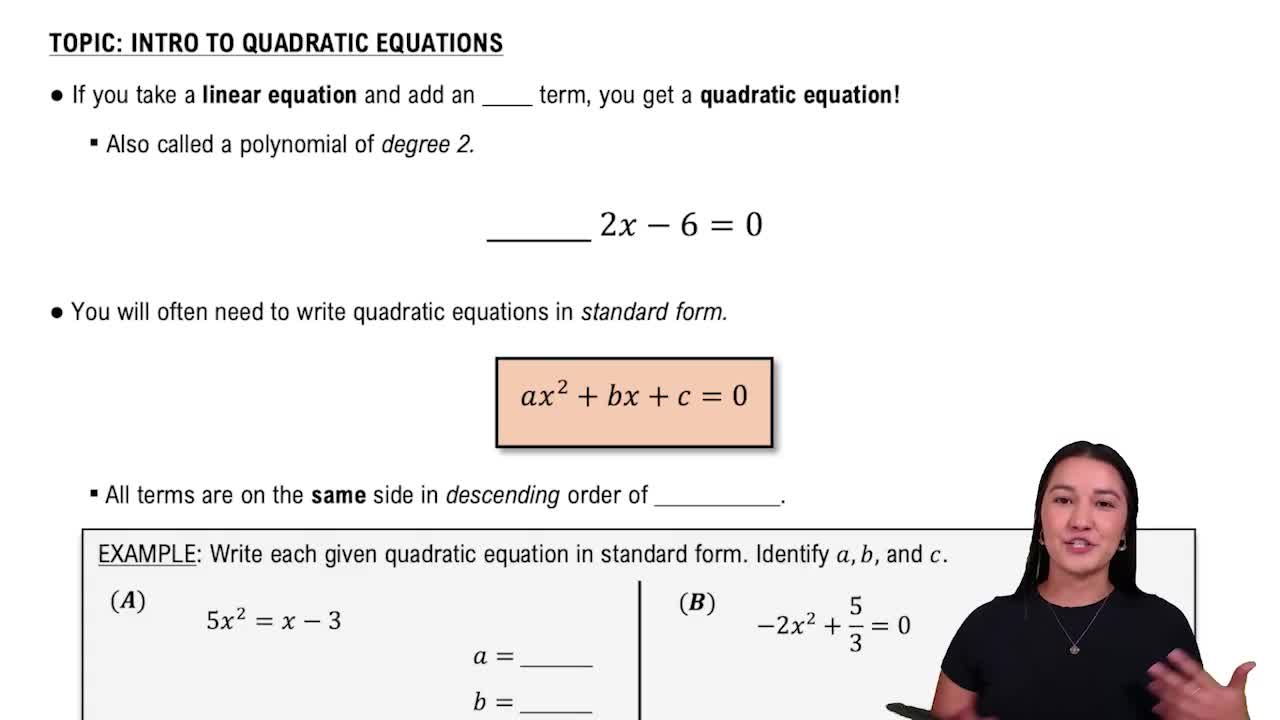
A quadratic equation is a second-degree polynomial equation in the form ax² + bx + c = 0, where a, b, and c are constants and a ≠ 0. It represents a parabola when graphed and can have zero, one, or two real solutions depending on its coefficients.
Recommended video:
Introduction to Quadratic Equations
Discriminant
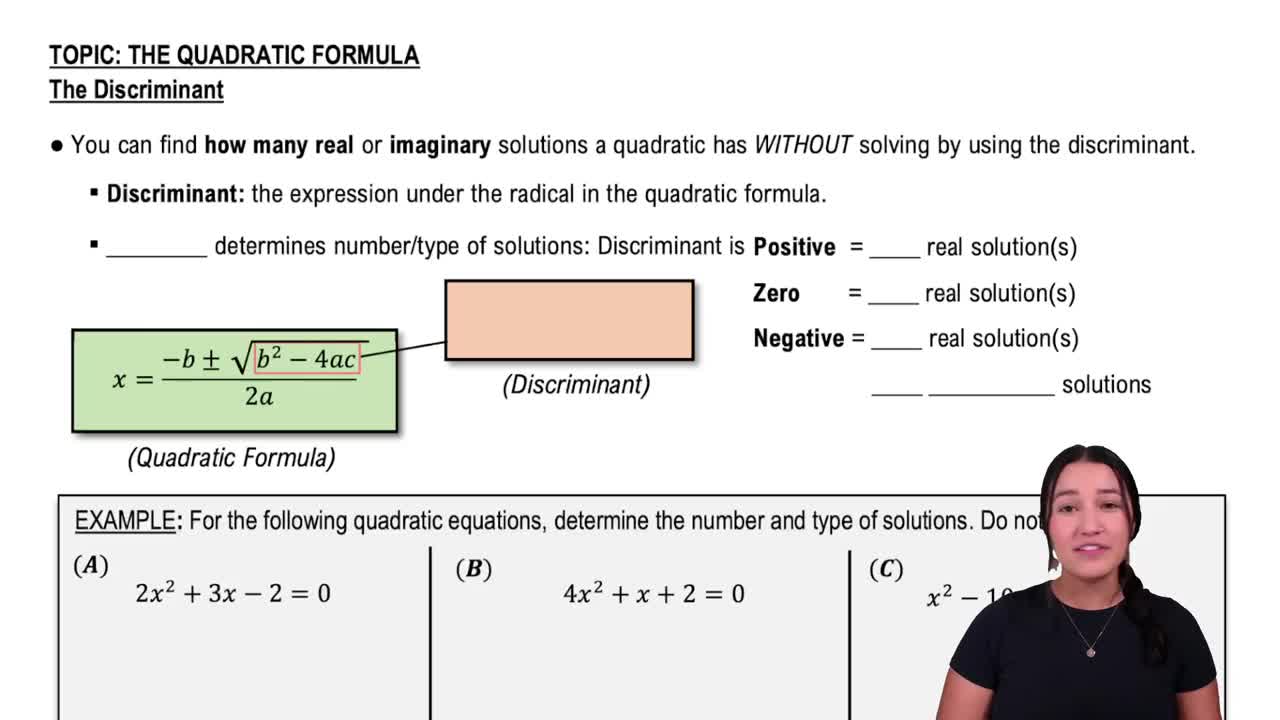
The discriminant is the part of the quadratic formula under the square root, given by b² - 4ac. It determines the nature and number of solutions of a quadratic equation: if positive, two distinct real solutions; if zero, one real repeated solution; if negative, two complex solutions.
Recommended video:
The Discriminant
Types of Solutions of Quadratic Equations
The solutions of a quadratic equation can be real or complex. Real solutions occur when the discriminant is zero or positive, indicating where the parabola intersects the x-axis. Complex solutions arise when the discriminant is negative, meaning the parabola does not cross the x-axis.
Recommended video:
Introduction to Quadratic Equations
Related Practice
Textbook Question
Textbook Question
Determine whether each statement is true or false. If the statement is false, make the necessary change(s) to produce a true statement. The ordered pair (2, 5) satisfies 3y - 2x = - 4.
Textbook Question
In Exercises 61–76, solve each absolute value equation or indicate that the equation has no solution. |2x - 1| + 3 = 3
1
views
Textbook Question
Solve each equation by the method of your choice.
Textbook Question
In Exercises 71–78, solve each equation. Then determine whether the equation is an identity, a conditional equation, or an inconsistent equation. 4(x + 5) = 21 + 4x
1
views
Textbook Question
In Exercises 71–78, solve each equation. Then determine whether the equation is an identity, a conditional equation, or an inconsistent equation. 10x + 3 = 8x + 3
5
views