In Exercises 71–78, solve each equation. Then determine whether the equation is an identity, a conditional equation, or an inconsistent equation. 5x + 9 = 9(x + 1) - 4x
Ch. 1 - Equations and Inequalities

Chapter 2, Problem 72
Without solving the given quadratic equation, determine the number and type of solutions.
Verified step by step guidance1
Rewrite the given quadratic equation in standard form \(ax^2 + bx + c = 0\). Start by moving all terms to one side: \(9x^2 + 3x - 2 = 0\).
Identify the coefficients: \(a = 9\), \(b = 3\), and \(c = -2\).
Calculate the discriminant using the formula \(\Delta = b^2 - 4ac\).
Substitute the values into the discriminant formula: \(\Delta = (3)^2 - 4(9)(-2)\).
Analyze the discriminant value: if \(\Delta > 0\), there are two distinct real solutions; if \(\Delta = 0\), there is one real repeated solution; if \(\Delta < 0\), there are two complex solutions.

Verified video answer for a similar problem:
This video solution was recommended by our tutors as helpful for the problem above.
Video duration:
3mWas this helpful?
Key Concepts
Here are the essential concepts you must grasp in order to answer the question correctly.
Standard Form of a Quadratic Equation
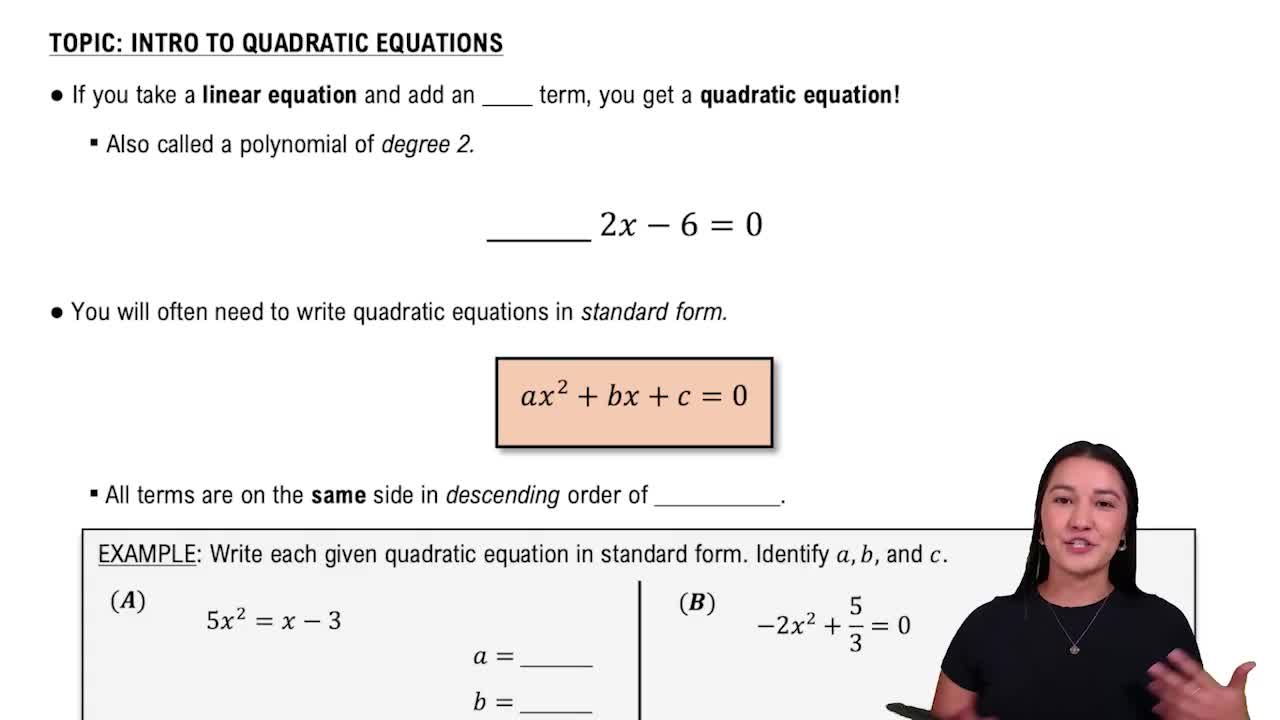
A quadratic equation is typically written in the form ax² + bx + c = 0, where a, b, and c are constants. Converting the given equation into this form is essential for analyzing its properties, such as the number and type of solutions.
Recommended video:
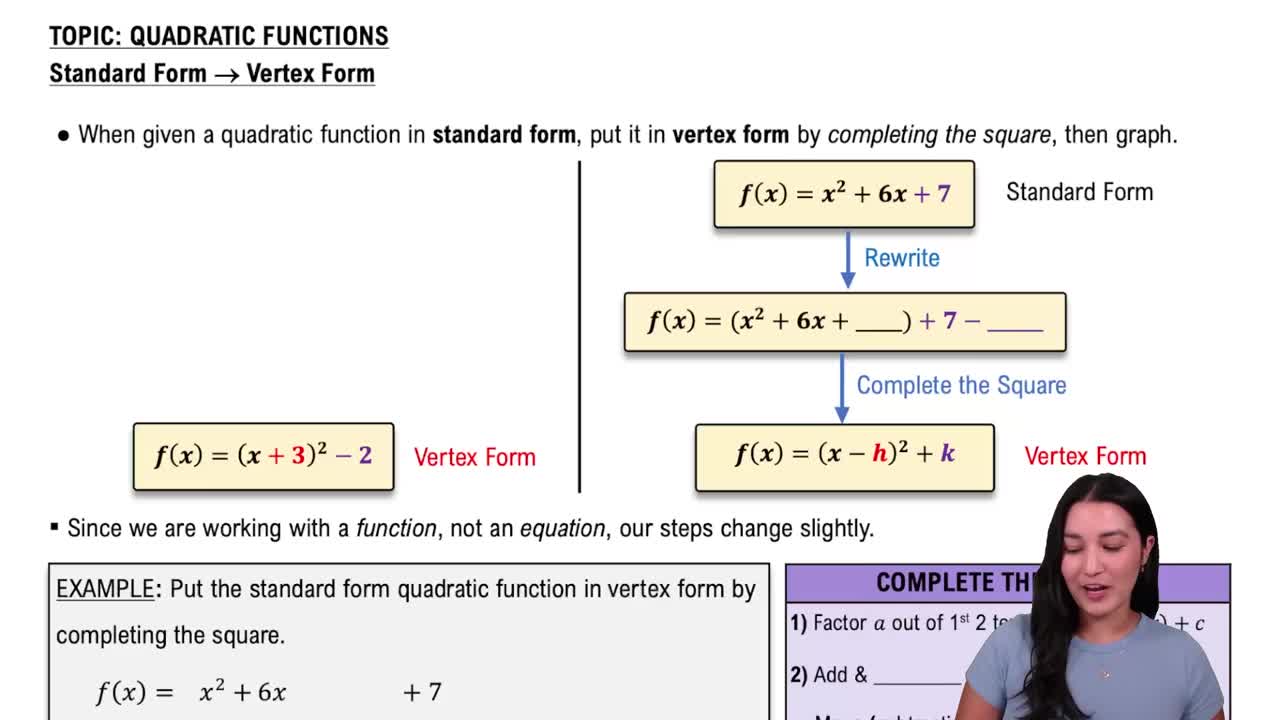
Converting Standard Form to Vertex Form
Discriminant of a Quadratic Equation
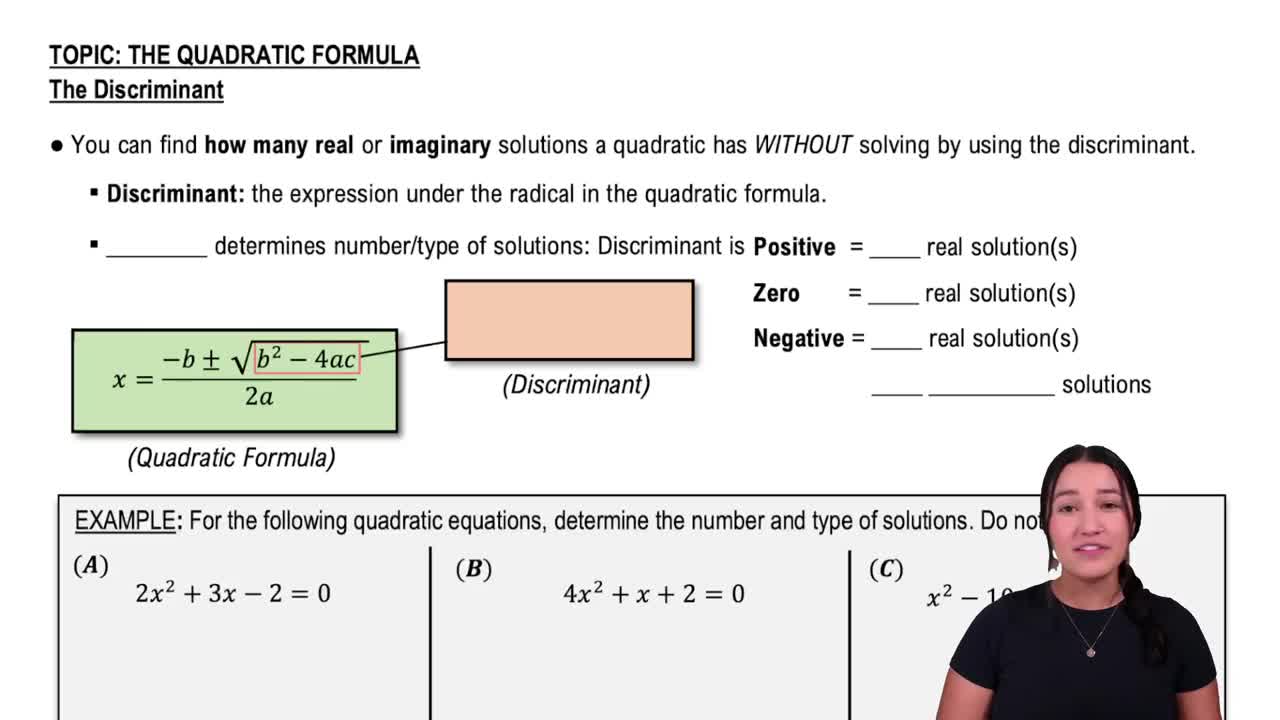
The discriminant, given by Δ = b² - 4ac, determines the nature of the roots of a quadratic equation. If Δ > 0, there are two distinct real solutions; if Δ = 0, there is one real repeated solution; and if Δ < 0, there are two complex conjugate solutions.
Recommended video:
The Discriminant
Types of Solutions for Quadratic Equations
Quadratic equations can have real or complex solutions. Real solutions occur when the graph of the quadratic intersects the x-axis, while complex solutions occur when it does not. Understanding this helps in interpreting the discriminant without solving the equation.
Recommended video:
Introduction to Quadratic Equations
Related Practice
Textbook Question
Textbook Question
In Exercises 61–76, solve each absolute value equation or indicate that the equation has no solution. |x + 1| + 5 = 3
1
views
Textbook Question
In Exercises 71–78, solve each equation. Then determine whether the equation is an identity, a conditional equation, or an inconsistent equation. 4x + 7 = 7(x + 1) - 3x
Textbook Question
In Exercises 61–76, solve each absolute value equation or indicate that the equation has no solution. 2|4 - (5/2)x| + 6 = 18
1
views
Textbook Question
In Exercises 59–94, solve each absolute value inequality. |x - 1| ≥ 2
Textbook Question
Exercises 73–75 will help you prepare for the material covered in the next section. Multiply: (7 - 3x)(- 2 - 5x)