Ch. 1 - Equations and Inequalities
Blitzer - College Algebra 8th Edition
Blitzer8th EditionCollege AlgebraISBN: 9780136970514Not the one you use?Change textbook
Chapter 2, Problem 70a

Find all values of x such that y = 0. y = 1/(5x + 5) - 3/(x + 1) + 7/5

Verified step by step guidance
1
Rewrite the equation y = 0 as 1/(5x + 5) - 3/(x + 1) + 7/5 = 0. The goal is to solve for x.
Identify the least common denominator (LCD) of the fractions. The denominators are (5x + 5), (x + 1), and 5. Factorize (5x + 5) as 5(x + 1), so the LCD is 5(x + 1).
Multiply through the entire equation by the LCD, 5(x + 1), to eliminate the fractions. This gives: 5(x + 1) * [1/(5x + 5)] - 5(x + 1) * [3/(x + 1)] + 5(x + 1) * [7/5] = 0.
Simplify each term after multiplying by the LCD. For the first term, the (5x + 5) cancels, leaving 1/(5x + 5) * 5(x + 1) = (x + 1). For the second term, the (x + 1) cancels, leaving -3. For the third term, the 5 cancels, leaving 7(x + 1). Combine these to form a simplified equation: (x + 1) - 3 + 7(x + 1) = 0.
Combine like terms in the simplified equation. Expand and simplify to form a linear equation in terms of x. Solve for x by isolating it on one side of the equation.

Verified video answer for a similar problem:

This video solution was recommended by our tutors as helpful for the problem above.
Video duration:
5m
Was this helpful?

Key Concepts

Here are the essential concepts you must grasp in order to answer the question correctly.

Rational Functions

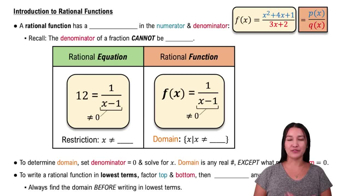
A rational function is a function that can be expressed as the ratio of two polynomials. In this case, the function involves terms like 1/(5x + 5) and -3/(x + 1), which are rational expressions. Understanding how to manipulate and simplify these expressions is crucial for solving equations involving them.
Recommended video:
6:04
Intro to Rational Functions

Finding Roots of an Equation

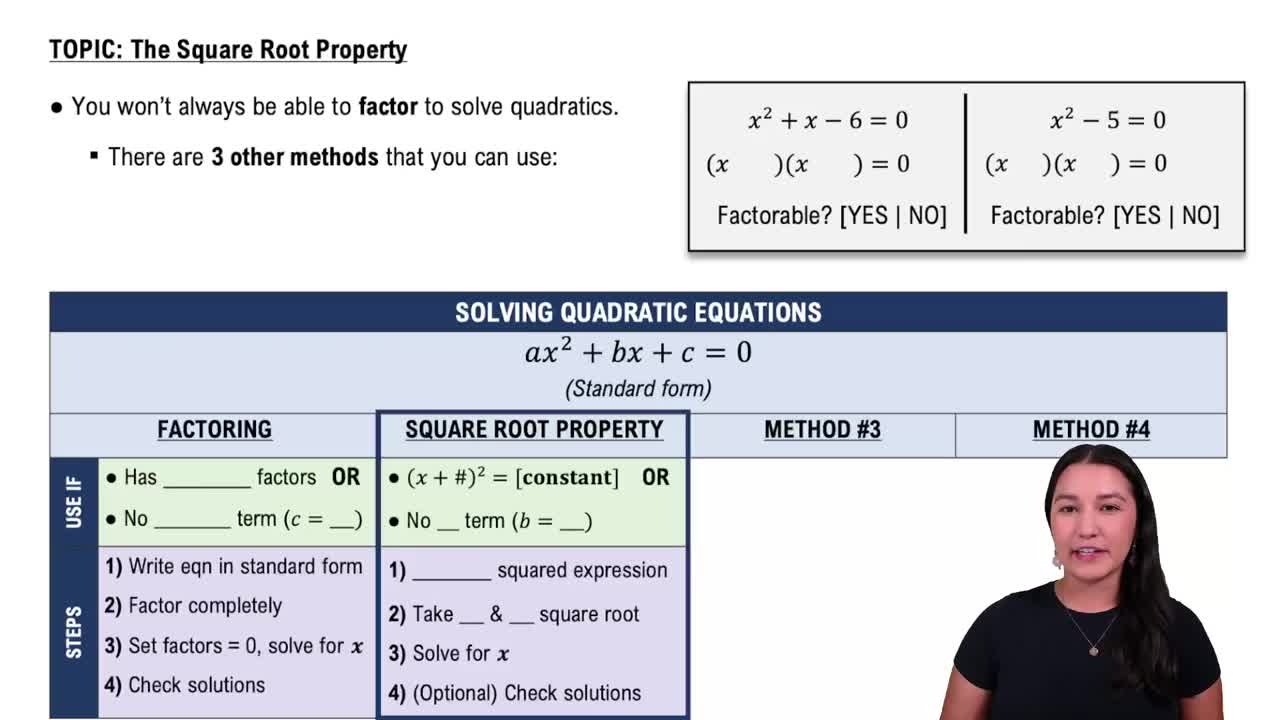
Finding the values of x such that y = 0 involves solving the equation for its roots. This means determining the x-values where the function intersects the x-axis. This process often requires setting the entire expression equal to zero and solving for x, which may involve combining like terms and factoring.
Recommended video:
06:12
Solving Quadratic Equations by the Square Root Property

Domain Restrictions

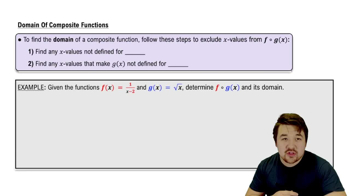
When dealing with rational functions, it is important to consider the domain, which includes all possible x-values for which the function is defined. In this case, values that make the denominators zero (like x = -1 and x = -1) must be excluded from the solution set, as they lead to undefined expressions.
Recommended video:
3:51
Domain Restrictions of Composed Functions