Ch. 1 - Equations and Inequalities
Blitzer - College Algebra 8th Edition
Blitzer8th EditionCollege AlgebraISBN: 9780136970514Not the one you use?Change textbook
Chapter 2, Problem 66

Perform the indicated operation(s) and write the result in standard form. (8 + 9i)(2 - i) - (1 - i)(1 + i)

Verified step by step guidance
1
First, apply the distributive property (FOIL method) to multiply the complex numbers in the first product: \((8 + 9i)(2 - i)\). Multiply each term in the first binomial by each term in the second binomial.
Next, multiply the complex numbers in the second product: \((1 - i)(1 + i)\). Recognize this as a difference of squares pattern, since \((a - b)(a + b) = a^2 - b^2\).
After expanding both products, combine like terms in each product separately. Remember that \(i^2 = -1\), so replace any \(i^2\) terms accordingly.
Subtract the result of the second product from the result of the first product by combining the real parts and the imaginary parts separately.
Finally, write the resulting expression in standard form \(a + bi\), where \(a\) is the real part and \(b\) is the coefficient of the imaginary part.

Verified video answer for a similar problem:

This video solution was recommended by our tutors as helpful for the problem above.
Video duration:
4m
Was this helpful?

Key Concepts

Here are the essential concepts you must grasp in order to answer the question correctly.

Complex Number Multiplication

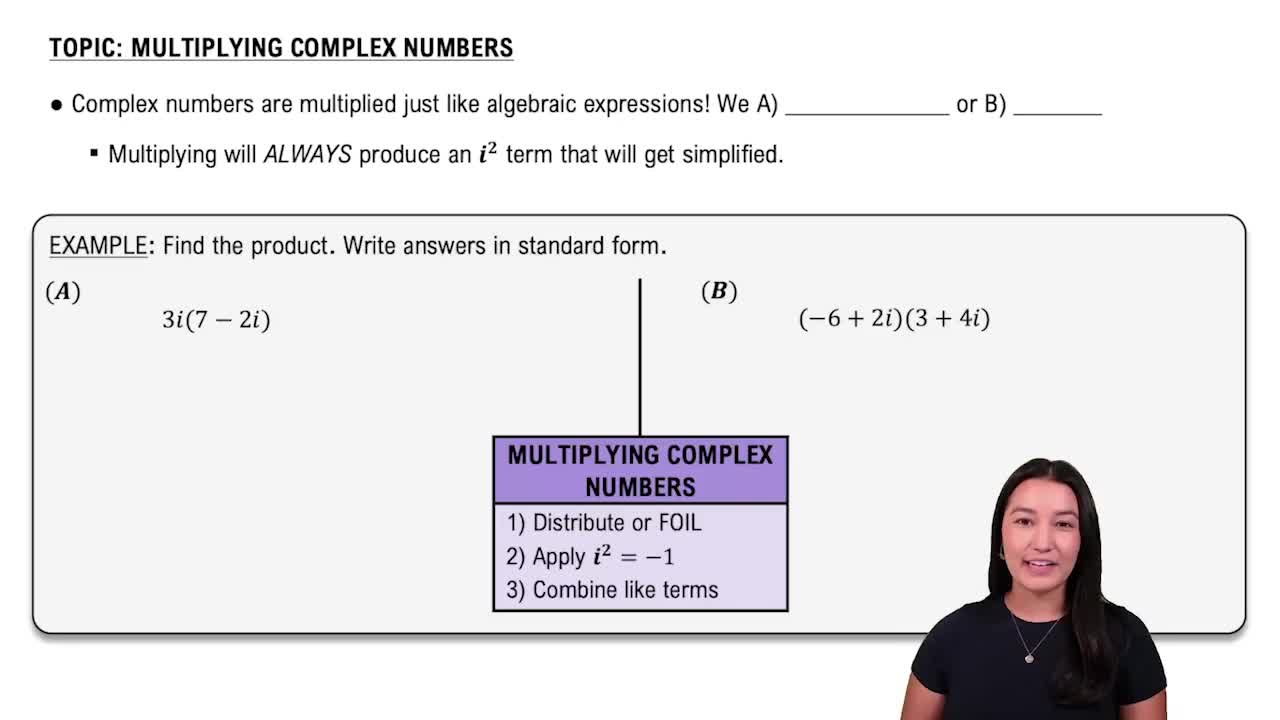
Multiplying complex numbers involves using the distributive property (FOIL) and applying the rule i² = -1. Each term in the first complex number is multiplied by each term in the second, then like terms are combined to simplify the expression.
Recommended video:
05:02
Multiplying Complex Numbers

Complex Number Subtraction

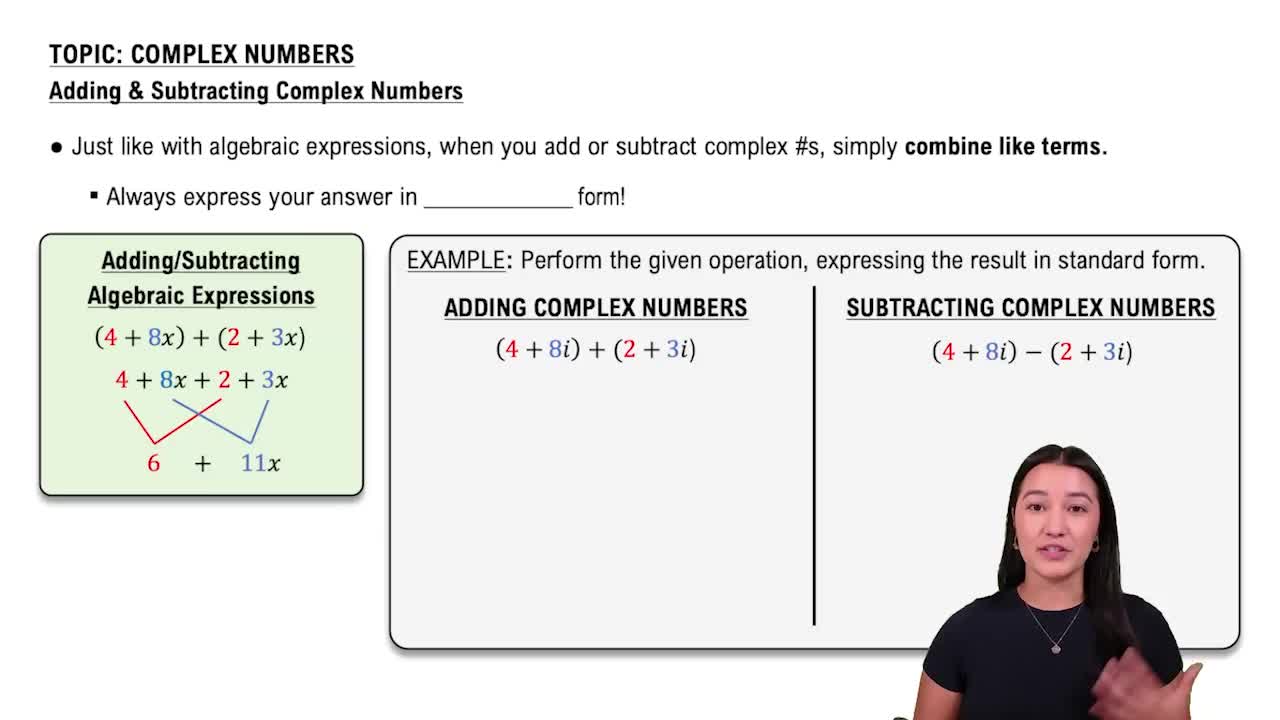
Subtracting complex numbers requires subtracting their real parts and their imaginary parts separately. This operation is straightforward once both complex numbers are expressed in standard form a + bi.
Recommended video:
03:18
Adding and Subtracting Complex Numbers

Standard Form of a Complex Number

The standard form of a complex number is a + bi, where a is the real part and b is the coefficient of the imaginary part i. Writing results in this form makes it easier to interpret and perform further operations.
Recommended video:
05:02
Multiplying Complex Numbers