Ch. 1 - Equations and Inequalities
Blitzer - College Algebra 8th Edition
Blitzer8th EditionCollege AlgebraISBN: 9780136970514Not the one you use?Change textbook
Chapter 2, Problem 55a

Write each power of i as i, - 1, - i, or 1.
i44

Verified step by step guidance
1
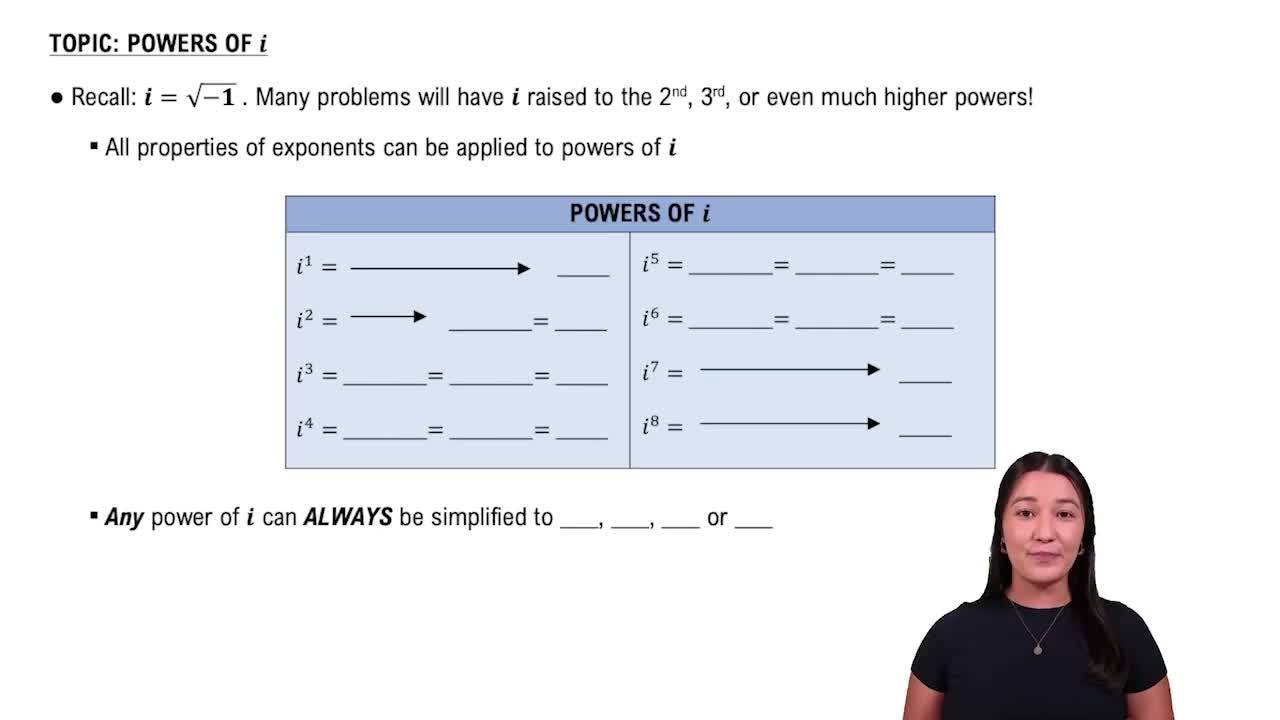
Step 1: Recall the powers of i follow a repeating cycle of 4: i^1 = i, i^2 = -1, i^3 = -i, and i^4 = 1. This cycle repeats for higher powers of i.
Step 2: To determine the value of i^44, divide the exponent (44) by 4 to find the remainder. This will help identify where in the cycle the power falls.
Step 3: Perform the division: 44 ÷ 4 = 11 with a remainder of 0. The remainder determines the position in the cycle.
Step 4: Since the remainder is 0, i^44 corresponds to i^4 in the cycle. From the cycle, we know that i^4 = 1.
Step 5: Conclude that i^44 simplifies to 1 based on the repeating cycle of powers of i.

Verified video answer for a similar problem:

This video solution was recommended by our tutors as helpful for the problem above.
Video duration:
2m
Was this helpful?

Key Concepts

Here are the essential concepts you must grasp in order to answer the question correctly.

Powers of i

The imaginary unit i is defined as the square root of -1. Its powers cycle through four distinct values: i^1 = i, i^2 = -1, i^3 = -i, and i^4 = 1. This cyclical pattern repeats every four powers, which is crucial for simplifying higher powers of i.
Recommended video:
04:10
Powers of i

Modulus Operation

To simplify powers of i, we can use the modulus operation with respect to 4, since the powers of i repeat every four terms. For example, to find i^44, we calculate 44 mod 4, which equals 0. This indicates that i^44 corresponds to i^0, which is equal to 1.
Recommended video:
Guided course
8:38
Performing Row Operations on Matrices

Complex Numbers

Complex numbers are numbers that have a real part and an imaginary part, expressed in the form a + bi, where a and b are real numbers. Understanding complex numbers is essential for working with i, as it allows for the manipulation and interpretation of expressions involving imaginary units in various mathematical contexts.
Recommended video:
04:22
Dividing Complex Numbers