Ch. 1 - Equations and Inequalities
Blitzer - College Algebra 8th Edition
Blitzer8th EditionCollege AlgebraISBN: 9780136970514Not the one you use?Change textbook
Chapter 2, Problem 60

Write each power of i as i, - 1, - i, or 1. i135

Verified step by step guidance
1
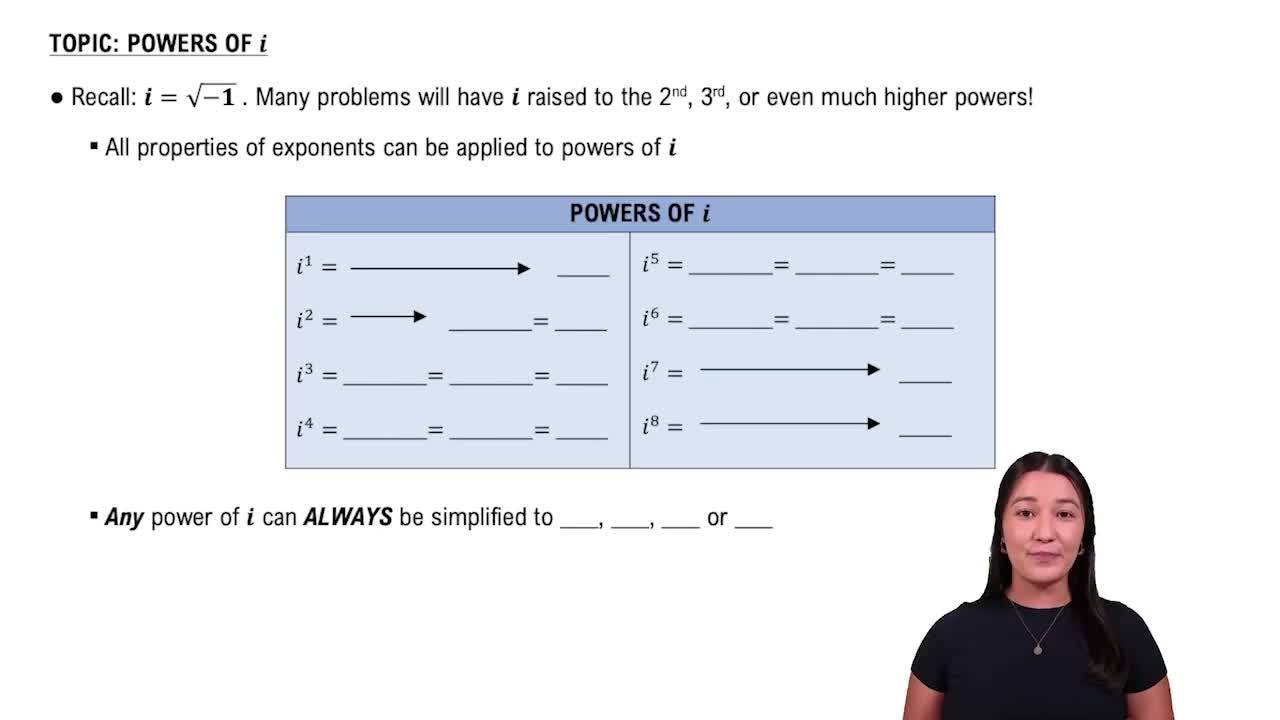
Understand that the powers of i (the imaginary unit) follow a repeating cycle: i, -1, -i, 1. This cycle repeats every 4 powers.
To determine the value of i^135, divide the exponent 135 by 4 and find the remainder. This is because the cycle repeats every 4 powers.
Perform the division: 135 ÷ 4. The quotient is 33, and the remainder is 3. The remainder determines the position in the cycle.
Match the remainder to the cycle: A remainder of 1 corresponds to i, 2 corresponds to -1, 3 corresponds to -i, and 0 corresponds to 1.
Since the remainder is 3, i^135 corresponds to the third position in the cycle, which is -i.

Verified video answer for a similar problem:

This video solution was recommended by our tutors as helpful for the problem above.
Video duration:
3m
Was this helpful?

Key Concepts

Here are the essential concepts you must grasp in order to answer the question correctly.

Powers of i

The imaginary unit i is defined as the square root of -1. Its powers cycle through four distinct values: i^1 = i, i^2 = -1, i^3 = -i, and i^4 = 1. This cyclical pattern repeats every four powers, which is crucial for simplifying higher powers of i.
Recommended video:
04:10
Powers of i

Modulo Operation

To simplify powers of i, we can use the modulo operation. Specifically, we find the exponent modulo 4, since the powers of i repeat every four terms. For example, to simplify i^135, we calculate 135 mod 4, which helps determine the equivalent lower power of i.
Recommended video:
Guided course
8:38
Performing Row Operations on Matrices

Complex Numbers

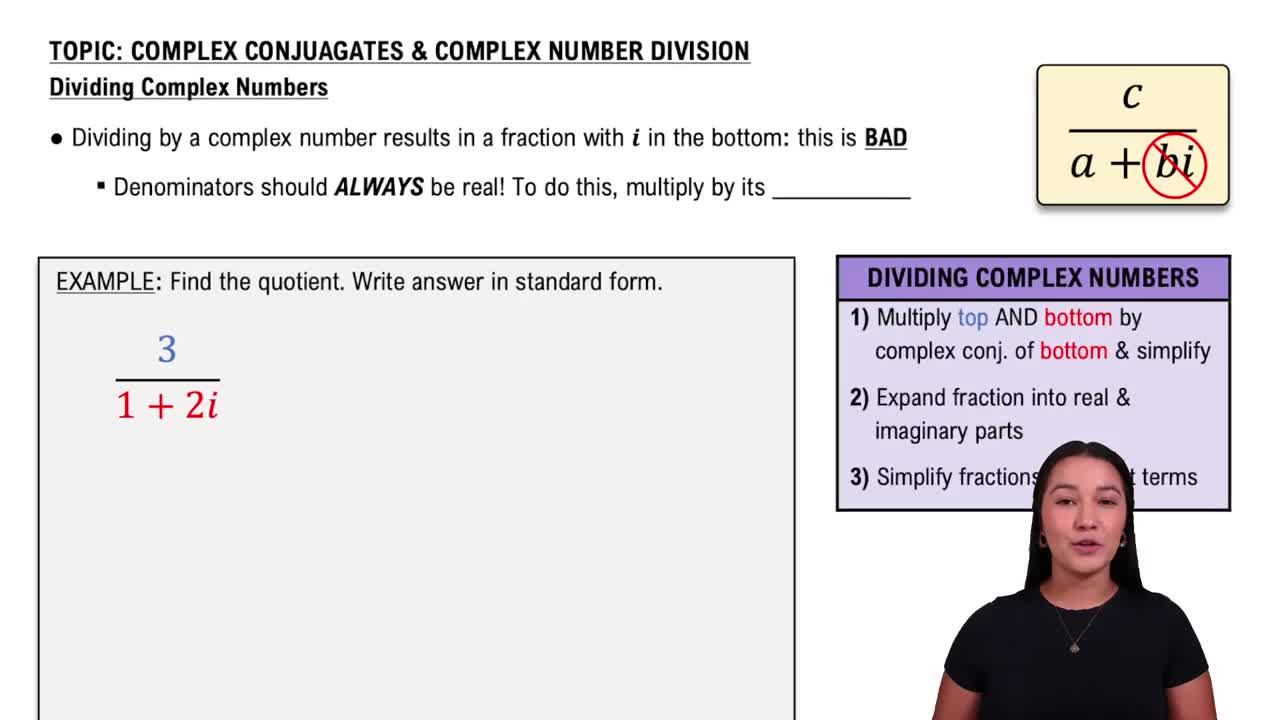
Complex numbers are numbers that have a real part and an imaginary part, expressed in the form a + bi, where a and b are real numbers. Understanding complex numbers is essential for working with powers of i, as they form the basis of operations involving imaginary units.
Recommended video:
04:22
Dividing Complex Numbers