In all exercises, other than exercises with no solution, use interval notation to express solution sets and graph each solution set on a number line. In Exercises 27–50, solve each linear inequality. 1 - x/2 > 4
Ch. 1 - Equations and Inequalities

Chapter 2, Problem 43a
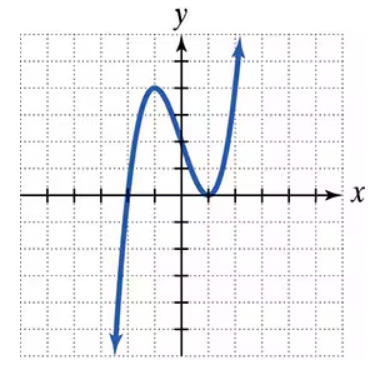
Use the graph to a. determine the x-intercepts, if any; b. determine the y-intercepts, if any. For each graph, tick marks along the axes represent one unit each.

Verified step by step guidance1
Observe the graph and identify the points where the curve crosses the x-axis. These points are the x-intercepts. The x-intercepts occur when the y-value is 0.
From the graph, locate the x-coordinates of the points where the curve intersects the x-axis. These are the x-intercepts.
Next, identify the point where the curve crosses the y-axis. This point is the y-intercept. The y-intercept occurs when the x-value is 0.
From the graph, locate the y-coordinate of the point where the curve intersects the y-axis. This is the y-intercept.
Summarize the x-intercepts and y-intercept based on the observations from the graph.

Verified video answer for a similar problem:
This video solution was recommended by our tutors as helpful for the problem above.
Video duration:
1mWas this helpful?
Key Concepts
Here are the essential concepts you must grasp in order to answer the question correctly.
X-Intercepts
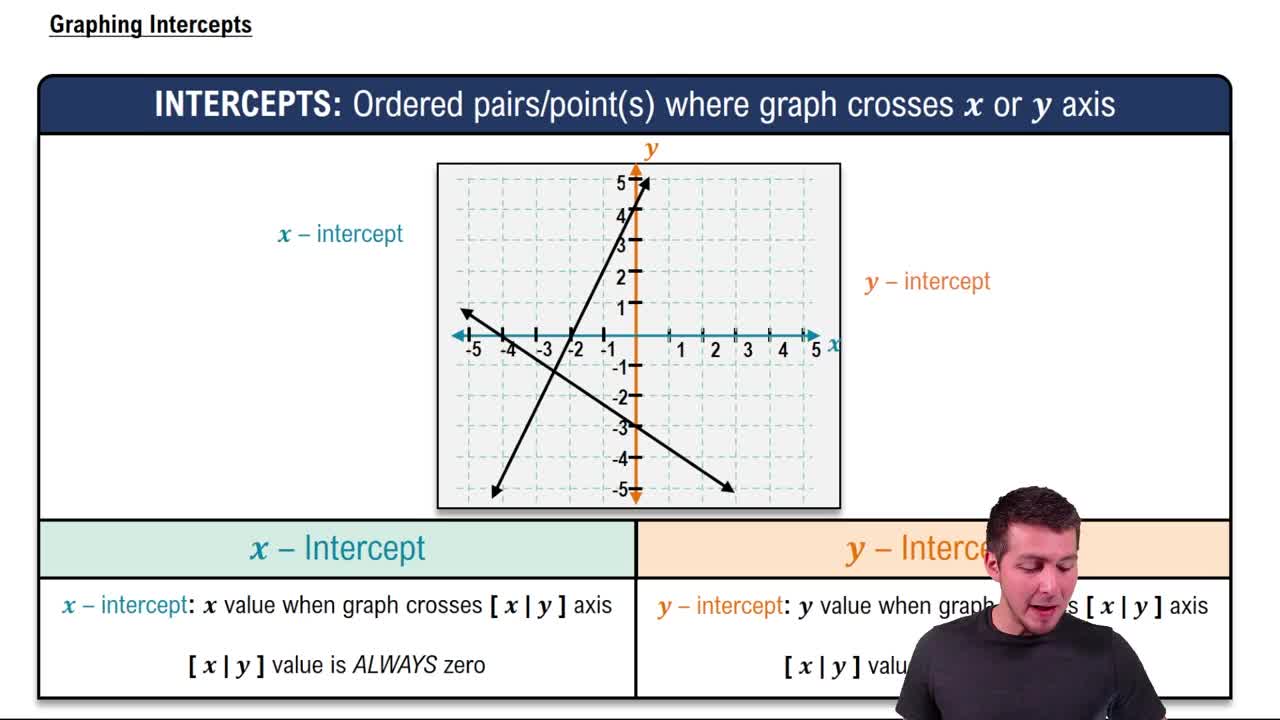
X-intercepts are the points where a graph crosses the x-axis. At these points, the value of y is zero. To find the x-intercepts, one can set the function equal to zero and solve for x. In graphical terms, these are the horizontal intersections of the curve with the x-axis.
Recommended video:
Guided course
Graphing Intercepts
Y-Intercepts
Y-intercepts are the points where a graph crosses the y-axis, occurring when the value of x is zero. To determine the y-intercept, substitute x = 0 into the function and solve for y. Graphically, these points represent the vertical intersections of the curve with the y-axis.
Recommended video:
Guided course
Graphing Intercepts
Graph Interpretation
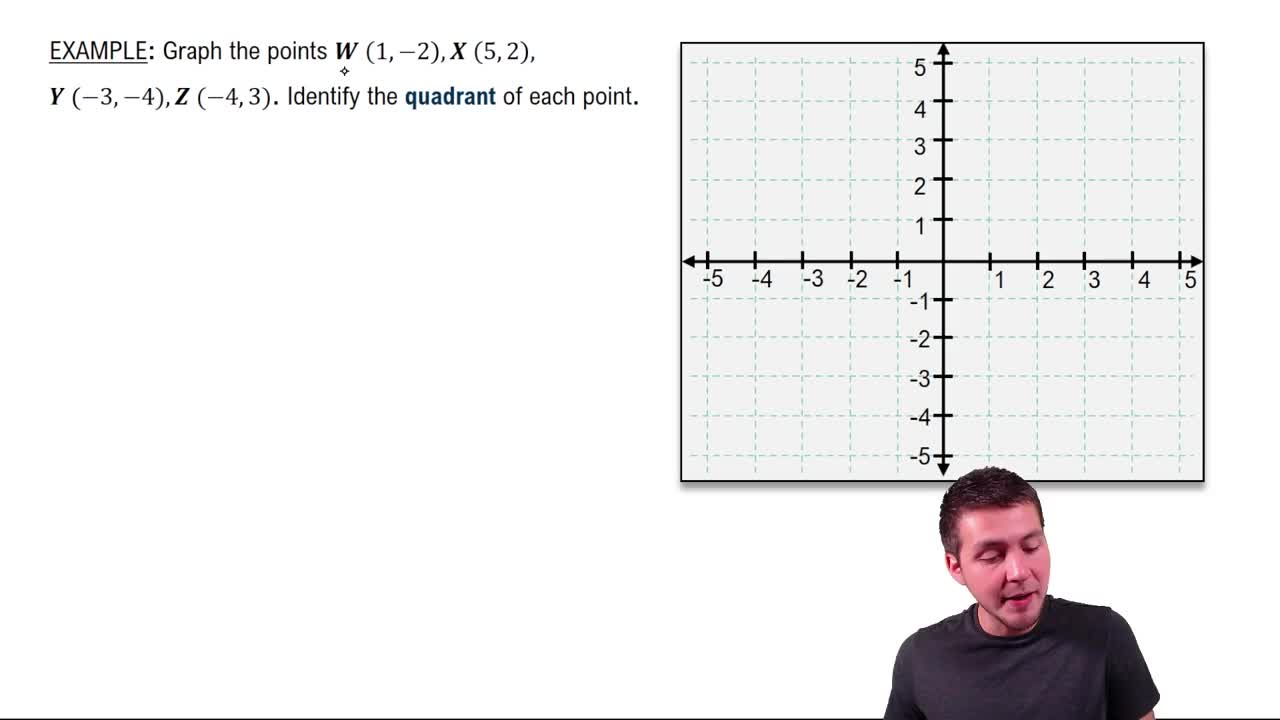
Graph interpretation involves analyzing the visual representation of a function to extract meaningful information, such as intercepts, trends, and behavior at extremes. Understanding how to read a graph, including the significance of axes and tick marks, is crucial for accurately identifying intercepts and other features of the function.
Recommended video:
Guided course
Graphs and Coordinates - Example
Related Practice
Textbook Question
1
views
Textbook Question
Solve and check: 24 + 3 (x + 2) = 5(x − 12).
Textbook Question
In Exercises 37–52, perform the indicated operations and write the result in standard form. (- 3 - √-7)2
1
views
Textbook Question
Use the graph to a. determine the x-intercepts, if any; b. determine the y-intercepts, if any. For each graph, tick marks along the axes represent one unit each.
Textbook Question
Exercises 41–60 contain rational equations with variables in denominators. For each equation, a. write the value or values of the variable that make a denominator zero. These are the restrictions on the variable. b. Keeping the restrictions in mind, solve the equation. 7/2x - 5/3x = 22/3
Textbook Question
Solve each equation in Exercises 41–60 by making an appropriate substitution.
2
views