Ch. 1 - Equations and Inequalities
Blitzer - College Algebra 8th Edition
Blitzer8th EditionCollege AlgebraISBN: 9780136970514Not the one you use?Change textbook
Chapter 2, Problem 26

Divide and express the result in standard form. - 6i/(3 + 2i)

Verified step by step guidance
1
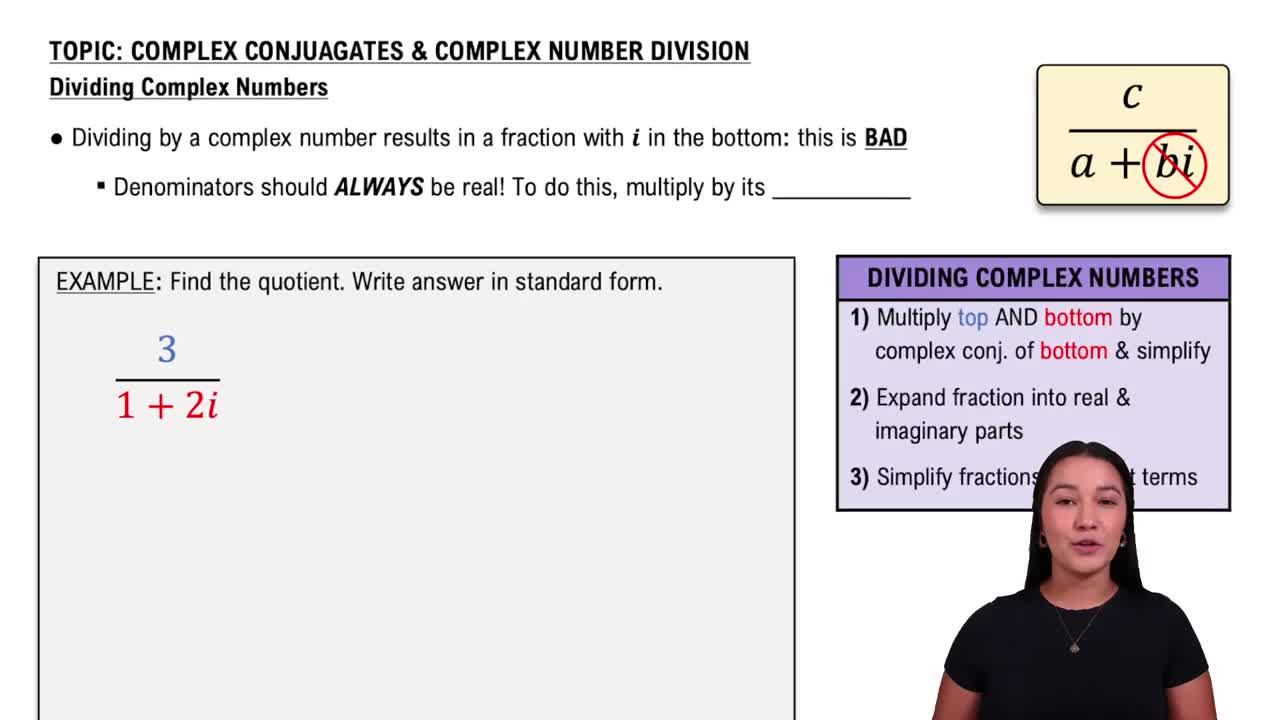
Step 1: Recognize that the denominator contains a complex number (3 + 2i). To simplify the division, multiply both the numerator and denominator by the conjugate of the denominator. The conjugate of (3 + 2i) is (3 - 2i).
Step 2: Write the expression as (6i * (3 - 2i)) / ((3 + 2i) * (3 - 2i)). This step ensures that the denominator becomes a real number.
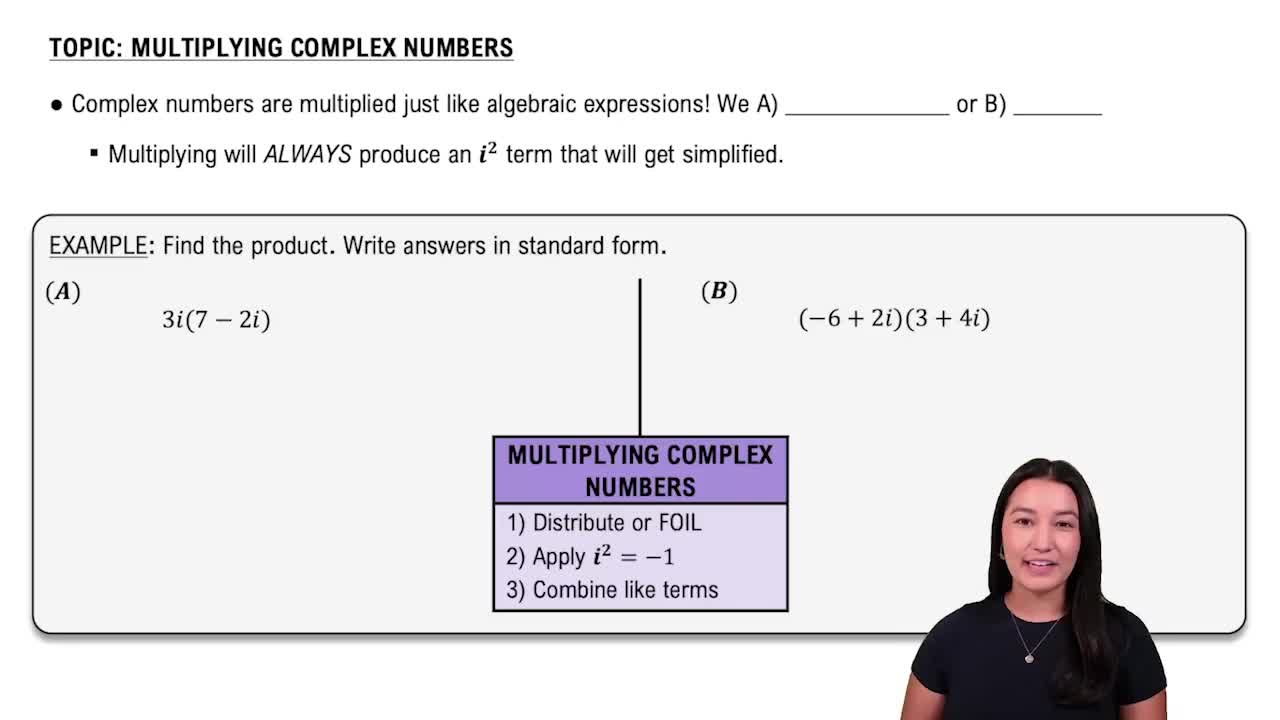
Step 3: Expand the numerator using the distributive property: 6i * 3 = 18i and 6i * (-2i) = -12i². Remember that i² = -1, so replace -12i² with 12.
Step 4: Expand the denominator using the difference of squares formula: (3 + 2i)(3 - 2i) = 3² - (2i)². Simplify this to 9 - (-4), which equals 13.
Step 5: Combine the results from the numerator and denominator. The numerator becomes (18i + 12), and the denominator is 13. Write the final expression in standard form as (12/13) + (18/13)i.

Verified video answer for a similar problem:

This video solution was recommended by our tutors as helpful for the problem above.
Video duration:
3m
Was this helpful?

Key Concepts

Here are the essential concepts you must grasp in order to answer the question correctly.

Complex Numbers

Complex numbers are numbers that have a real part and an imaginary part, expressed in the form a + bi, where a is the real part, b is the imaginary part, and i is the imaginary unit defined as the square root of -1. Understanding complex numbers is essential for performing operations such as addition, subtraction, multiplication, and division.
Recommended video:
04:22
Dividing Complex Numbers

Division of Complex Numbers

Dividing complex numbers involves multiplying the numerator and the denominator by the conjugate of the denominator. The conjugate of a complex number a + bi is a - bi. This process eliminates the imaginary part from the denominator, allowing the result to be expressed in standard form, which is a + bi.
Recommended video:
04:22
Dividing Complex Numbers

Standard Form of Complex Numbers

The standard form of a complex number is a + bi, where a and b are real numbers. In this form, a represents the real part and b represents the imaginary part. Expressing complex numbers in standard form is crucial for clarity and consistency in mathematical communication, especially when performing further calculations or comparisons.
Recommended video:
05:02
Multiplying Complex Numbers