Ch. 1 - Equations and Inequalities
Blitzer - College Algebra 8th Edition
Blitzer8th EditionCollege AlgebraISBN: 9780136970514Not the one you use?Change textbook
Chapter 2, Problem 25

In Exercises 15–26, use graphs to find each set. [3, ∞) ⋃ (6, ∞)

Verified step by step guidance
1
Understand the problem: You are asked to find the union of two intervals, \([3, \infty)\) and \((6, \infty)\), using graphs. The union means all values that belong to either interval or both.
Graph the first interval \([3, \infty)\) on a number line. This includes all numbers starting at 3 (including 3) and extending to positive infinity. Represent this with a solid dot at 3 and a ray extending to the right.
Graph the second interval \((6, \infty)\) on the same number line. This includes all numbers greater than 6 but not including 6. Represent this with an open dot at 6 and a ray extending to the right.
Identify the union of these two intervals on the graph. Since \([3, \infty)\) already includes all numbers from 3 onwards, and \((6, \infty)\) is a subset of that starting from 6, the union will cover all numbers starting at 3 and going to infinity.
Write the union interval notation based on the graph: it will be \([3, \infty)\) because this interval already contains all elements of both sets.

Verified video answer for a similar problem:

This video solution was recommended by our tutors as helpful for the problem above.
Video duration:
3m
Was this helpful?

Key Concepts

Here are the essential concepts you must grasp in order to answer the question correctly.

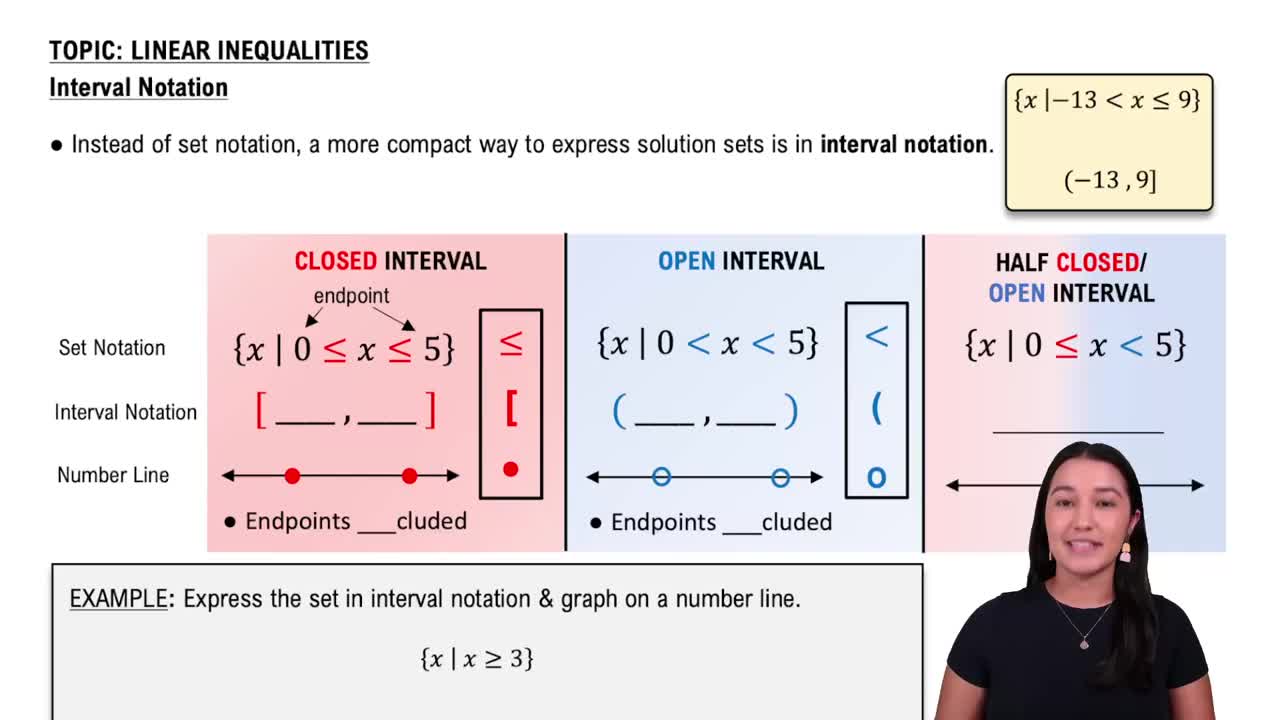
Interval Notation

Interval notation is a way to represent sets of real numbers using brackets and parentheses. Square brackets [ ] include the endpoint, while parentheses ( ) exclude it. For example, [3, ∞) includes all numbers from 3 to infinity, including 3.
Recommended video:
05:18
Interval Notation

Union of Sets

The union of two sets combines all elements from both sets without duplication. In interval notation, the union symbol (∪) merges intervals, so [3, ∞) ∪ (6, ∞) includes all numbers from 3 onwards, considering overlaps.
Recommended video:
5:10
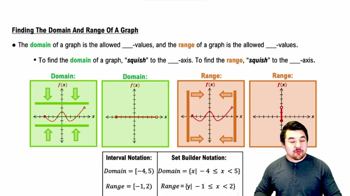
Finding the Domain and Range of a Graph

Graphing Intervals on the Number Line

Graphing intervals involves shading regions on a number line to represent sets of numbers. Closed dots indicate included endpoints, open dots indicate excluded endpoints, and shading shows all numbers within the interval, helping visualize unions and intersections.
Recommended video:
Guided course
02:35
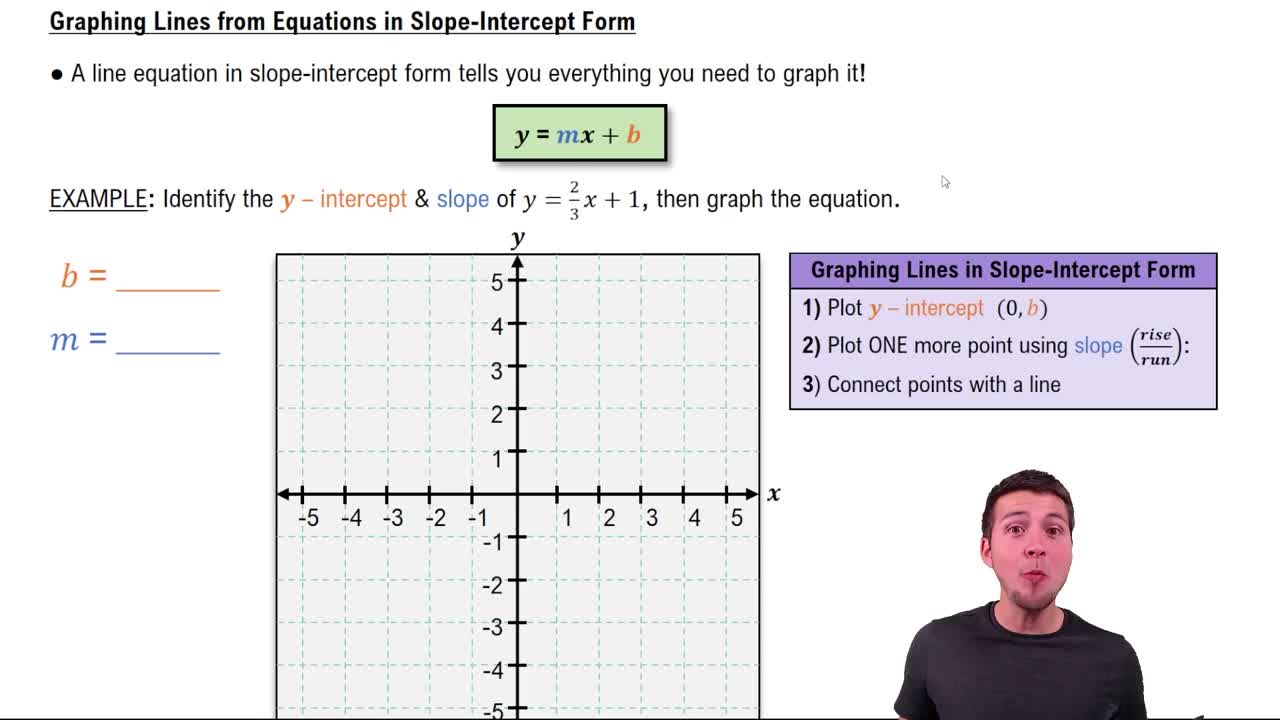
Graphing Lines in Slope-Intercept Form