Ch. 1 - Equations and Inequalities
Blitzer - College Algebra 8th Edition
Blitzer8th EditionCollege AlgebraISBN: 9780136970514Not the one you use?Change textbook
Chapter 2, Problem 117

Find all values of x satisfying the given conditions. y1 = x - 1, y2 = x + 4 and y1y2 = 14

Verified step by step guidance
1
Step 1: Start by substituting the expressions for y1 and y2 into the equation y1y2 = 14. Replace y1 with (x - 1) and y2 with (x + 4), resulting in the equation (x - 1)(x + 4) = 14.
Step 2: Expand the left-hand side of the equation using the distributive property (FOIL method). Multiply the terms: (x - 1)(x + 4) = x^2 + 4x - x - 4, which simplifies to x^2 + 3x - 4.
Step 3: Set the equation equal to 14 and simplify. Subtract 14 from both sides to form a standard quadratic equation: x^2 + 3x - 4 - 14 = 0, which simplifies to x^2 + 3x - 18 = 0.
Step 4: Solve the quadratic equation x^2 + 3x - 18 = 0. Use factoring, the quadratic formula, or completing the square. If factoring, look for two numbers that multiply to -18 and add to 3.
Step 5: Once the quadratic equation is factored or solved, find the values of x that satisfy the equation. These will be the solutions to the original problem.

Verified video answer for a similar problem:

This video solution was recommended by our tutors as helpful for the problem above.
Video duration:
2m
Was this helpful?

Key Concepts

Here are the essential concepts you must grasp in order to answer the question correctly.

Linear Equations

Linear equations are mathematical statements that express a relationship between two variables, typically in the form y = mx + b, where m is the slope and b is the y-intercept. In this question, y1 and y2 are linear equations representing two lines in a coordinate system. Understanding how to manipulate and solve these equations is essential for finding the intersection points or solutions.
Recommended video:
06:00
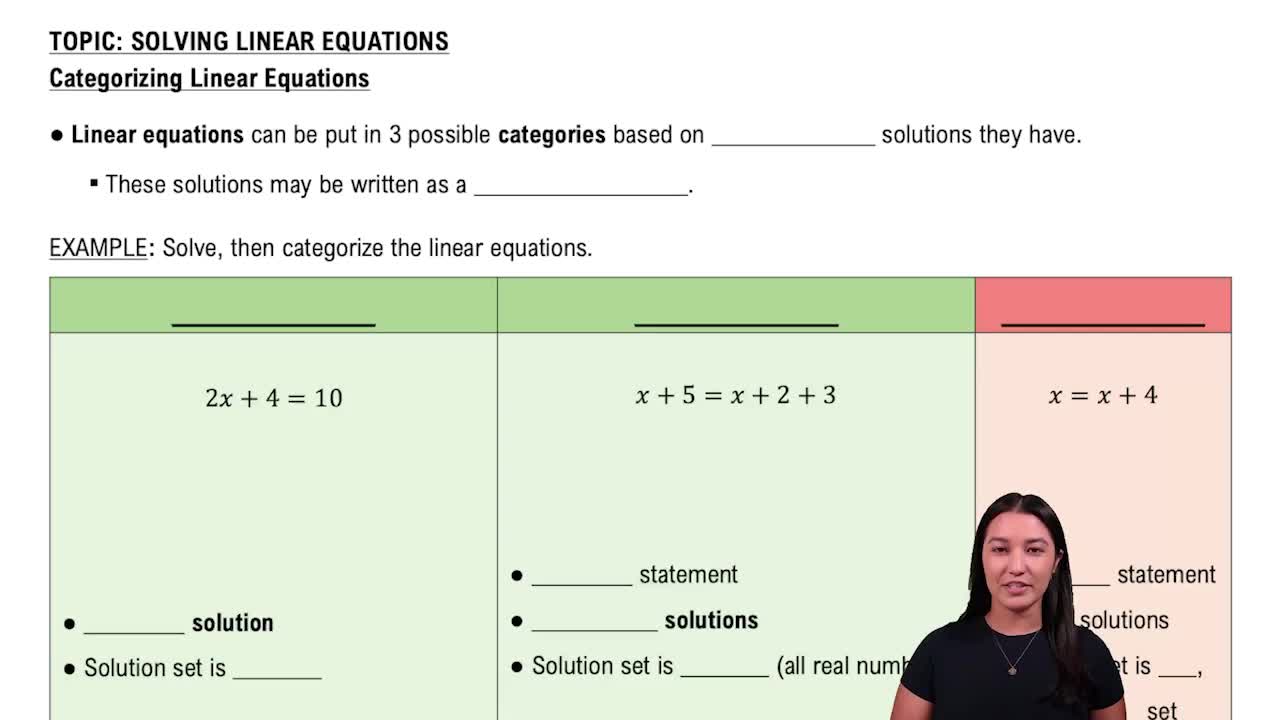
Categorizing Linear Equations

Product of Functions

The product of functions involves multiplying two or more functions together to create a new function. In this case, y1y2 = 14 indicates that the product of the two linear functions y1 and y2 must equal 14. This concept is crucial for setting up the equation that will lead to finding the values of x that satisfy the given condition.
Recommended video:
Guided course
03:41
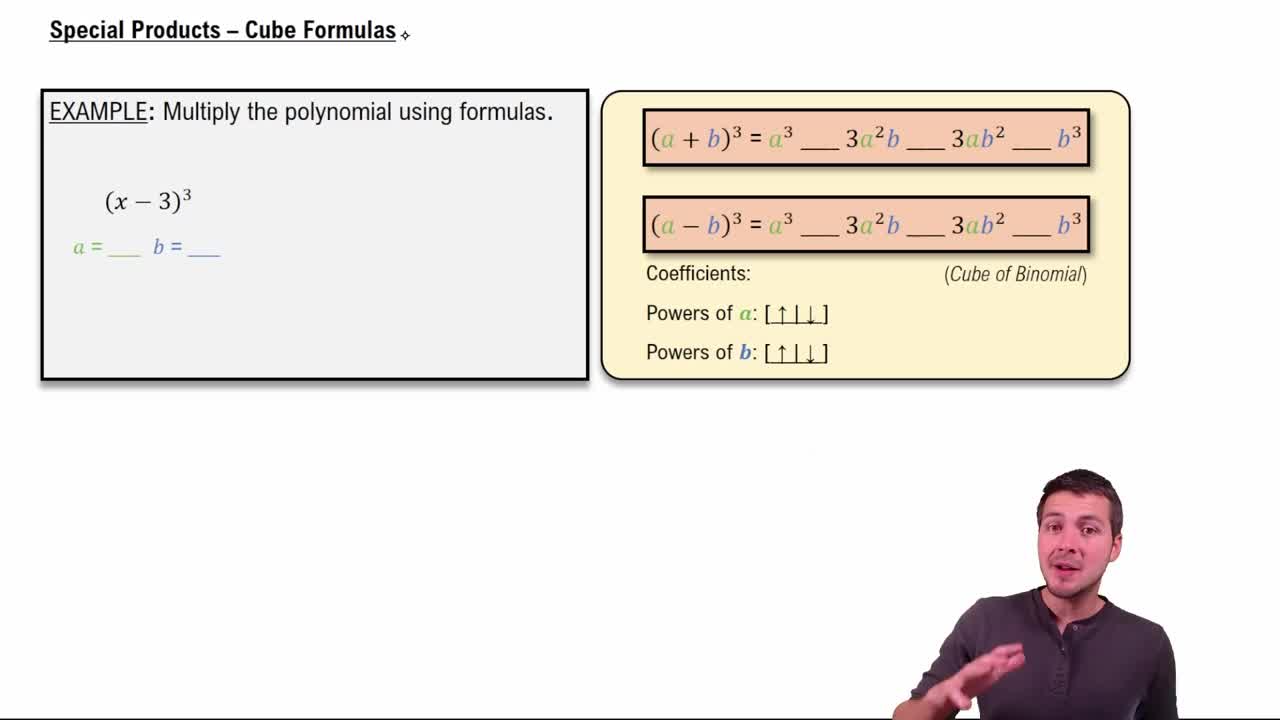
Special Products - Cube Formulas

Quadratic Equations

Quadratic equations are polynomial equations of the form ax^2 + bx + c = 0, where a, b, and c are constants. When we set the product of the two linear functions equal to a constant (14), we can rearrange the equation into a quadratic form. Solving this quadratic equation will yield the values of x that satisfy the original conditions.
Recommended video:
05:35
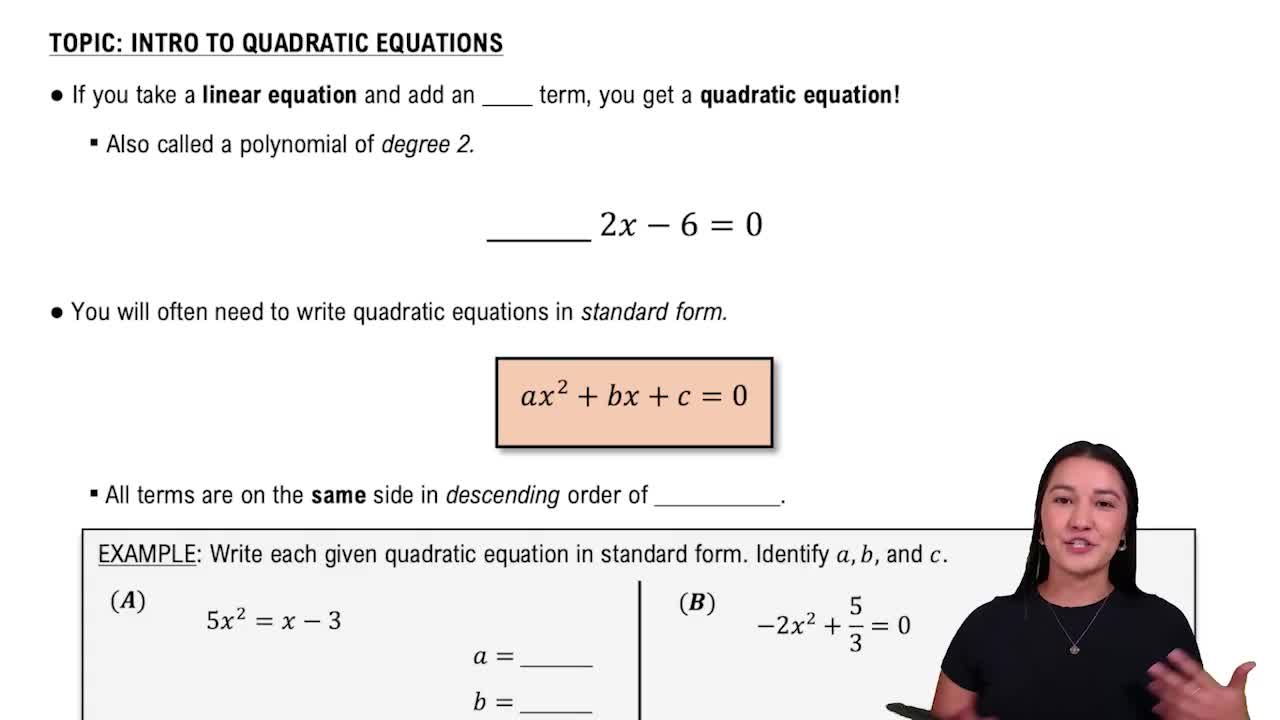
Introduction to Quadratic Equations