 Back
BackSquare Roots in College Algebra 22
You can tap to flip the card.
Control buttons has been changed to "navigation" mode.
1/10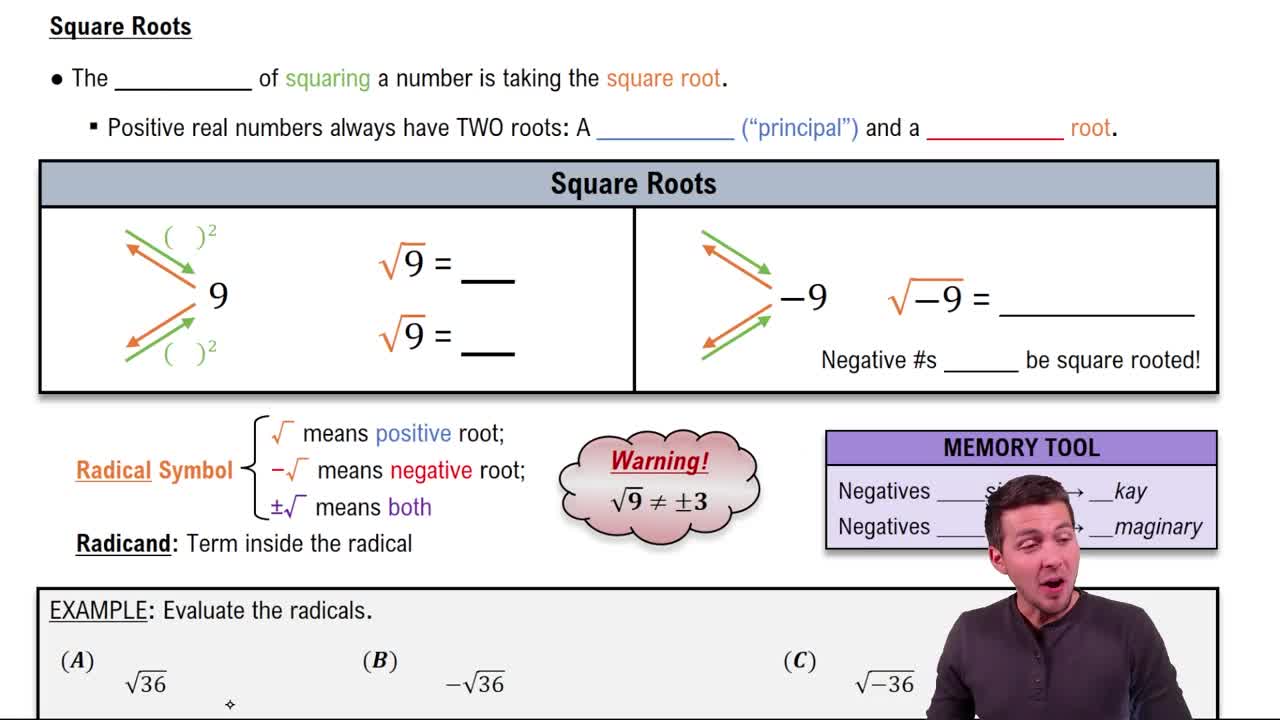
 05:49
05:49
Terms in this set (10)
A square root of a number is a value that, when squared, equals the original number.
A positive real number has two square roots: one positive (principal root) and one negative.
The square roots of 9 are 3 (principal root) and -3 because both satisfy \(x^2=9\).
The principal square root is the positive square root of a number.
Because both 3 and -3 squared equal 9, so both satisfy the definition of square roots.
\(x=5\) and \(x=-5\) are the two square roots of 25.
Zero has one square root: 0, since \(0^2=0\).
Negative numbers do not have real square roots because no real number squared is negative.
It means it is the non-negative square root of a number.
Square the candidate number and check if the result equals the original number.