Skip to main content
College Algebra
My Course
Learn
Exam Prep
AI Tutor
Study Guides
Textbook Solutions
Flashcards
Explore
Try the app
My Course
Learn
Exam Prep
AI Tutor
Study Guides
Textbook Solutions
Flashcards
Explore
Try the app
Back
Solving Linear Equations in College Algebra
You can tap to flip the card.
What is the first step in solving a linear equation?
You can tap to flip the card.
👆
What is the first step in solving a linear equation?
Distribute constants to remove parentheses.
Track progress
Control buttons has been changed to "navigation" mode.
1/20
Recommended videos
04:02
Solving Linear Equations with Fractions
12
views
07:48
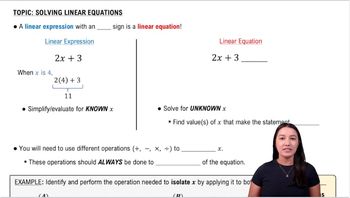
Introduction to Solving Linear Equtions
22
views
06:00
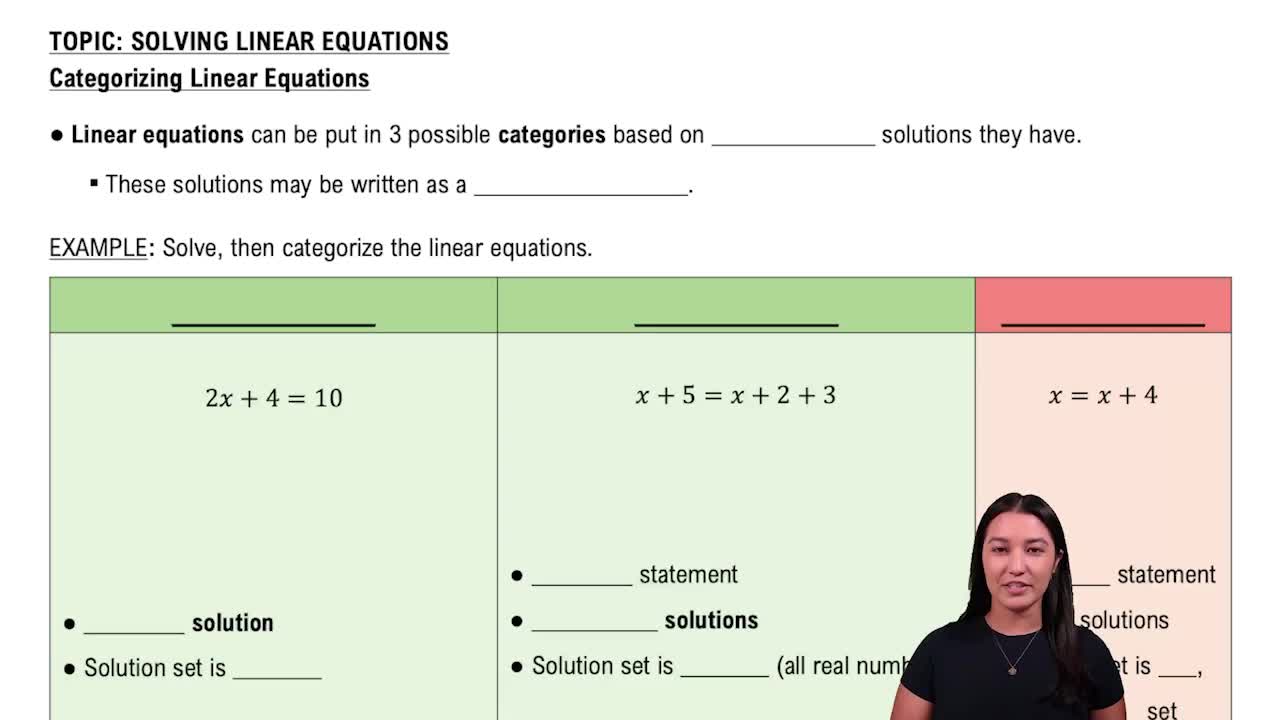
Categorizing Linear Equations
6
views
1
rank
Terms in this set (20)
Hide definitions
What is the first step in solving a linear equation?
Distribute constants to remove parentheses.
After distributing constants, what is the next step?
Combine like terms on each side of the equation.
How do you arrange terms when solving linear equations?
Group terms with
x
on one side and constants on the opposite side.
What does it mean to isolate
x
in a linear equation?
Manipulate the equation so that
x
is alone on one side.
Why should you check your solution after solving a linear equation?
To verify the solution by substituting
x
back into the original equation.
How do you solve linear equations that contain fractions?
Multiply both sides by the Least Common Denominator (LCD) to eliminate fractions.
What is the purpose of multiplying by the LCD in fractional linear equations?
To clear fractions and simplify the equation for easier solving.
What are the six general steps to solve linear equations with fractions?
1) Multiply by LCD, 2) Distribute constants, 3) Combine like terms, 4) Group
x
and constants, 5) Isolate
x
, 6) Check solution.
What are the three possible categories of linear equations based on their solutions?
Equations can have one solution, no solution, or infinitely many solutions.
How can solutions to linear equations be expressed?
Solutions may be written as a single value, no solution, or all real numbers.
What is the solution to the equation \(2(x-3)=0\)?
The solution is \(x=3\).
What does it mean if a linear equation simplifies to a true statement like \(0=0\)?
The equation has infinitely many solutions.
What does it mean if a linear equation simplifies to a false statement like \(0=5\)?
The equation has no solution.
How do you combine like terms in an equation?
Add or subtract terms that have the same variable and exponent.
What is the role of distribution in solving linear equations?
To remove parentheses by multiplying the term outside by each term inside.
Why is grouping terms with
x
and constants on opposite sides important?
It helps isolate the variable to solve the equation.
What should you do if the equation has multiple operations on
x
?
Perform inverse operations step-by-step to isolate
x
.
What is the Least Common Denominator (LCD)?
The smallest common multiple of the denominators in a fractional equation.
How do you check your solution to a linear equation?
Substitute the solution back into the original equation to verify equality.
What is the solution process for the equation \(3(2-5x)=4x+25\)?
Distribute, combine like terms, group
x
terms, isolate
x
, then solve.
 BackBack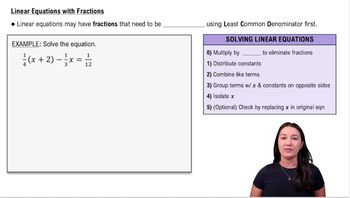
 04:02
04:02