Back

Rules of Exponents - College Algebra

Control buttons has been changed to "navigation" mode.
1/20
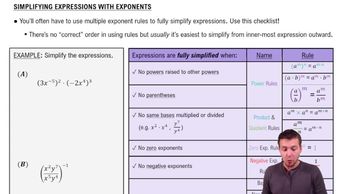
  • When is an expression with exponents considered fully simplified?

    • No powers raised to other powers
    • No parentheses
    • No same bases multiplied or divided
    • No zero exponents
    • No negative exponents
    • All numbers with exponents evaluated
    • All operations performed
  • What is the Product Rule for exponents?

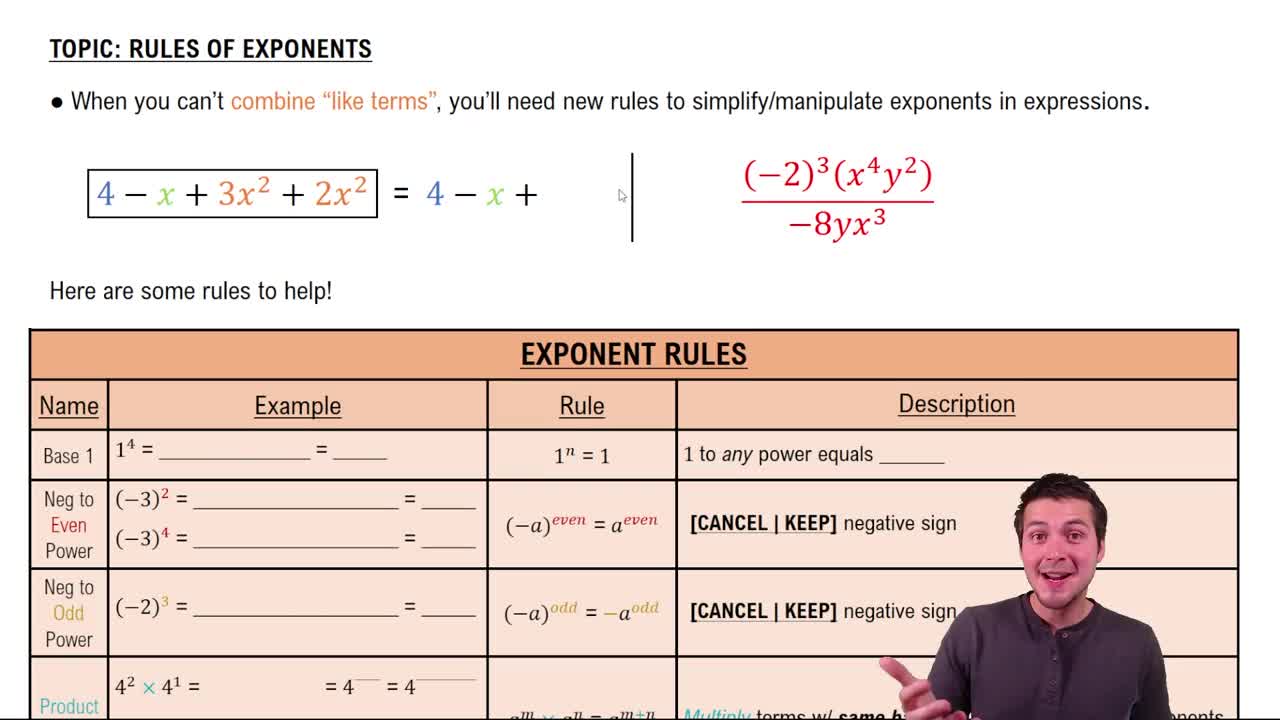
    For the same base, multiply by adding exponents: \(a^m \times a^n = a^{m+n}\)
  • What is the Quotient Rule for exponents?

    For the same base, divide by subtracting exponents: \(\frac{a^m}{a^n} = a^{m-n}\)
  • What is the Power Rule for exponents?

    A power raised to another power multiplies the exponents: \((a^m)^n = a^{m \times n}\)
  • How do you handle an exponent applied to a product?

    Distribute the exponent to each factor: \((ab)^m = a^m b^m\)
  • How do you handle an exponent applied to a quotient?

    Distribute the exponent to numerator and denominator: \(\left(\frac{a}{b}\right)^m = \frac{a^m}{b^m}\)
  • What is the Zero Exponent Rule?

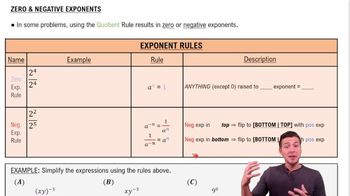
    Any nonzero base raised to the zero power equals 1: \(a^0 = 1\)
  • What is the Negative Exponent Rule?

    A negative exponent means the reciprocal with a positive exponent: \(a^{-n} = \frac{1}{a^n}\)
  • How do you simplify \((3x^{-5})^2 \cdot (-2x^4)^3\)?

    Apply power to each factor and multiply:
    \(3^2 x^{-10} \cdot (-2)^3 x^{12}\) = \(9 x^{-10} \cdot (-8) x^{12}\) = \(-72 x^{2}\)
  • How do you simplify \(\frac{x^2 y^7}{x^5 y^4}\)?

    Use quotient rule on each base:
    \(x^{2-5} y^{7-4} = x^{-3} y^{3}\) = \(\frac{y^3}{x^3}\)
  • What happens when you raise a negative base to an even power?

    The result is positive: \((-a)^{even} = a^{even}\)
  • What happens when you raise a negative base to an odd power?

    The result is negative: \((-a)^{odd} = -a^{odd}\)
  • What is the value of \(1^n\) for any integer n?

    It is always 1 regardless of n: \(1^n = 1\)
  • What is the recommended order to simplify expressions with exponents?

    Simplify from the innermost expressions outward, applying exponent rules step-by-step.
  • Why should expressions have no parentheses when fully simplified?

    Because all powers should be distributed and combined, leaving no grouped factors.
  • Why should expressions have no same bases multiplied or divided when simplified?

    Because bases with exponents should be combined using product or quotient rules to a single power.
  • Why should expressions have no zero exponents when simplified?

    Because any base to the zero power equals 1 and should be replaced accordingly.
  • Why should expressions have no negative exponents when simplified?

    Because negative exponents represent reciprocals and should be rewritten with positive exponents.
  • What is the effect of multiplying powers with the same base?

    Add the exponents to combine into a single power.
  • What is the effect of dividing powers with the same base?

    Subtract the exponents to combine into a single power.