Skip to main content
College Algebra
My Course
Learn
Exam Prep
AI Tutor
Study Guides
Textbook Solutions
Flashcards
Explore
Try the app
My Course
Learn
Exam Prep
AI Tutor
Study Guides
Textbook Solutions
Flashcards
Explore
Try the app
Back
Graphs of Functions: Intercepts and Domain
You can tap to flip the card.
What is the x-intercept of a graph?
You can tap to flip the card.
👆
What is the x-intercept of a graph?
The
x-intercept
is the point(s) where the graph crosses the x-axis, meaning
y = 0
.
Track progress
Control buttons has been changed to "navigation" mode.
1/26
Recommended videos
02:16
Graphs and Coordinates - Example
14
views
05:10
Graphs & the Rectangular Coordinate System
16
views
Terms in this set (26)
Hide definitions
What is the x-intercept of a graph?
The
x-intercept
is the point(s) where the graph crosses the x-axis, meaning
y = 0
.
How do you find the x-intercept from a graph?
Identify the point(s) where the graph crosses the x-axis; these points have coordinates where
y = 0
.
What is the domain of a function?
The
domain
is the set of all possible
x
-values for which the function is defined.
How is the domain written in set-builder notation?
The domain is written as
{x | condition on x}
, where the condition describes all valid x-values.
How do you determine the domain from a graph?
Look at the leftmost and rightmost points on the graph along the x-axis, noting if endpoints are included or excluded.
Give an example of domain in set-builder notation for a function defined from x = -2 to x = 5 including endpoints.
The domain is
{x | -2 \(\leq\) x \(\leq\) 5}
.
What does an open circle on a graph endpoint indicate about the domain?
An open circle means the endpoint is
excluded
from the domain, so use parentheses in interval notation.
What does a closed circle or solid line endpoint indicate about the domain?
A closed circle or solid line means the endpoint is
included
in the domain, so use brackets in interval notation.
What does it mean to find x when f(x) = 5 from a graph?
It means finding the
x
-value(s) where the graph's
y
-coordinate is 5.
How do you find the x-value where f(x) = 5 on a graph?
Draw a horizontal line at
y = 5
and find the x-coordinate(s) where this line intersects the graph.
Give an example of finding x when f(x) = 5.
If the graph crosses y = 5 at x = 3, then
f(3) = 5
.
What does f(a) represent in a function?
f(a)
is the value of the function at the input
x = a
.
How do you find f(1) from a graph?
Locate
x = 1
on the x-axis, move vertically to the graph, then read the corresponding y-value.
Give an example of evaluating a function at x = 1 using a graph.
If the graph passes through (1, 4), then
f(1) = 4
.
What is the range of a function?
The
range
is the set of all possible
y
-values that the function attains.
How do you determine the domain from a graph?
Look at the leftmost and rightmost points of the graph along the x-axis to find the interval of x-values.
How do you determine the range from a graph?
Look at the lowest and highest points of the graph along the y-axis to find the interval of y-values.
How do you decide whether to use brackets or parentheses in interval notation for domain or range?
Use
brackets [ ]
if endpoints are included (closed circle), and
parentheses ( )
if excluded (open circle).
Give an example of domain and range in interval notation.
Domain:
[-3, 5]
, Range:
(0, 7]
means x is from -3 to 5 inclusive, y is greater than 0 up to 7 inclusive.
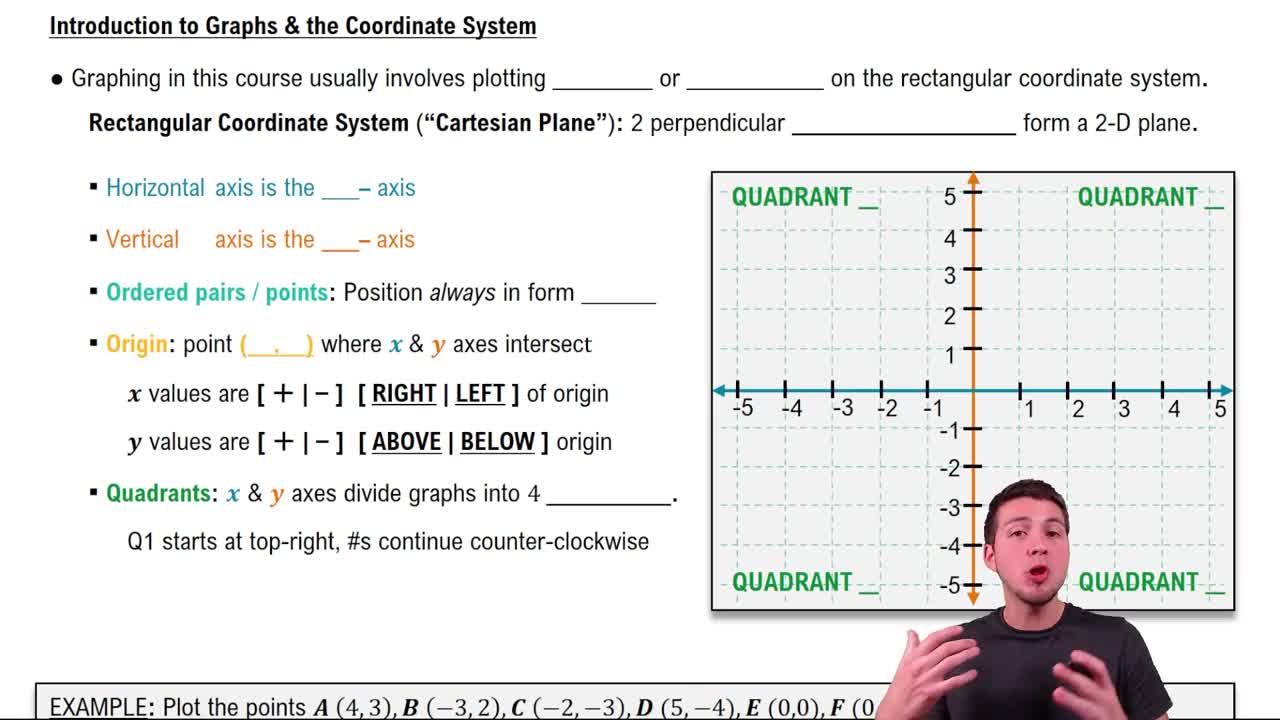
What is the Cartesian coordinate system?
A plane defined by a horizontal
x-axis
and a vertical
y-axis
used to locate points.
How do you plot the point (-2, 3) on the Cartesian plane?
Start at the origin, move 2 units left (negative x), then 3 units up (positive y), and mark the point.
What is the x-intercept of a graph?
The point(s) where the graph crosses the x-axis, where
y = 0
.
What is the y-intercept of a graph?
The point where the graph crosses the y-axis, where
x = 0
.
How do you find the x-intercepts from a graph?
Look for points where the graph crosses the x-axis; these points have
y = 0
.
How do you find the y-intercept from a graph?
Find the point where the graph crosses the y-axis; this point has
x = 0
.
Give an example of x and y intercepts.
If a graph crosses the x-axis at (4, 0) and the y-axis at (0, -1), then x-intercept is 4 and y-intercept is -1.
 BackBack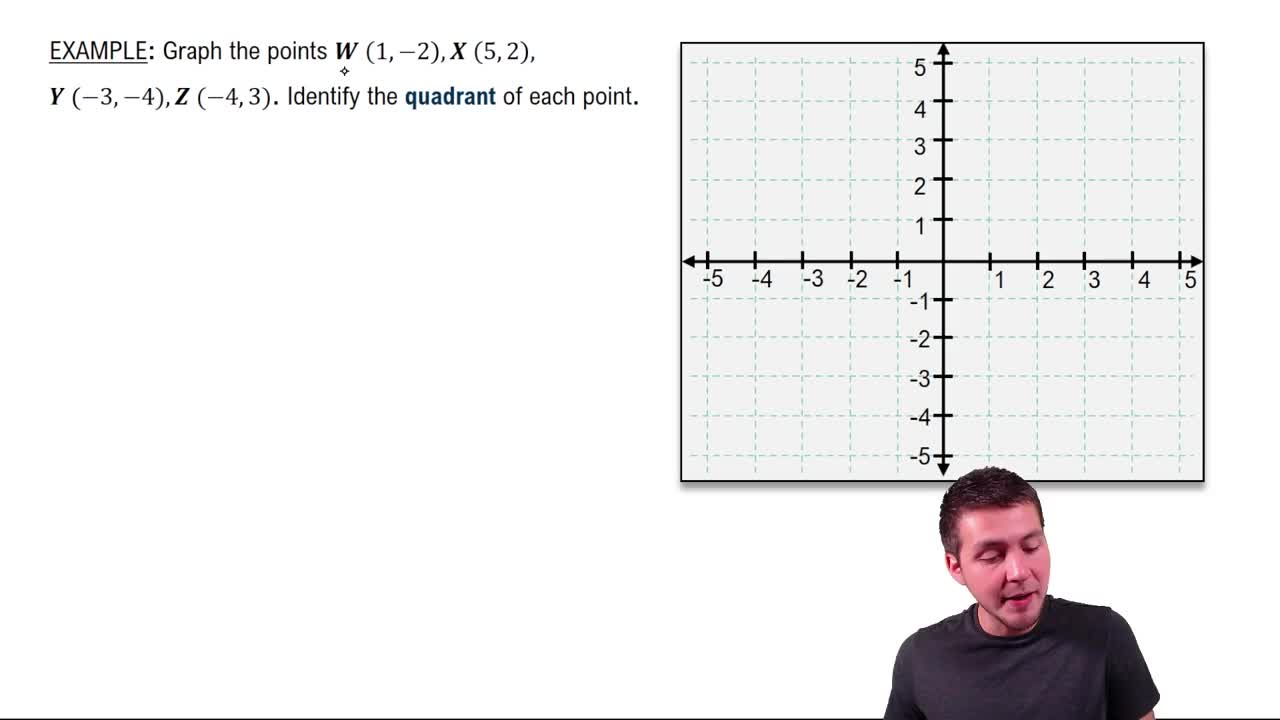
 02:16
02:16