Skip to main content
College Algebra
My Course
Learn
Exam Prep
AI Tutor
Study Guides
Textbook Solutions
Flashcards
Explore
Try the app
My Course
Learn
Exam Prep
AI Tutor
Study Guides
Textbook Solutions
Flashcards
Explore
Try the app
Back
College Algebra: Algebraic Expressions
You can tap to flip the card.
What is an algebraic expression?
You can tap to flip the card.
👆
What is an algebraic expression?
A combination of numbers and
variables
with math operations.
Track progress
Control buttons has been changed to "navigation" mode.
1/21
Recommended videos
03:11
Evaluating Algebraic Expressions
217
views
3
rank
05:09
Introduction to Algebraic Expressions
190
views
3
rank
1:51
Introduction to College Algebra Channel
83
views
1
rank
Terms in this set (21)
Hide definitions
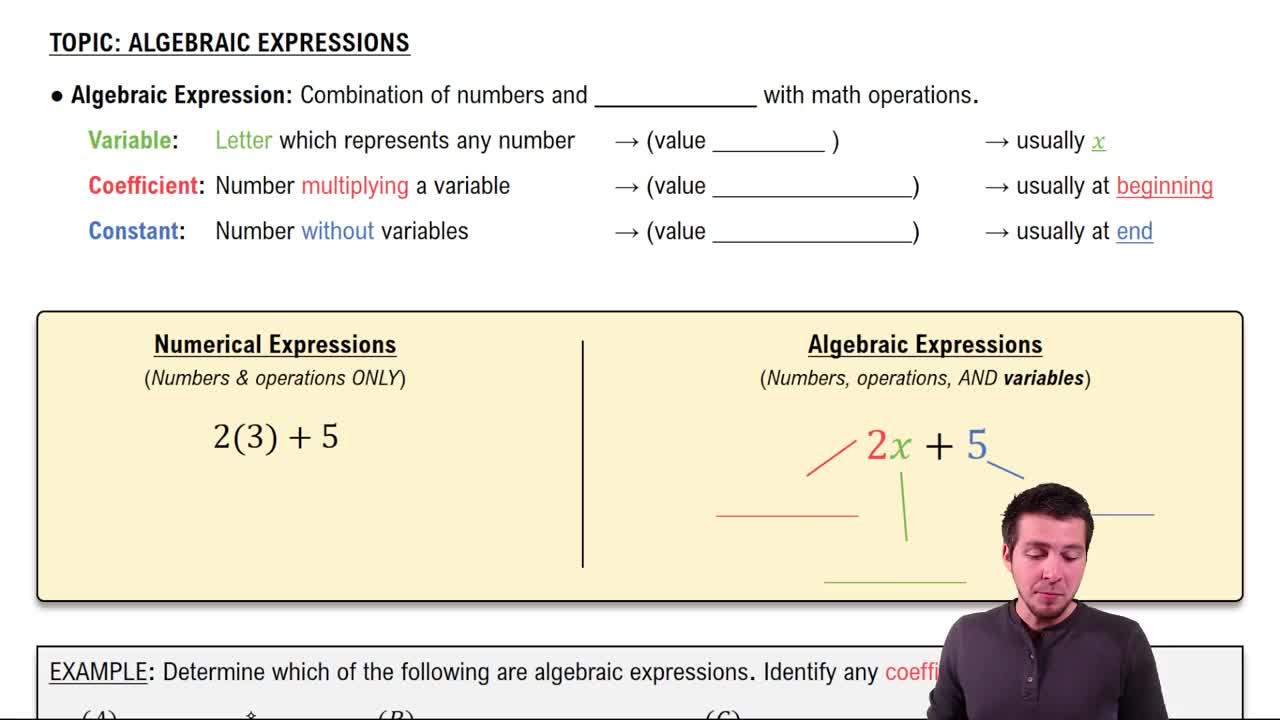
What is an algebraic expression?
A combination of numbers and
variables
with math operations.
Define a variable in algebraic expressions.
A
letter
which represents any number.
What is a coefficient?
A
number multiplying a variable
in an algebraic expression.
What is a constant?
A
number without variables
in an algebraic expression.
Does the value of a numerical expression vary?
No, numerical expressions have values that
do not vary
.
Does the value of an algebraic expression vary?
Yes, algebraic expressions
can vary
depending on variable values.
What symbol forms an equation when placed between expressions?
An
equal sign (=)
forms an equation.
What does it mean to evaluate an algebraic expression?
To
substitute given values
for variables and calculate using PEMDAS.
What is the order of operations?
Parentheses, Exponents, Multiply/Divide, Add/Subtract
.
What do exponents represent?
Repeated
multiplication
of the same base number.
In the expression \(a^n\), what does
a
represent?
Base
: the number being multiplied repeatedly.
In the expression \(a^n\), what does
n
represent?
Exponent or power
: the number of times the base is multiplied.
When simplifying algebraic expressions, what is a term?
Parts of expressions separated by
plus (+) or minus (−) signs
.
What are like terms?
Terms with the same
variables
raised to the same
powers
.
What are the three types of terms in expressions?
Number only (constant), variable only, and number with variable.
What is the first step in simplifying algebraic expressions?
Distribute
constants or variables through parentheses.
What is the second step in simplifying algebraic expressions?
Group like terms
by writing them next to each other.
What is the third step in simplifying algebraic expressions?
Combine like terms
by adding or subtracting their coefficients.
Why must exponents be evaluated before other operations?
Because exponents have higher priority in the
order of operations
.
How do you evaluate the expression \(2x+5\) when \(x=3\)?
Substitute 3 for x: \(2(3)+5=11\).
What does the expression \(4x\) represent?
A variable
x
multiplied by the coefficient
4
.
 BackBack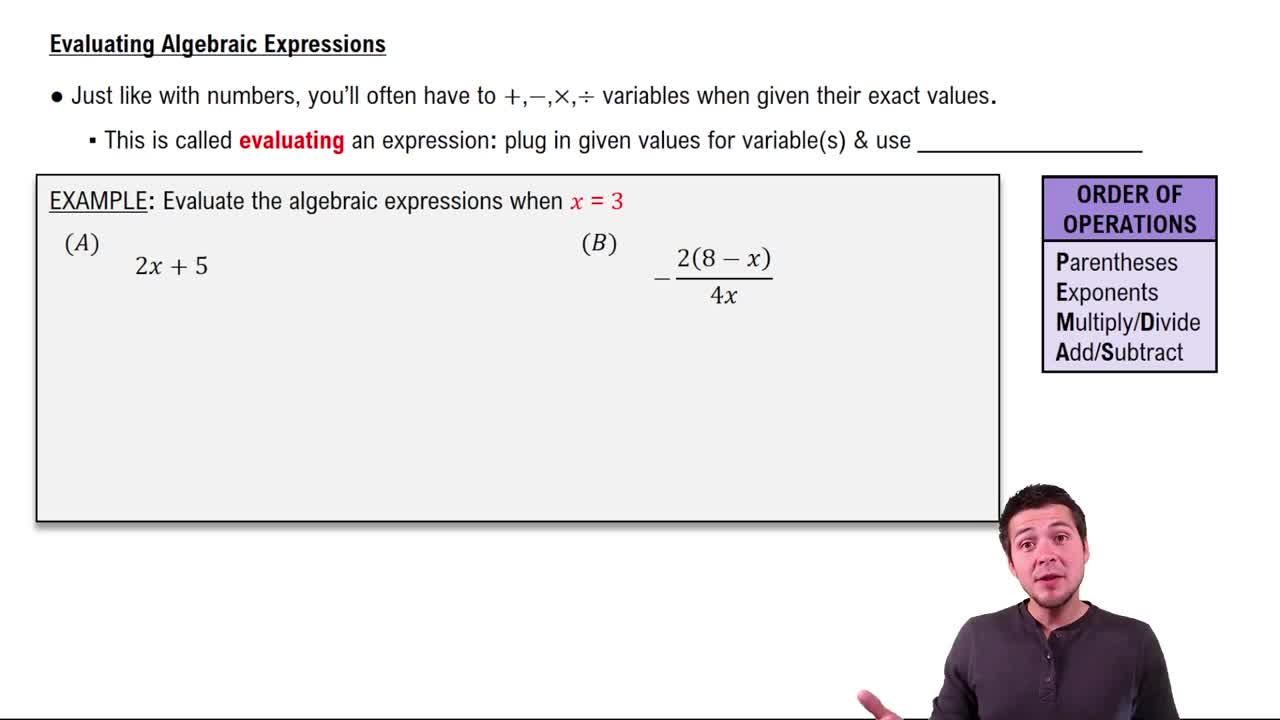
 03:11
03:11