Skip to main content
College Algebra
My Course
Learn
Exam Prep
AI Tutor
Study Guides
Textbook Solutions
Flashcards
Explore
Try the app
My Course
Learn
Exam Prep
AI Tutor
Study Guides
Textbook Solutions
Flashcards
Explore
Try the app
Back
Two-Variable Equations quiz
You can tap to flip the card.
What is the main difference between equations with one variable and equations with two variables?
You can tap to flip the card.
👆
What is the main difference between equations with one variable and equations with two variables?
Equations with one variable have a single solution, while equations with two variables have infinitely many solutions represented as ordered pairs.
Track progress
Control buttons has been changed to "navigation" mode.
1/15
Related flashcards
Related practice
Recommended videos
Two-Variable Equations definitions
Two-Variable Equations
15 Terms
Two-Variable Equations
2. Graphs of Equations
5 problems
Topic
Callie
Lines
2. Graphs of Equations
7 problems
Topic
Callie
2. Graphs of Equations
3 topics
8 problems
Chapter
Callie
04:29
Graphing Equations of Two Variables by Plotting Points
5
views
04:08
Graphing Intercepts
7
views
05:28
Equations with Two Variables
6
views
Terms in this set (15)
Hide definitions
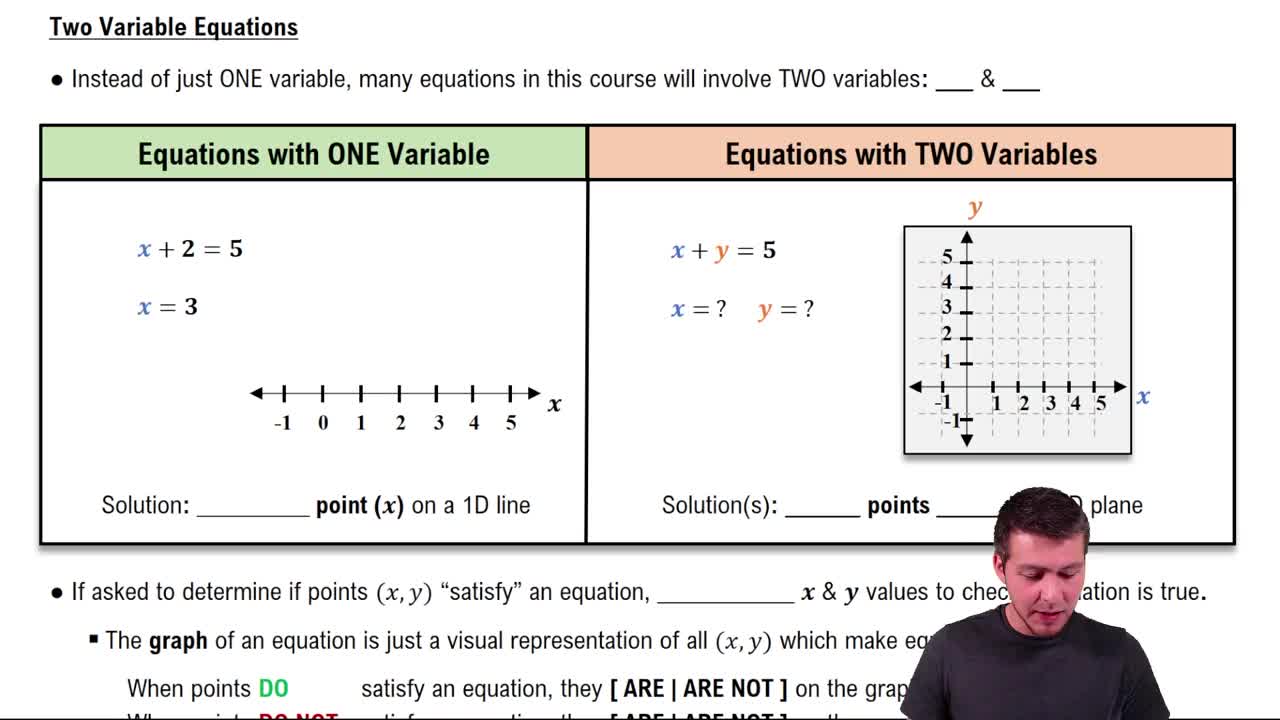
What is the main difference between equations with one variable and equations with two variables?
Equations with one variable have a single solution, while equations with two variables have infinitely many solutions represented as ordered pairs.
How do you determine if an ordered pair is a solution to a two-variable equation?
Substitute the x and y values from the ordered pair into the equation and check if the equation is true.
What does it mean for a point to satisfy a two-variable equation?
It means that when the point's x and y values are substituted into the equation, the equation holds true.
How are solutions to two-variable equations represented graphically?
They are represented as points (ordered pairs) on a two-dimensional plane.
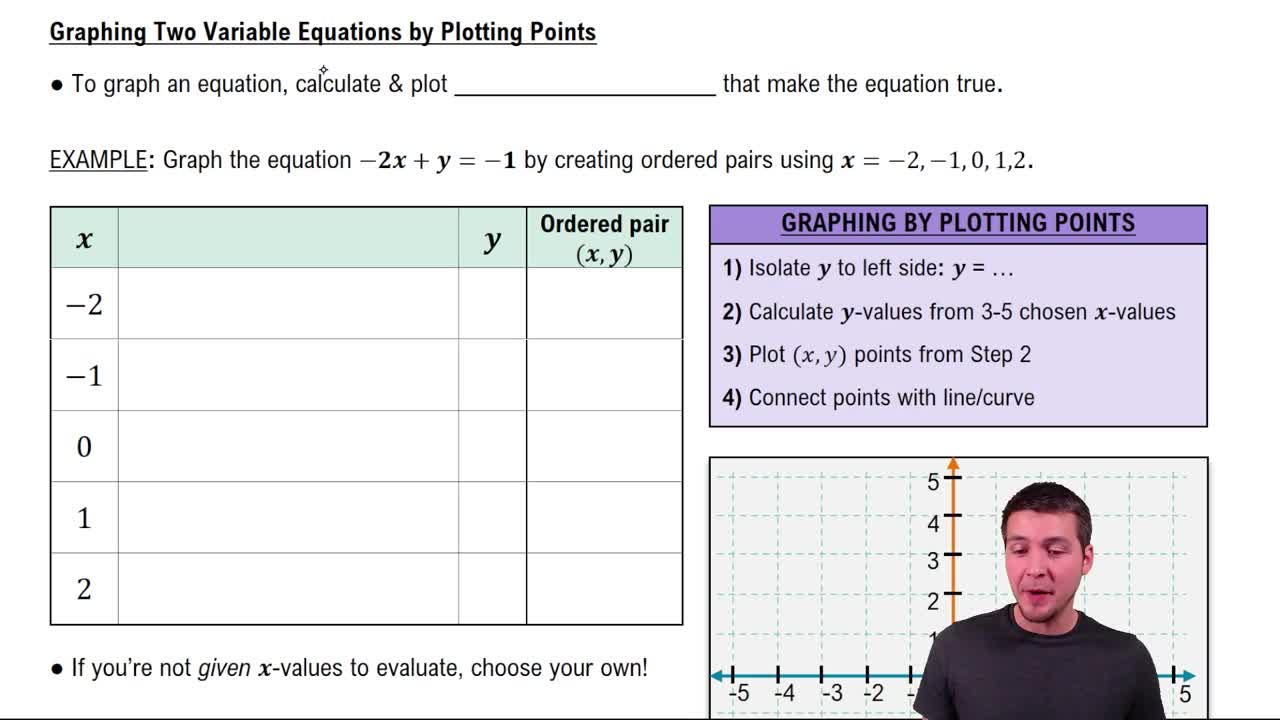
What is the general process for graphing a two-variable equation like -2x + y = -1?
Isolate y, substitute various x values to find corresponding y values, plot the ordered pairs, and connect them with a line.
Why is it helpful to isolate y when graphing a two-variable equation?
Isolating y makes it easier to substitute x values and directly calculate the corresponding y values.
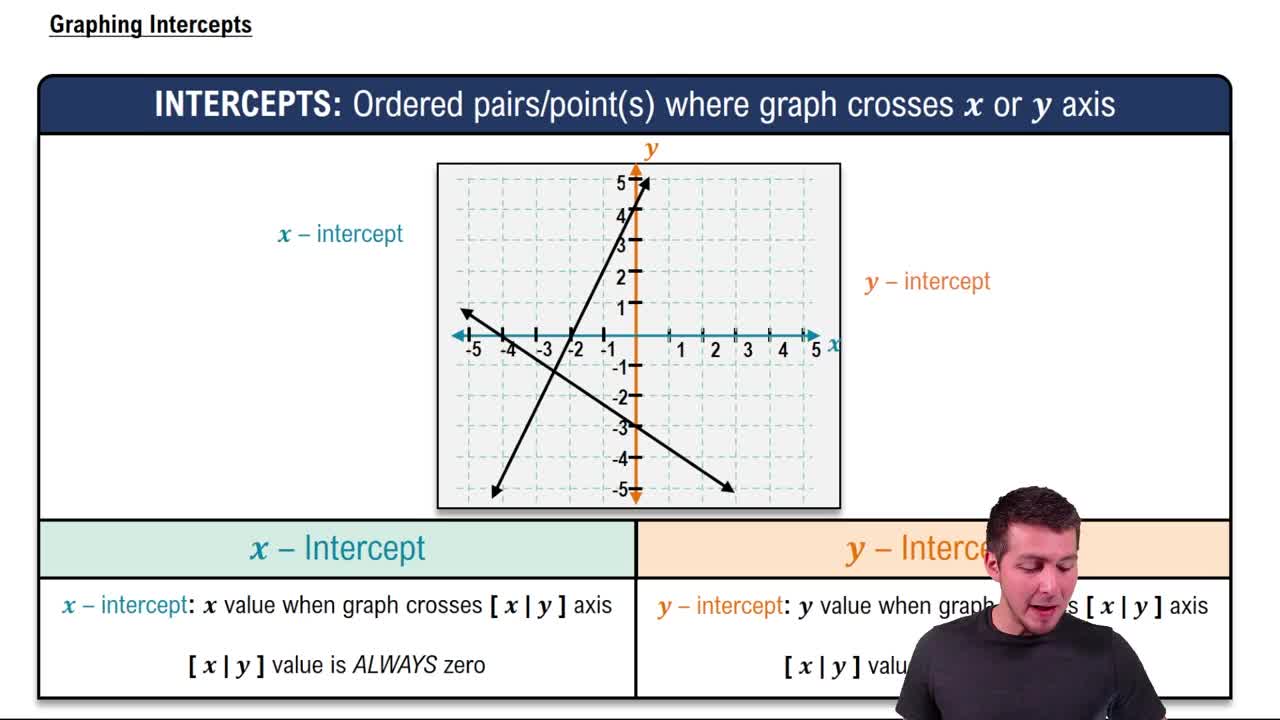
What is an x-intercept and how do you find it?
An x-intercept is where the graph crosses the x-axis, found by setting y = 0 and solving for x.
What is a y-intercept and how do you find it?
A y-intercept is where the graph crosses the y-axis, found by setting x = 0 and solving for y.
What is always true about the y value at an x-intercept?
The y value is always 0 at an x-intercept.
What is always true about the x value at a y-intercept?
The x value is always 0 at a y-intercept.
If you are asked for the x-intercepts of a graph, what should you provide?
You should provide the x values where the graph crosses the x-axis.
If you are asked for the intercepts of a graph (without specifying x or y), what should you provide?
You should provide the ordered pairs where the graph crosses the axes.
How many ordered pairs do you typically need to plot to graph a straight line from a two-variable equation?
Usually, 3 to 5 ordered pairs are enough to graph a straight line.
What happens to the graph of a two-variable equation if you plot all points that satisfy the equation?
You get a straight line (for linear equations) that passes through all those points.
What does it mean if a point does not lie on the graph of a two-variable equation?
It means the point does not satisfy the equation when its x and y values are substituted in.
 BackBack
 04:29
04:29