Textbook QuestionFind the vertical asymptotes, if any, and the values of x corresponding to holes, if any, of the graph of each rational function. g(x)=(x−3)/(x2−9)
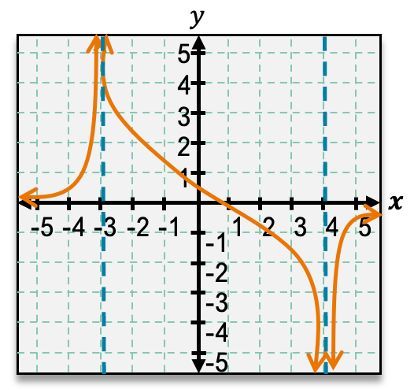
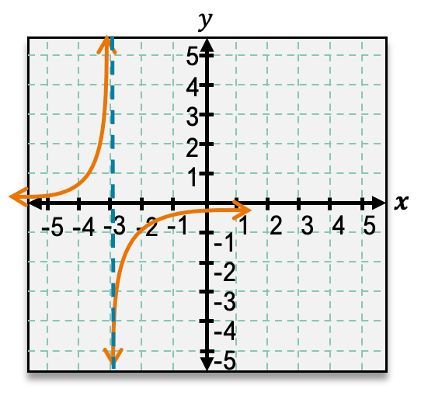
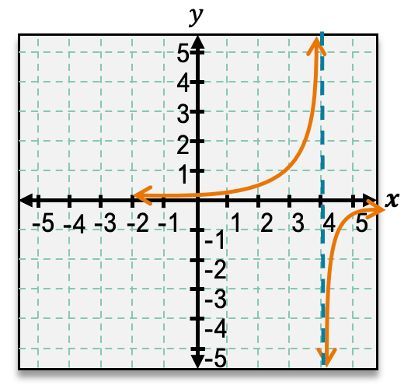
Textbook QuestionWork each problem. Choices A–D below show the four ways in which the graph of a rational function can approach the vertical line x=2 as an asymptote. Identify the graph of each rational function defined in parts (a) – (d). ƒ(x)=−1/(x−2)2ƒ(x)=-1/(x-2)^2
Multiple ChoiceSketch the graph of the function f(x)=1x2f\(\left\)(x\(\right\))=\(\frac{1}{x^2}\)f(x)=x21. Identify the asymptotes on the graph.6views
Multiple ChoiceFind all vertical asymptotes and holes of each function. f(x)=−5x(2x−3)2f\(\left\)(x\(\right\))=\(\frac{-5x}{\left(2x-3\right)^2}\)f(x)=(2x−3)2−5x9views
Multiple ChoiceFind all vertical asymptotes and holes of each function. f(x)=x2−2x2x3−x2−6xf\(\left\)(x\(\right\))=\(\frac{x^2-2x}{2x^3-x^2-6x}\)f(x)=2x3−x2−6xx2−2x5views
Multiple ChoiceFind all vertical asymptotes and holes of each function. f(x)=x2+10x+252x2+8x−10f\(\left\)(x\(\right\))=\(\frac{x^2+10x+25}{2x^2+8x-10}\)f(x)=2x2+8x−10x2+10x+256views
Multiple ChoiceFind the horizontal asymptote of each function. f(x)=−5x(2x+3)2f\(\left\)(x\(\right\))=\(\frac{-5x}{\left(2x+3\right)^2}\)f(x)=(2x+3)2−5x7views




 Verified step by step guidance