Begin by graphing the absolute value function, f(x) = |x|. Then use transformations of this graph to graph the given function. g(x) = -2|x+3|+2
Table of contents
- 0. Review of Algebra4h 18m
- 1. Equations & Inequalities3h 18m
- 2. Graphs of Equations1h 43m
- 3. Functions2h 17m
- 4. Polynomial Functions1h 44m
- 5. Rational Functions1h 23m
- 6. Exponential & Logarithmic Functions2h 28m
- 7. Systems of Equations & Matrices4h 5m
- 8. Conic Sections2h 23m
- 9. Sequences, Series, & Induction1h 22m
- 10. Combinatorics & Probability1h 45m
- Appendix 1. Review of Real Numbers2h 24m
- Appendix 2. Linear Equations and Inequalities3h 42m
- OLD 9. Sequences, Induction, and Probability Coming soon
- 1. - OLD - Fundamental Concepts of Algebra Coming soon
- 2. - OLD - Equations and Inequalities Coming soon
- OLD 4. Rational Functions Coming soon
- OLD 2. Functions & Graphs Coming soon
- OLD 6. Exponential and Logarithmic Functions Coming soon
- OLD 7. Systems of Equations and Inequalities Coming soon
- OLD 8. Matrices and Determinants Coming soon
- OLD 9. Conic Sections Coming soon
3. Functions
Transformations
Problem 97
Textbook Question
Begin by graphing the standard cubic function, f(x) = x3. Then use transformations of this graph to graph the given function. g(x) = (x − 3)3
Verified step by step guidance1
Start by recalling the standard cubic function f(x) = x³. This function has a characteristic S-shaped curve, passing through the origin (0, 0), with symmetry about the origin. The graph increases to the right and decreases to the left.
Understand the transformation applied to f(x) = x³ to obtain g(x) = (x − 3)³. The term (x − 3) indicates a horizontal shift. Specifically, the graph of f(x) = x³ is shifted 3 units to the right.
To graph g(x) = (x − 3)³, take each key point on the graph of f(x) = x³ (e.g., (-1, -1), (0, 0), (1, 1), etc.) and shift it 3 units to the right. For example, the point (0, 0) on f(x) becomes (3, 0) on g(x).
Sketch the new graph by connecting the shifted points smoothly, maintaining the same S-shaped curve as the original cubic function. Ensure the graph still increases to the right and decreases to the left, with the inflection point now at (3, 0).
Label the graph of g(x) = (x − 3)³ clearly, and verify that the transformation has been applied correctly by checking a few additional points. For example, if x = 4, g(4) = (4 − 3)³ = 1³ = 1, so the point (4, 1) should be on the graph.
Verified video answer for a similar problem:This video solution was recommended by our tutors as helpful for the problem above
Video duration:
4mPlay a video:
0 Comments
Key Concepts
Here are the essential concepts you must grasp in order to answer the question correctly.
Cubic Functions
A cubic function is a polynomial function of degree three, typically expressed in the form f(x) = ax³ + bx² + cx + d. The graph of a cubic function has a characteristic 'S' shape and can have one or two turning points. Understanding the basic shape and behavior of the standard cubic function, f(x) = x³, is essential for analyzing transformations.
Recommended video:
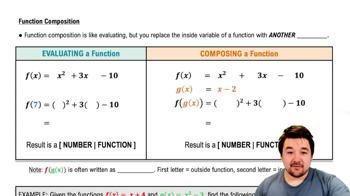
Function Composition
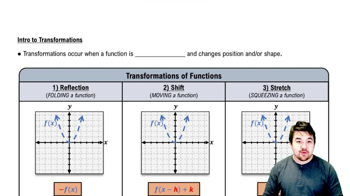
Graph Transformations
Graph transformations involve shifting, reflecting, stretching, or compressing the graph of a function. For example, the function g(x) = (x - 3)³ represents a horizontal shift of the standard cubic function f(x) = x³ to the right by 3 units. Recognizing how these transformations affect the graph is crucial for accurately sketching the transformed function.
Recommended video:
Intro to Transformations
Function Notation and Evaluation
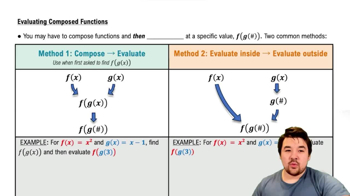
Function notation, such as f(x) or g(x), is a way to represent a function and its output for a given input x. Evaluating a function involves substituting a specific value for x to find the corresponding output. Understanding how to manipulate and evaluate functions is necessary for applying transformations and analyzing the resulting graphs.
Recommended video:
Evaluating Composed Functions
Related Videos
Related Practice
Textbook Question